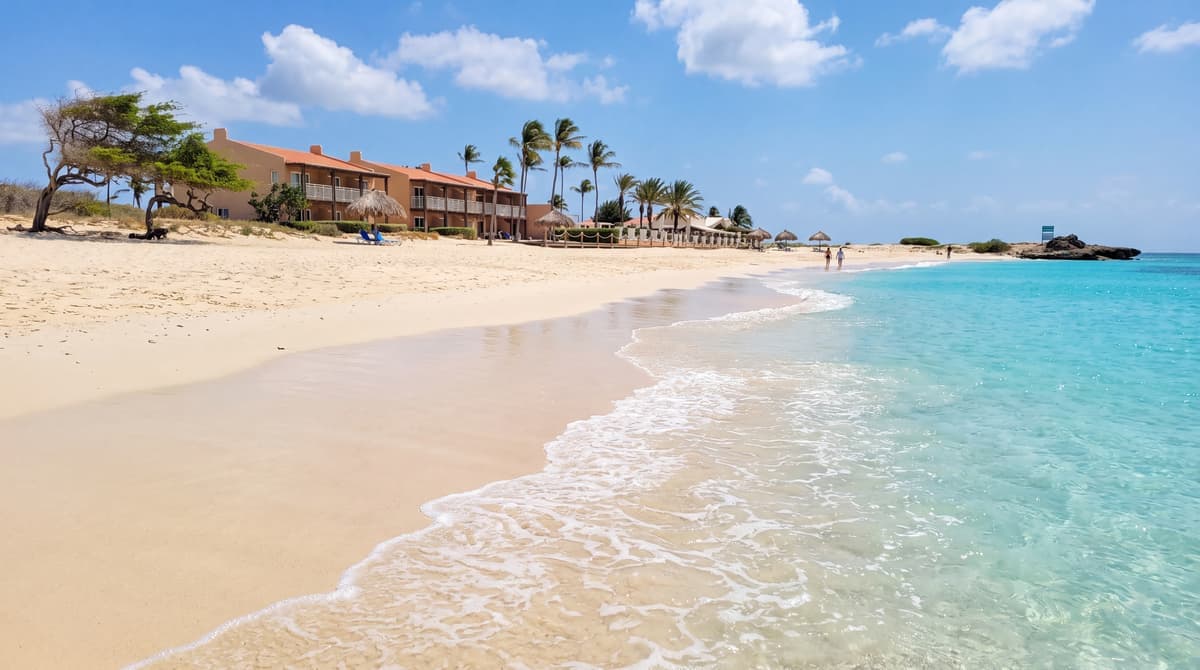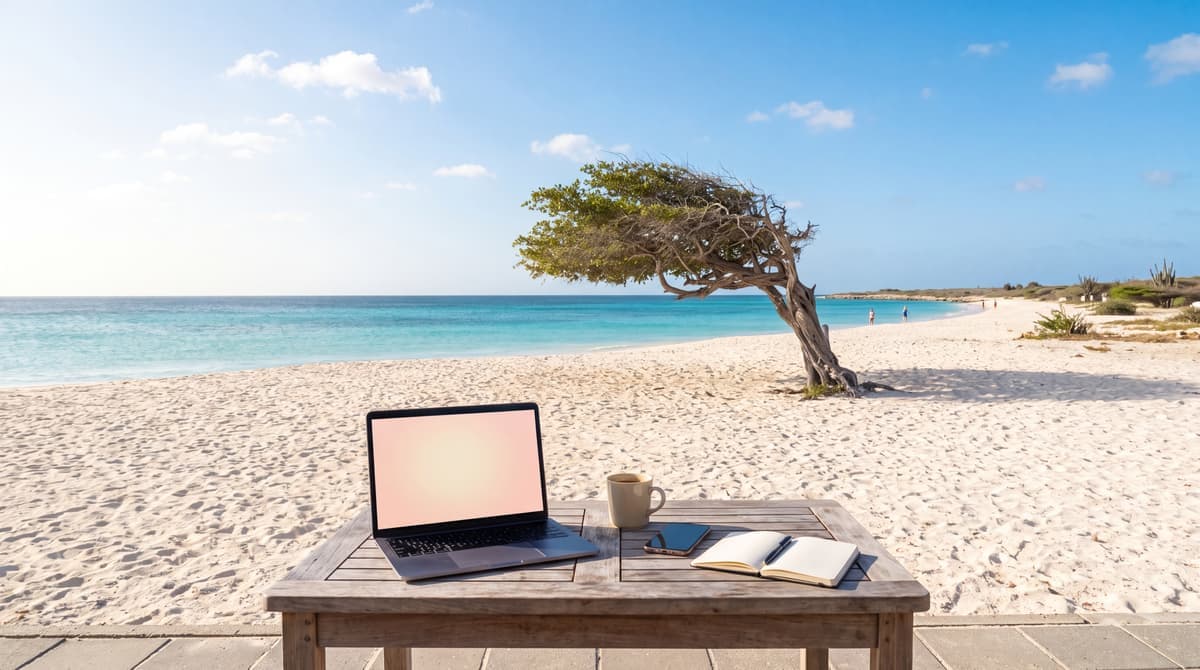
You have run the daydream a hundred times: laptop open, trade winds coming through the screen door, the workday done by the time the light goes gold over the water. The worry underneath it is always the same. Will the wifi actually hold a video call? Am I even allowed to work here? Is this going to cost a fortune?
We live here, we work here, and we have watched a steady stream of remote workers come test the dream in person. The short version: Aruba is one of the easier Caribbean islands to base yourself for a while, the internet is better than you expect, and the rules are more welcoming than most. But there are real trade-offs, and a few things that will trip you up if nobody warns you. This is the honest version.
Can you actually work remotely from Aruba, legally?
Yes, with one distinction that matters more than any other. You can log into a job or run a business based back home. You cannot take paid work from an Aruban company without a work permit. That line is the whole game. Answering emails for your employer in Denver or Amsterdam from a balcony in Noord is fine. Doing paid graphic design for a local restaurant is not, and needs a permit.
On arrival, US visitors do not need a visa. The general tourist admission is 30 days, and US nationals can be granted up to 90 days. Want longer? DIMAS, the island's immigration department, handles extensions, and the total cannot exceed 180 days in any calendar year. Rules do change, so confirm the current terms with DIMAS before you count on a long stay.
Aruba has also promoted a program built for exactly this, called One Happy Workation, aimed at remote workers who want to base themselves here for up to 90 days. The core rule is the same one above: you work for your own employer or business back home, never for an Aruban company or client. Check the program's current status and fine print with the Aruba government before you rely on it, since these schemes get updated and quietly change.
Dutch and Netherlands passport holders enter visa-free too, but do not assume that automatically means the right to settle and work. Aruba is its own country inside the Kingdom of the Netherlands with its own immigration and labor rules, so if you plan to stay long term, check the permit question directly rather than guessing.
Find your hotel by month, beach & budget
Compare current Aruba rates across the major booking sites in one place, in USD. Most rooms are free to cancel.
The internet is better than you expect
This is the fear that keeps people from booking, and it is mostly outdated. SETAR, the main provider, has spent the last few years converting the island to fiber and sells home internet plans that run into the hundreds of megabits per second. Its mobile network carries 4G LTE across the island and 5G around Oranjestad. Digicel is the second carrier. In a decent rental or condo, video calls hold up fine.
Two honest caveats. First, a cheap guesthouse or a far-flung rental can still have thin, shared bandwidth, so if your job lives on calls, ask the host for the actual plan speed and whether it is wired, not just "yes we have wifi." Second, always have a backup. An island runs on one grid and a few undersea cables, and the occasional outage happens.
That backup is an eSIM, and it is the smartest thing you can sort before you fly. Aruba is well covered: some providers sell an Aruba-specific plan, others fold it into a regional Caribbean package, so you can land with data already working and tether your laptop if the house wifi stumbles. You can line up a travel eSIM, along with hotels, insurance, and everything else, on our booking hub before you leave. More of the practical connection setup lives in our travel tips.
One more thing worth being upfront about: Aruba's dedicated coworking scene is small, and specific spaces come and go, so do not build your trip around a shared office. Most remote workers here settle into a rhythm of working from their rental, borrowing a resort's lobby or poolside wifi for a change of scene, and rotating through a few cafes with good coffee and a strong signal. If a coworking space happens to be open during your stay, treat it as a bonus, not the plan.
Where to set up: rent by the month, not the night
The single biggest lever on both cost and comfort is this: book a rental with a kitchen and a real desk, by the week or month, instead of a resort by the night. Resorts are built for a seven-day holiday, not a seven-week base. You want a proper table to work at, a kitchen to cook in, and a monthly rate.
Where you plant yourself changes the whole feel:
- Eagle Beach and the low-rise strip. Calm, wide, world-class sand, quieter evenings. Our pick if your work is heads-down and you want the beach to be a place to think. The caveat: fewer restaurants and bars in walking distance, so you will want a car. See why we love it in our Eagle Beach guide.
- Palm Beach. The lively high-rise strip, everything walkable, water sports and restaurants at the door. Great if you would go stir-crazy somewhere quiet. The caveat: it is the busiest, most touristy, and priciest corner, and beach chairs fill by mid-morning.
- Noord, inland. The best value on the island and where a lot of longer-stay rentals sit. The caveat: not walkable to the beach, so a rental car stops being optional.
- Oranjestad. The capital, walkable, full of cafes and local life, close to the cruise port buzz. Good for a social solo stay. The caveat: it is not beachfront, so you trade sand-out-the-door for city convenience.
We break down every zone, honestly, in our where to stay in Aruba guide. To compare live monthly and long-stay rates across the island for your dates, use our booking hub.
The time zone is a quiet superpower
Aruba runs on Atlantic Standard Time, UTC minus 4, and it does not change for daylight saving. For a US team that is a genuine gift. In summer you are on the exact same clock as New York, and in winter you are just one hour ahead. Standups, calls, Slack, none of it shifts in a way that hurts.
If your team sits in Europe, be honest with yourself before you book. Aruba is roughly six hours behind the Netherlands, so a 5pm Amsterdam meeting lands at 11am here. Workable, and arguably ideal, since the back half of the European workday happens while you are already off the clock and heading for the water. But a Dutch team that likes late-afternoon calls will pull you back to the laptop at what feels like beach o'clock.
What a month here actually costs
We will not pretend Aruba is a budget destination. It is not. But a month here costs a fraction of a week at peak-season resort rates, and the levers are simple.
Rent by the month, cook some of your own meals, and shop like a local. A vacation rental or condo with a kitchen, booked for weeks instead of nights, drops your effective nightly cost dramatically, and groceries instead of three restaurant meals a day is where the real money is saved. The August to October low season is when long-stay rental rates are at their softest, so a shoulder-season base stretches the budget furthest. Price a few grocery runs so the supermarket bill does not surprise you, and see our full Aruba cost breakdown for the honest numbers. If you are optimizing hard, our Aruba on a budget guide is the companion piece.
Getting around when you are here a while
For a week, you can get by on taxis. For a month, a rental car pays for itself fast and hands you the island on your own schedule, grocery runs, a Tuesday-afternoon swim, dinner on the far coast. There is no Uber or Lyft here, taxis run on fixed government rates, and the bus covers the main hotel corridor but not much else. We lay out the real options in getting around Aruba, and the pickup-counter details in our car rental guide. Booking ahead beats the resort-desk walk-up rate every time, and you can compare cars on our booking hub.
Your weekends are the reason you came
The whole point of working from a rock in the Caribbean is that when you close the laptop on Friday, you are already there. This is where Aruba earns it, and where a month turns into the best stretch of the year.
Spend a Saturday on the water. A catamaran sail-and-snorkel cruise with stops at the reef and the Antilla shipwreck is the classic, open bar and lunch included. Trade the beach for the desert interior on an Arikok National Park jeep safari out to the caves and the wild north coast. When you would rather DIY, our beaches guide maps the quiet ones the tour buses miss, and the full menu of tours lives on our activities page.
And because you have weeks, not days, you get to eat your way through the island properly instead of cramming it into one blowout dinner. Fresh fish by the water, a proper local lunch, the fine-dining splurge when a project ships. Start with our where to eat in Aruba guide and let the dining page fill in the rest.
Browse 32 vetted Aruba experiences
Most confirm instantly with free cancellation up to 24h, and 4 of them are free.
The best months to base yourself
Aruba is a year-round island, 82 to 84 degrees almost every day, and, reassuringly for a long booking, it sits below the main hurricane belt. If your dates are flexible, the August to October low season brings the softest rental rates and the emptiest beaches, and September is the quietest, cheapest month of all, ideal for a heads-down work stretch. Peak season, mid-December through April, is flawless weather but the priciest time to hold a rental for weeks. Our month-by-month best-time guide has the full trade-offs.
The practical setup checklist
A few island facts that make the logistics painless:
- The ED Card is mandatory. Every arrival completes the online embarkation card before flying. Do it on the official site only. Details in our ED Card guide.
- Bring nothing for your plugs. Aruba uses the same 120V outlets and plug shape as the United States, so US gear needs no adapter.
- Drink the tap water. It is desalinated and among the purest anywhere, so skip the bottled-water budget. More in our tap water guide.
- It is one of the safest islands in the Caribbean. Normal common sense applies, but this is a place people feel comfortable settling into. See our honest take in is Aruba safe.
- Sort travel insurance and your eSIM before you fly, both alongside your stay on the booking hub. A longer trip is exactly when insurance stops being optional.
The honest verdict
Aruba will not be the cheapest place you could take your laptop, and if your whole team lives in Europe the time zone will nudge you. But for a US-based remote worker who wants reliable internet, real safety, a language-barrier-free island, tap water you can drink, weekends that feel like a vacation, and a legal, welcoming path to stay up to 90 days, it is one of the easiest calls in the Caribbean. Book a rental by the month, sort your connectivity before you land, and give yourself the low season. You will get more work done than you expect, and a far better life around it.