One of the most common questions we get from first-time Aruba visitors is whether the tap water is safe to drink. The short answer is yes. Emphatically yes. Aruba has some of the cleanest, purest tap water in the entire Western Hemisphere. But the full story of how a desert island in the Caribbean produces world-class drinking water is actually fascinating.
Yes, Aruba's Tap Water Is Safe to Drink
Aruba's tap water is not just safe. It is exceptionally pure. The island produces its own fresh water through seawater desalination, and the result is water that consistently tests at or above the quality standards of most US and European cities.
You can drink directly from the tap in your hotel room, restaurant, or rental property. You can brush your teeth with it. You can use it to wash fruits and vegetables. You can make ice with it. There is no need to buy bottled water for safety reasons, though you may prefer the taste of a particular brand.
This is a genuine rarity in the Caribbean. Many island destinations recommend bottled water only. In Aruba, the tap water is the better choice. Cleaner than most bottled water you would buy at home and far better for the environment.
Browse 32 vetted Aruba experiences
Most confirm instantly with free cancellation up to 24h, and 4 of them are free.
How Aruba Makes Fresh Water: The Desalination Story
Aruba is a desert island that receives only about 18 inches of rain per year. There are no rivers, no lakes, and no natural freshwater sources to speak of. Every drop of fresh water on the island is produced through desalination. The process of removing salt and impurities from seawater.
The WEB Aruba N.V. Plant
Aruba's water is produced by WEB Aruba N.V. (Water en Energiebedrijf Aruba), the government-owned utility company. Their desalination plant in Balashi has been operating since the 1930s, making Aruba one of the first places in the world to rely on industrial desalination.
The plant now uses reverse osmosis technology, which forces seawater through semi-permeable membranes at high pressure to remove salt, minerals, bacteria, and virtually all contaminants. The process is remarkably effective. The output water is nearly pure H2O.
After reverse osmosis, the water goes through additional treatment:
- Remineralization. Small amounts of calcium and other minerals are added back for taste and health benefits.
- Chlorination. A minimal amount of chlorine is added to maintain water safety through the distribution system.
- pH adjustment. The water is balanced to prevent pipe corrosion.
The result is water that meets or exceeds World Health Organization standards, US EPA standards, and Dutch water quality standards (the strictest in Europe).
Production Capacity
WEB Aruba produces approximately 11.5 million gallons of fresh water per day. Enough to supply the entire island's residents, hotels, businesses, and tourists. During peak tourist season, consumption increases significantly, but the plant has surplus capacity.
The facility also generates the island's electricity, creating an integrated water-energy system that is remarkably efficient for a small island nation.
Environmental Considerations
Desalination is energy-intensive, which is worth noting. Aruba is investing in renewable energy (wind and solar) to power the process more sustainably. The island has some of the largest wind turbines in the Caribbean, and WEB Aruba has committed to increasing the renewable energy percentage of its operations.
The brine (concentrated salt water) byproduct is returned to the sea through diffusion systems designed to minimize environmental impact on marine life.
Water Quality: The Numbers
For the data-minded traveler, here is how Aruba's water stacks up:
- Total Dissolved Solids (TDS): Less than 30 ppm (for comparison, most US tap water is 150-300 ppm, and bottled water brands like Dasani and Aquafina are typically 15-30 ppm)
- Chlorine levels: 0.3-0.5 ppm (well within WHO and EPA guidelines)
- pH: 7.0-8.0 (neutral to slightly alkaline)
- Bacterial contamination: Essentially zero thanks to the reverse osmosis process
In practical terms, Aruba's tap water is among the purest municipal water supplies in the world. It is comparable in quality to premium bottled water brands.
Taste: What to Expect
Because Aruba's water starts as essentially pure H2O and then has minerals added back, it has a clean, neutral taste. Most visitors describe it as "very clean" or "slightly sweet." Some people who are accustomed to heavily mineralized tap water may find it tastes flat or different.
If you notice a slight chlorine taste, it is from the disinfection process and is completely harmless. Letting the water sit in a glass for a few minutes allows the chlorine to dissipate, or you can request filtered water at restaurants.
Overall, the taste is excellent. Many visitors comment that Aruba's tap water tastes better than the water at home.
Ice Safety
Yes, ice is safe everywhere in Aruba. Hotels, restaurants, bars, and beach shacks all use ice made from the same desalinated tap water. You do not need to ask for "no ice" in your drinks. A precaution that is wise in some Caribbean destinations but completely unnecessary in Aruba.
This applies to frozen cocktails, ice in your rum punch at the beach bar, and ice from the machine at your hotel. All safe, all made from the same excellent water.
Staying Hydrated in Aruba
While the water quality is outstanding, staying properly hydrated in Aruba requires attention because of the island's climate conditions.
Why You Dehydrate Faster in Aruba
Intense UV radiation: At 12 degrees north of the equator, the sun is significantly stronger than what most visitors are accustomed to. UV exposure increases fluid loss through the skin even when you do not feel like you are sweating.
Constant trade winds: Aruba's persistent 15-25 mph trade winds evaporate sweat so quickly that you may not realize you are sweating at all. The wind creates a cooling sensation that masks the reality of fluid loss. This is the number one cause of tourist dehydration in Aruba.
Alcohol consumption: Let us be honest. Many Aruba vacations involve more alcohol than a typical week at home. Alcohol is a diuretic that accelerates dehydration, and combined with sun and wind, it can create problems quickly.
Activity level: Snorkeling, hiking Arikok, exploring the island. You are likely more active on vacation than you realize.
Hydration Guidelines
- Drink at least 3 liters (100 ounces) of water per day. This is more than the standard recommendation because of Aruba's climate.
- Start your morning with a full glass of water before coffee or anything else.
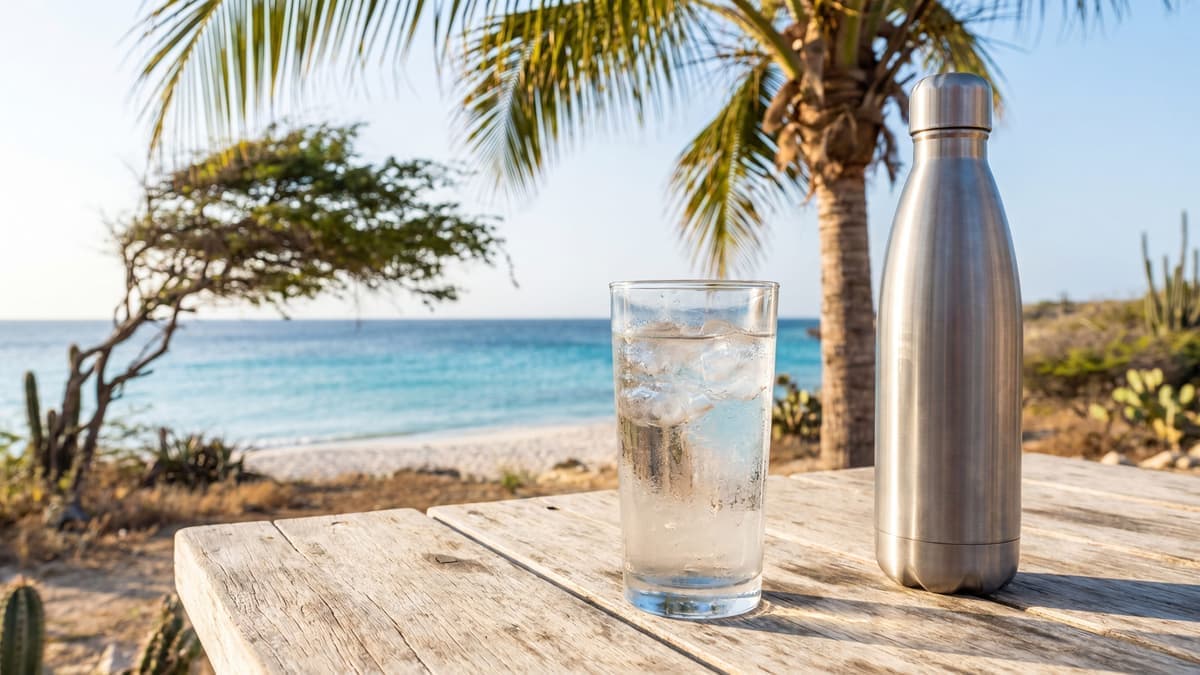
- Carry a refillable water bottle everywhere. Fill it from the tap.
- Match every alcoholic drink with a glass of water. Your future self will thank you.
- Watch for dehydration signs: headache, dizziness, dark urine, fatigue, dry mouth. These can sneak up on you, especially after a day at the beach with a few cocktails.
- Eat water-rich foods: Fruits like watermelon, pineapple, and oranges are widely available and help with hydration.
Electrolytes
If you are very active (hiking, kiteboarding, diving) or spending long days in the sun, consider bringing electrolyte packets or tablets. Brands like Liquid IV, LMNT, or Nuun are lightweight and easy to pack. Dissolve them in your tap water. You can also find Gatorade and similar drinks at grocery stores, though at higher prices than the US.
Bottled Water: Do You Need It?
Strictly speaking, no. Tap water is perfectly safe and tastes good. However, here are scenarios where bottled water makes sense:
- Convenience: Small bottles for your beach bag when you are out all day.
- Preference: If you strongly prefer a particular brand or sparkling water.
- Rental without a good water bottle: If your vacation rental does not have reusable bottles and you are on the go.
Bottled water costs approximately $1.50-2.50 at grocery stores and $3-5 at hotels and restaurants. Over a week-long vacation, buying bottled water adds up to $30-50+ when tap water is free and just as good.
Our recommendation: Bring a reusable water bottle from home, fill it from the tap, and save the money for a nice dinner instead. It is also significantly better for the environment. Aruba is working hard to reduce plastic waste on the island.
The Reef-Safe Sunscreen Connection
This may seem like an odd inclusion in a water article, but it is directly related. Aruba's pristine marine environment. The same ocean that provides the source water for desalination. Is threatened by chemical sunscreens containing oxybenzone and octinoxate.
These chemicals wash off swimmers and snorkelers into the ocean, where they damage coral reefs and marine ecosystems. Since 2020, there has been growing awareness in Aruba about reef-safe sunscreen, and some beaches and tour operators now request that visitors use reef-safe options.
Reef-safe sunscreen essentials:
- Look for mineral-based sunscreens with zinc oxide or titanium dioxide as the active ingredients.
- Avoid products listing oxybenzone, octinoxate, octocrylene, or homosalate.
- Popular reef-safe brands available in the US: Sun Bum Mineral, Blue Lizard, Thinksport, Raw Elements.
- Apply 15-30 minutes before entering the water for best protection.
- In Aruba's intense sun, use SPF 50+ regardless of brand.
By using reef-safe sunscreen, you are helping protect the ocean ecosystem that Aruba depends on. Not just for marine life but literally for the drinking water supply.
Browse 32 vetted Aruba experiences
Most confirm instantly with free cancellation up to 24h, and 4 of them are free.
Water Tips for Specific Activities
Snorkeling and Diving
Dehydration is the leading cause of diver fatigue and cramping. Drink a full liter of water in the hour before any water activity. Avoid alcohol the morning of a dive. After snorkeling or diving, rehydrate immediately. The combination of salt water, sun, and physical exertion depletes fluids rapidly. Check our Aruba snorkeling guide for more preparation tips.
Hiking Arikok National Park
Bring at least 2 liters of water per person. There are no water fountains or vendors in the park. The hike to the Natural Pool is exposed to full sun with no shade for most of the trail. On hot days, 3 liters per person is not excessive.
Beach Days
Even "doing nothing" on the beach requires hydration. Bring water, drink consistently, and do not wait until you feel thirsty. By the time you are thirsty, you are already mildly dehydrated.
Golf and Outdoor Sports
Tierra del Sol and the island's outdoor activity providers all have water available, but bring your own supply as backup. The wind can mask how much you are sweating during 4+ hours of golf.
Hotel and Accommodation Water
Resorts and Hotels
All resorts use the municipal desalinated water. Some upscale restaurants may offer bottled water as a premium option (and charge accordingly), but the tap-water-based ice, coffee, and cooking water is all the same excellent quality.
Vacation Rentals
Same water system. If you are staying in a condo or Airbnb, the tap water is identical to what the resorts use. Investing in a simple Brita pitcher if you prefer filtered water is an option, but truly unnecessary.
Cruise Ship Visitors
If you are visiting Aruba on a cruise and spend the day on the island, you can drink tap water from any restaurant or bar without concern. Fill your water bottle at any public restroom or restaurant and save your money for experiences.
Common Water Myths About Aruba
Myth: "Only drink bottled water to be safe." False. Aruba's tap water is as safe or safer than bottled water. This myth persists because it is good advice for many Caribbean islands. Just not Aruba.
Myth: "The water tastes like chemicals." False for almost everyone. The chlorine content is minimal and the taste is clean. If you are extremely sensitive to chlorine, let water sit for 5 minutes or add a slice of lemon.
Myth: "Hotel water is different from local water." False. Everyone is on the same municipal system supplied by WEB Aruba.
Myth: "You need a water purifier or UV sterilizer." Completely unnecessary. Save the luggage space.
The Bottom Line
Aruba's tap water is excellent. Among the purest in the Americas. Drink it freely, use it for ice, brush your teeth with it, and skip the bottled water unless you have a strong personal preference. The money you save can go toward a sunset dinner at Barefoot or a catamaran cruise.
Stay extra vigilant about hydration because the sun, wind, and vacation lifestyle dehydrate you faster than you expect. Bring a reusable bottle, drink consistently throughout the day, and choose reef-safe sunscreen to protect the ocean that makes it all possible.
For more practical Aruba travel tips, check out our comprehensive travel tips guide, which covers water safety and dozens of other essential details.