Renting a car in Aruba costs roughly $45 to $70 per day for a compact in peak season (December through April) and $25 to $45 in low season. There is no Uber or Lyft on the island, so your only alternative is taxis at fixed government rates. For most visitors who want to explore beyond the Palm Beach strip, a rental car for at least 2 to 3 days of the trip is the most affordable option. You only need a 4WD if you are driving the unpaved track to the Natural Pool inside Arikok National Park.
Still weighing whether you want a car at all? That question has its own page: our honest read on whether you need a car in Aruba is written for the days you are choosing between taxis and your own keys. This guide picks up after that decision and covers the mechanics: who to rent from, what it costs, and what the small print actually does. For a full picture of transportation and other trip costs, see our Aruba vacation cost guide.
Do you actually need a rental car in Aruba?
Let us start with the honest assessment. Not everyone needs a car in Aruba.
You probably do NOT need a car if: You are staying at a Palm Beach resort, plan to spend most of your time on the beach and at nearby restaurants, and are happy using taxis for the occasional trip. The Palm Beach strip is walkable, and Eagle Beach is a short $10 taxi ride away. Many visitors have a perfectly good vacation without ever driving.
You SHOULD rent a car if: You want to explore the island beyond the hotel strip. If Baby Beach, Arikok National Park, Zeerovers in Savaneta, the San Nicolas street art district, or the California Lighthouse are on your list, a rental car makes these excursions easy and affordable. If you plan to eat at restaurants outside the resort area (and you should, because some of the best food is scattered around the island), a car gives you freedom. If you are staying in Noord, Oranjestad, or Savaneta, a car is essentially required.
Our recommendation: Rent a car for at least 2-3 days of your trip, even if you do not need one every day. A single day of exploring the south coast and Arikok National Park justifies the rental. You can rent for specific days rather than your entire stay.
Renting a car? Compare every Aruba agency
One search across the island rental companies, free cancellation on most cars, no card to reserve.
Which rental car companies operate in Aruba?
Aruba has a mix of international brands and local companies. Here is the honest breakdown.
| Company | Type | Sedan daily rate (peak) | Notes |
|---|---|---|---|
| Avis / Budget / Hertz / Dollar / National | International | $50-80 | Airport counters; most predictable experience |
| Top Drive Car Rental | Local | $35-60 | Most popular local company; airport pickup |
| Tropic Car Rental | Local | $35-60 | Location near high-rise hotels; convenient mid-trip |
| Economy Car Rental | Local budget | $25-35 | Older fleet; best for lowest-cost transport only |
| Green Car / Amigo Rent-a-Car | Local | Varies | Check recent reviews before booking |
International companies have counters at or near Queen Beatrix International Airport. Prices are higher but the experience is more predictable with easier dispute resolution. Local companies offer better value; Top Drive and Tropic are the most consistently well-reviewed.
SUVs and Jeeps run $65-95 per day (local) or $75-120 (international) in peak season.
Booking Tips
Book through a comparison site like DiscoverCars to see all available options and prices. Our Aruba car rental page has the search widget plus our current advice on which class of car to pick. Prices are almost always better when booked in advance online rather than walking up to a counter at the airport.
During peak season (December through April), rental cars can sell out, especially Jeeps and SUVs. Book at least 2-4 weeks ahead. During low season, you can often get last-minute deals, but booking a week ahead is still smart for the best selection.
How much does it cost to rent a car in Aruba?
Daily rental rates vary by vehicle class and season. All prices below typically include basic liability insurance but not collision damage waiver (CDW). Add $15-25 per day for CDW if you choose it through the rental company.
| Vehicle class | Peak season (Dec-Apr) | Shoulder | Low season (Jul-Oct) |
|---|---|---|---|
| Economy/Compact (Yaris, Picanto) | $45-70 | $35-55 | $25-45 |
| Mid-Size Sedan (Corolla, Elantra) | $55-85 | $40-65 | $35-55 |
| SUV/Jeep (Wrangler, RAV4, Jimny) | $75-120 | $60-95 | $50-80 |
| Convertible/Soft-Top (Wrangler Open) | $90-140 | $70-110 | $60-90 |
What insurance do you need for an Aruba rental car?
Insurance is where most tourists either overpay or leave themselves exposed. Read this carefully.
What the Rental Company Offers
Liability Insurance. Usually included in the base price. Covers damage you cause to other people or their property.
Collision Damage Waiver (CDW). Offered at the counter for $15-25 per day. This reduces your liability for damage to the rental car, but typically still leaves a deductible of $500-1,500. In other words, even with CDW, you could be on the hook for up to $1,500 if the car is damaged.
Super CDW / Zero Deductible. An additional charge ($10-15/day on top of CDW) that reduces the deductible to zero. This is the full peace-of-mind option from the rental company.
Theft Protection (TP). Often bundled with CDW. Covers the vehicle in case of theft.
The Credit Card Insurance Option
Many credit cards (particularly premium cards like Chase Sapphire, Amex Platinum, and Capital One Venture X) include rental car insurance as a cardholder benefit. This typically acts as secondary coverage, meaning it kicks in after your personal auto insurance and covers the deductible.
How to use it: Decline the CDW at the rental counter and pay with your qualifying credit card. If the car is damaged, you file a claim with your credit card company. They typically reimburse the rental company's damage charge.
Important caveats: Credit card coverage often does NOT cover SUVs, Jeeps, or vehicles with more than 4 seats. It may not cover damage from driving on unpaved roads. Read your card's specific terms before relying on this.
Our Recommendation
If you are renting a standard sedan and have a premium credit card with rental insurance, declining the CDW and relying on your card is a reasonable choice. If you are renting a Jeep or SUV (which credit cards often exclude), purchasing CDW from the rental company is worth the cost. If you want zero stress, the Super CDW/zero deductible option eliminates all worry for $25-40 per day total.
Critical tip: Take photos and video of the entire car (every angle, every scratch) before driving off the lot AND when you return it. Do this in front of the rental agent if possible. Disputes about pre-existing damage are the most common rental car headache in Aruba. Document everything.
What is it like to drive in Aruba?
Road Conditions
Main roads connecting the hotel areas, Oranjestad, and the south coast are well-paved and well-signed. The highways (Route 1 along the coast, Route 4/5 through the interior) are comparable to any US secondary road.
Side roads and residential streets are generally in good condition but can have occasional potholes. Nothing that would surprise a US driver.
The exception: Arikok National Park. The roads inside the park, particularly the track to the Natural Pool (Conchi), are genuinely rough. Large rocks, steep inclines, and deep ruts make this impassable in a standard sedan. You NEED a 4WD or high-clearance vehicle (Jeep, SUV) to reach the Natural Pool. Do not attempt it in a rental car without 4WD capability. Some rental companies explicitly prohibit taking standard vehicles on the park's unpaved roads, and damage would not be covered.
Driving Rules
- Drive on the right side (same as the United States).
- Speed limits: 30 km/h (about 19 mph) in town, 60 km/h (37 mph) on main roads, 80 km/h (50 mph) on the highway. Speed cameras exist and tickets are enforced.
- Seatbelts are mandatory for all passengers.
- The blood alcohol limit is 0.05% (lower than the US limit of 0.08%). Be cautious after drinking.
- Traffic circles (roundabouts) are common. Traffic in the circle has the right of way.
- Right turns on red are NOT allowed unless a sign specifically permits it.
Traffic
Traffic on Aruba is generally light. The one exception is the road between the hotel strip and Oranjestad during rush hours (7:30-9 AM and 4:30-6:30 PM on weekdays). The single-lane stretches near the port area can create backups of 15-20 minutes. Avoid this route during peak commute times or use the bypass road through Bubali.
Cruise ship days (check the port schedule online) can also create congestion around Oranjestad and the main shopping areas.
Navigation
Google Maps works well in Aruba for main roads and major destinations. Waze is also popular with locals and can help you avoid traffic. Download offline maps before your trip in case cell signal is weak in remote areas like Arikok.
For where to actually point the car, our beach guide, restaurant picks, and activities guide cover every spot we recommend with locations and parking notes.
Gas Stations
Aruba has several gas stations, and you will never be far from fuel on this small island.
Locations: There are stations in Oranjestad, along the main road to the hotel strip, in Noord, and in Santa Cruz. The most convenient for tourists are the stations along L.G. Smith Boulevard near the airport and the station on the road between Palm Beach and Eagle Beach.
Fuel types: Most rental cars take regular gasoline. Diesel vehicles are rare in the tourist rental fleet.
Prices: Gas prices in Aruba are set by the government and are consistent across all stations. As of early 2026, expect to pay approximately AWG 2.50-3.00 per liter (roughly $5.50-6.50 per gallon USD). A full tank for a compact car (about 10-12 gallons) will cost approximately $55-75. Given the island's size, one tank of gas should last your entire rental period unless you are driving extensively.
Payment: Most stations accept credit cards, but carry some cash as a backup. Full-service is standard at many Aruba gas stations, meaning an attendant will pump your gas. Tipping AWG 1-2 is customary.
Hours: Most stations are open from 6 AM to 10 PM. Some close earlier on Sundays.
Parking
Parking is generally straightforward in Aruba, but here are the specifics.
Hotel parking: Most resorts include parking for guests with rental cars. The Hyatt, Marriott, Hilton, and other major properties have parking garages or lots. Confirm with your hotel whether parking is complimentary or has a daily fee (some charge $10-15/day).
Beach parking: Most beaches have free parking. Eagle Beach has a large free lot. Palm Beach parking is available along the road but can be competitive during peak hours. Baby Beach has a free dirt lot. Arashi Beach has roadside parking. Arikok National Park charges the $11 entry fee, and parking inside is included.
Oranjestad parking: Street parking in downtown Oranjestad requires feeding a meter or using a parking app. Rates are modest (AWG 2-3 per hour). The parking garage near the cruise terminal and the lot near the Renaissance Mall are convenient options when meters are full.
Tip: Avoid leaving anything visible in your parked car. As mentioned in our safety guide, smash-and-grab from rental cars is the most common property crime affecting tourists.
Do you need a 4WD in Aruba?
This comes down to what you plan to do.
Rent a sedan if: You plan to explore the paved roads, visit beaches accessible by car, eat at restaurants around the island, and drive the south coast. A sedan handles everything on Aruba's paved road network perfectly. It is also the most fuel-efficient and affordable option.
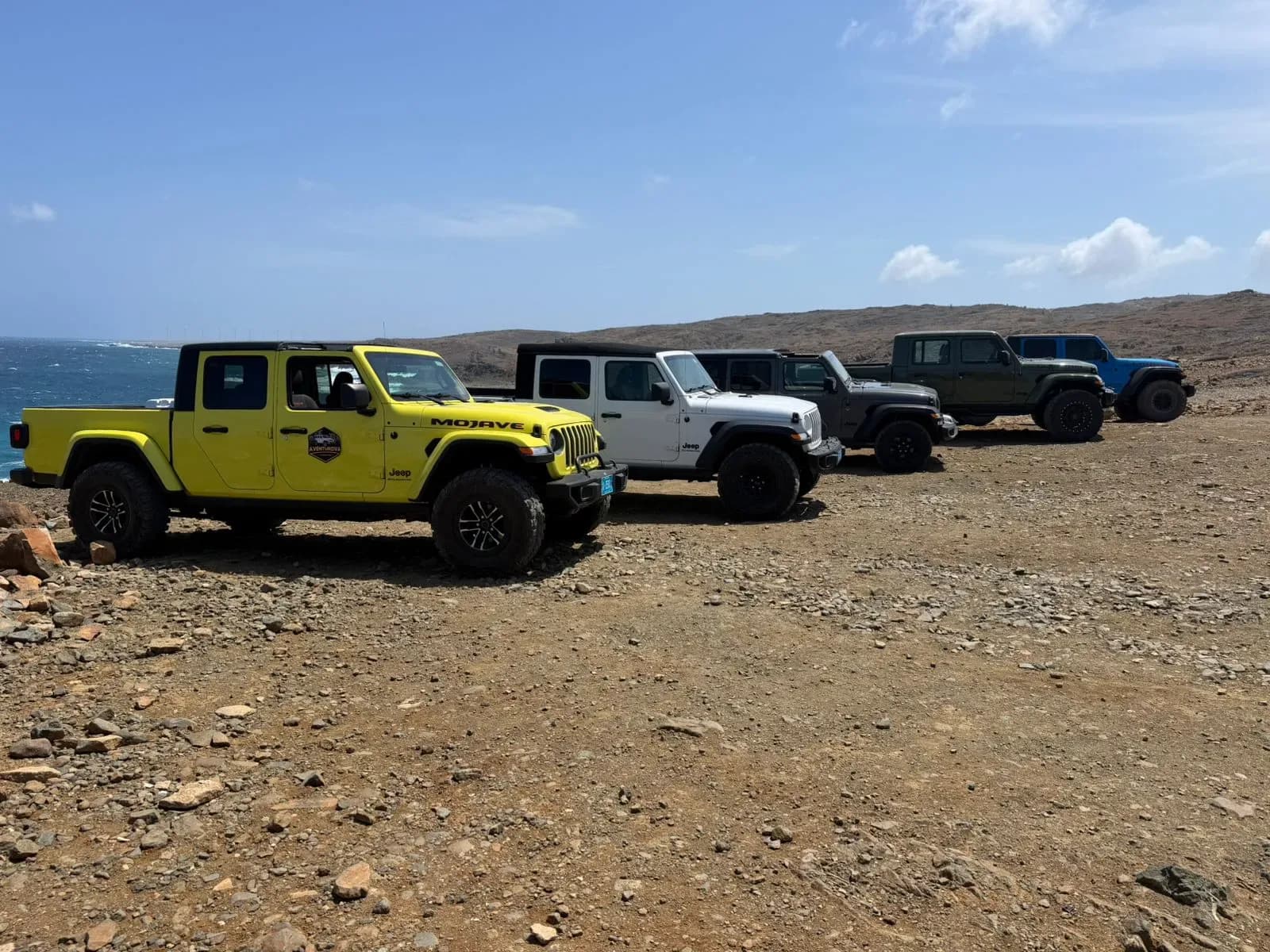
Rent a 4WD/SUV if: You want to drive to the Natural Pool in Arikok National Park, explore the rugged north coast, or tackle the unpaved tracks through the park. The Jeep Wrangler is the most popular choice for this purpose and is an iconic Aruba experience in itself.
The compromise: Rent a sedan for most of your trip and book a guided UTV or Jeep tour for the Arikok/Natural Pool excursion. This saves you the daily premium of an SUV rental while still getting the off-road experience with an expert guide. A UTV tour costs $120-180 per person and handles all the tricky navigation for you.
If you are renting for your entire stay and want the flexibility to go anywhere, the Jeep Wrangler is worth the extra $20-40 per day. The open-air driving experience on a sunny day is quintessentially Aruba.
Find your hotel by month, beach & budget
Compare current Aruba rates across the major booking sites in one place, in USD. Most rooms are free to cancel.
Returning Your Rental
Most companies require you to return the car with the same fuel level as when you received it (usually full). Fill up at the gas station nearest to the airport or your drop-off location before returning.
Take photos of the car and the fuel gauge when you return it. Get written confirmation (or a photo of the return form) showing the car was accepted without damage.
If you have an early flight, confirm with the rental company whether they have early-morning drop-off procedures. Some offer after-hours key drop boxes at the airport; others require you to return the car the evening before.
Our Top Recommendations
Best overall value: Top Drive or Tropic for a mid-size sedan, booked 2-3 weeks in advance through DiscoverCars.
Best for Arikok adventure: Jeep Wrangler from any reputable company, with CDW insurance.
Best for budget travelers: Economy Car Rental for a basic compact during low season.
Best for convenience: Any international brand (Avis, Budget, Hertz) at the airport counter for walk-up ease, accepting the premium for predictability.
Common Mistakes to Avoid
After hearing from hundreds of Aruba travelers, here are the most common rental car mistakes to learn from.
Mistake 1: Renting for the entire trip when you only need it for 2-3 days. If you are staying on Palm Beach and plan four beach days plus two exploring days, rent only for the exploring days. You will save $150-300.
Mistake 2: Taking a sedan into Arikok National Park unpaved roads. The track to the Natural Pool will damage a standard car, and the rental company will charge you for it. Either rent a 4WD or book a guided tour.
Mistake 3: Not documenting the car's condition at pickup. We cannot stress this enough. Walk around the entire vehicle and photograph every panel, bumper, wheel, and the interior. Get scratches and dents noted on the rental agreement before you drive away. Disputes about pre-existing damage are the number one complaint from Aruba renters.
Mistake 4: Leaving valuables visible in a parked car. Even at popular tourist beaches, theft from parked cars happens. Put everything in the trunk or take it with you.
Mistake 5: Not checking the fuel policy. Most companies have a full-to-full policy. Some smaller companies may charge for a full tank upfront and let you return it empty (which means you overpay unless you return it truly empty). Full-to-full is always the better deal.
Mistake 6: Ignoring the speed cameras. Aruba has automatic speed enforcement. Speeding tickets are mailed to the rental company and charged to your credit card. Obey the posted limits, especially through Santa Cruz and Oranjestad.
Driving Routes We Recommend
If you have a rental car, here are three routes that showcase different sides of the island.
The South Coast Drive (3-4 hours with stops): Start from the hotel area, drive south through Oranjestad to Savaneta. Stop at Zeerovers for fresh fish and Balashi beer. Continue to Mangel Halto for snorkeling. Drive to San Nicolas and explore the street art district. End at Baby Beach on the southern tip for a swim in the calm lagoon. Return via the east coast road through Santa Cruz for a different perspective.
The Arikok Adventure (4-5 hours, requires 4WD): Enter Arikok National Park from the south entrance. Drive the main trail to Boca Prins for dramatic cliff views. Continue to the Natural Pool (Conchi) for a swim. Exit via the north side and stop at the Bushiribana Gold Mill ruins and the Natural Bridge. End at the California Lighthouse for sunset.
The Complete Island Loop (5-6 hours with stops): Drive the entire perimeter of the island in a day. Start at Palm Beach heading north to the California Lighthouse. Continue along the wild north coast (paved road) past Ayo Rock Formations. Cut through Arikok on the main road. Hit the south coast beaches and restaurants. Return through Oranjestad. This is the best way to see everything Aruba has to offer in a single day.
Several stops on these routes have full guides on the site: the Natural Pool, the California Lighthouse, and the Arikok safari if you would rather let a guide handle the off-road sections.
For a complete plan that strings the driving days together with beach and restaurant time, see our 7-day itinerary or have our local team plan your trip.