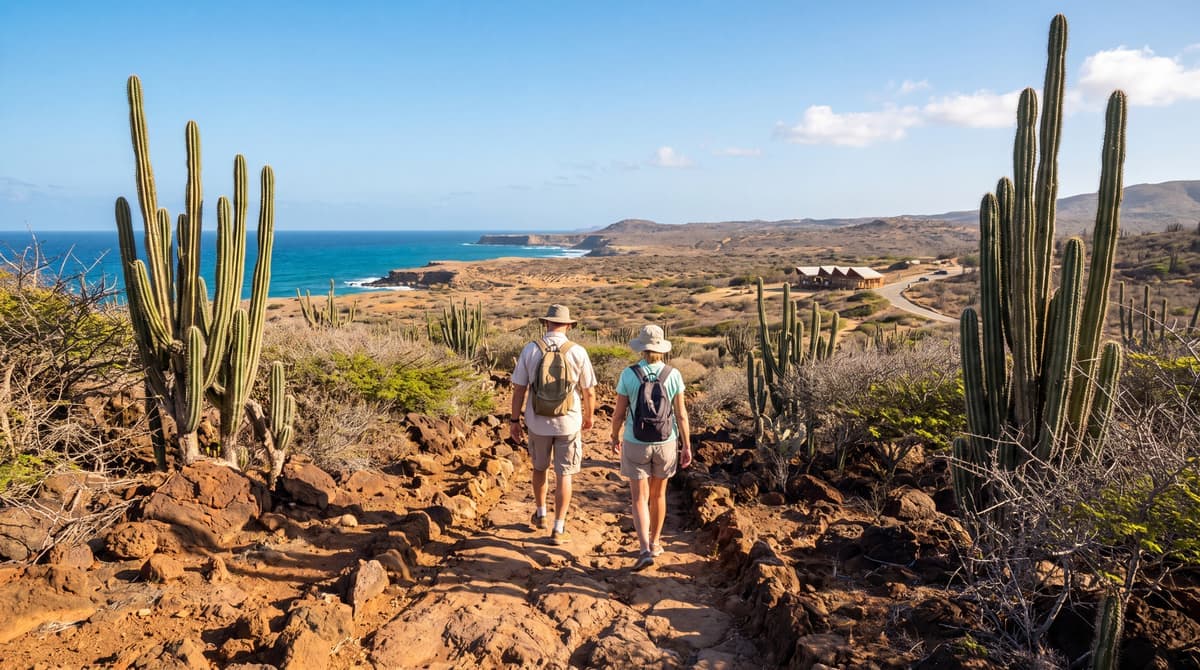
Can you actually hike in Aruba, or is it all cactus, heat and a sunburn by ten in the morning? We live here, and the honest answer is both. The island has a handful of short, steep, genuinely beautiful walks, and the difference between a great morning and a miserable one is almost entirely the clock.
Nothing here is long. The highest point on the island is 188 meters. What makes a hike hard in Aruba is not distance, it is sun, loose rock and the fact that the shade, where it exists at all, is the shadow of a cactus. Plan around that and the rewards come fast: the whole island at your feet from Hooiberg, gold mine ruins on a hilltop in Arikok, and a rock pool on the north coast at the end of a trail.
Below are the hikes we send friends to, in the order most visitors meet them, with the one thing about each that nobody puts on the brochure.
Climb Hooiberg Before Breakfast
Hooiberg is the cone-shaped hill you see from almost everywhere, sitting in the middle of the island. The Aruba Tourism Authority describes it as rising 540 feet from the center of the island and says hikers can take about 600 steps to the top; Visit Aruba gives the summit as 165 meters and the stair count as about 587. Counts genuinely differ by source, so call it roughly 600 steps and you will not be disappointed either way.
It is a staircase, not a trail, which makes it the easiest real climb on the island to plan: no route finding, no park pass, no fee listed on the tourism board's page. At the top you get the panoramic view the climb is famous for, across the cunucu countryside and out to the coast in every direction.
The honest caveat: those steps sit in full sun the whole way up, so carry everything you need. Go at first light, take a full bottle each, and treat the descent with respect, because tired legs on uneven steps are how ankles get turned.
Scramble the Boulders at Casibari
Casibari is the short, playful one. The tourism board's page describes walking trails and steps through giant boulders, with stairways carved into the stones that lead to a 360-degree view from the top. It is a short stop, not a half day, and it fits easily into the same inland morning as Hooiberg.
This is the walk we suggest for families with younger kids or anyone who wants a summit without a workout.
The honest caveat: some of the passages between the boulders are narrow and the carved steps are uneven, so it is more scramble than stroll. Anyone with a bad back or knees should take it slowly and skip the tight spots.
Arikok National Park: Where the Real Trails Are
Most of Aruba's proper hiking lives inside Arikok National Park, on the wild eastern side of the island. Before you go, the rules that matter. The Aruba Conservation Foundation (ACF), which runs the park, says a valid conservation pass is required to enter, sold at both the San Fuego and Vader Piet entrances. The adult day pass is $22 per person, and children under 17 are free. The visitor centers open daily, San Fuego from 8:00 am to 3:30 pm and Vader Piet from 8:30 am to 3:00 pm.
ACF is also clear on one rule every hiker should know: disturbing, collecting or feeding any plant or animal in the park is strictly prohibited. Look, photograph, leave it where it is.
Our full park guide covers the caves, the farmhouse, the wildlife and when to go: Arikok National Park: the complete visitor guide. Here is the hiking layer on top of it.
The ranger-led hikes, and why we like them
ACF runs guided hikes with its own Nature Experience Rangers. Each carries a $25 guided hike fee and takes a maximum of 10 people, and you reserve by email at reservations@acf.aw (the address is on their experiences page). The guided fee is listed on its own, separately from the conservation pass, so ask ACF in your email exactly what you will pay at the gate.
- Jamanota Hill: 4.8 km (2.9 miles), about 2 hours, suggested start 8:00 am, rated hard. Jamanota is the highest point on the island at 188 meters (617 feet). The ranger takes you to the sub-top, with a panoramic view across the south of Aruba, and the route passes the Miralamar Gold Mine Ruins trail.
- Miralamar: 2 km (1.2 miles), about 1.5 hours, suggested start 8:00 am, rated easy, up to the gold mine ruins on the hilltop.
- Cunucu Arikok: 5 km (3.1 miles), about 1.5 hours, suggested start 8:00 am, rated easy. ACF calls it the best introduction to Aruba's flora and fauna, and it passes rock drawings and a traditional adobe house.
If you only book one, the Cunucu Arikok walk is the gentle all-rounder and Jamanota is the one for people who want to feel it in their legs. A ranger also turns a dry hillside into a story: which cactus is which, what the old farmers grew, what you are looking at on the horizon.
The honest caveat: these are small-group hikes booked by email, not something you can add with a tap on the morning. Write well before your trip, and do not plan your day around a date until ACF has replied.
Walking to the Natural Pool
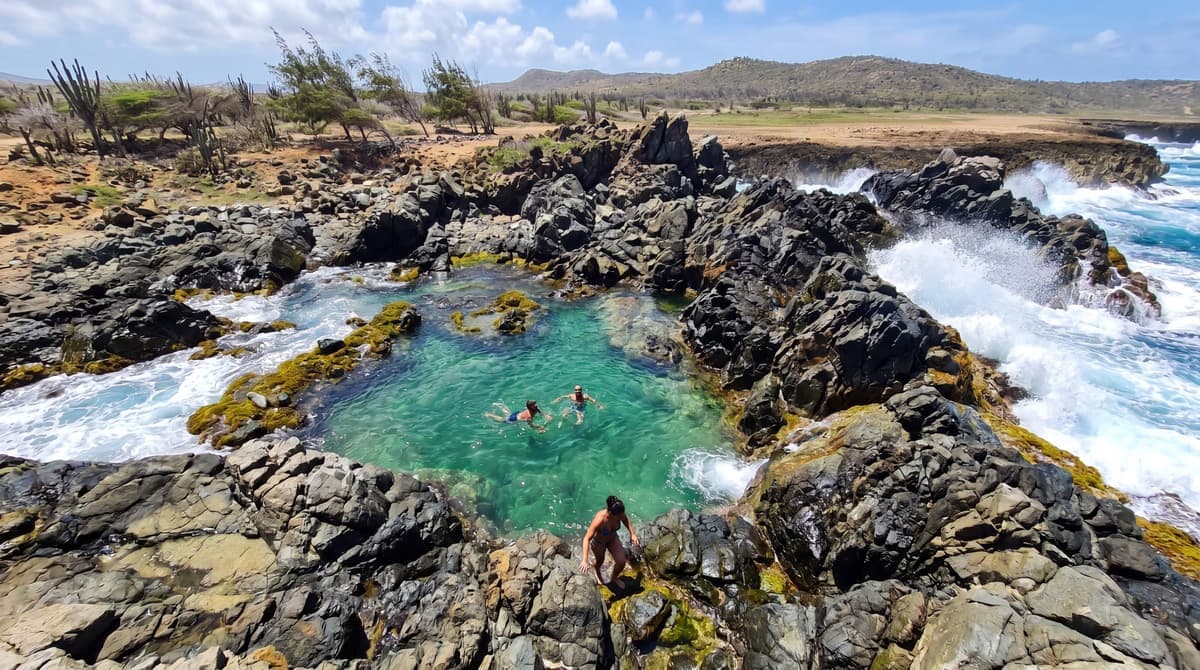
The most famous walk on the island ends at Conchi, the Natural Pool, a rock-ringed basin on the north coast. You can walk there, and the payoff is a swim inside the rocks with the ocean breaking over the rim. Our honest Natural Pool guide lays out the routes, the steps down to the water and how to judge whether the pool is swimmable that day, so we will not repeat it all here.
Two things we will repeat. First, the pool is on the open-ocean coast, and on rough days the sea decides whether anyone gets in, so listen to the rangers and to what the water is doing, not to the plan you made at home. Second, there is no shade and nothing for sale on the way, so this is a dawn walk, never a noon one.
If you would rather not navigate it yourself, a local guide we work with walks small groups in from Santa Cruz at 6:00 AM, so you swim before the jeep convoys arrive. It runs daily, takes about 3 hours, costs $60 per person ($55 for kids 5 to 12) with snorkel gear and snacks included, and goes out once there are 4 hikers in total. The trail asks for moderate fitness, and the park conservation pass is not included in the price; your guide confirms what applies when you book. The sunrise Natural Pool hike, booked direct.
The honest caveat: it is a 6:00 AM start, and the minimum group of 4 means a couple on their own may need to wait for others to join a date.
When the Walk Is Not the Point
Some people want the north coast and the Natural Pool without hiking a single meter of it. That is a perfectly good choice, and it is a different activity.
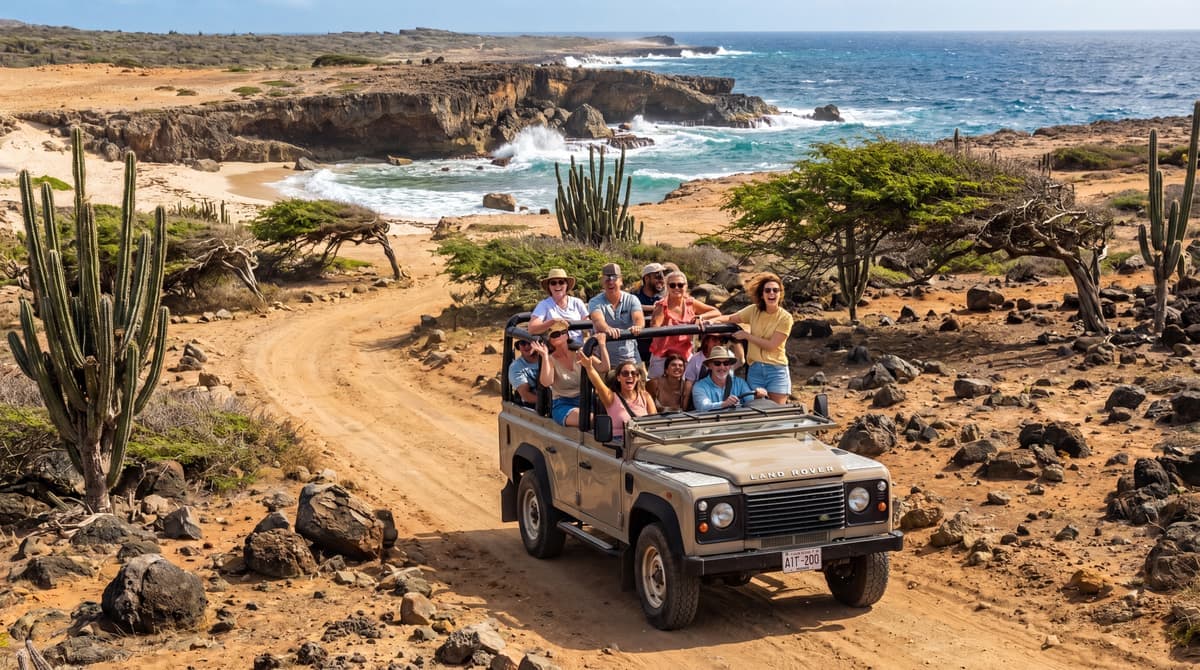
Our direct Arikok jeep safari covers the Natural Pool and two caves in an open-air 4x4, about 4 hours, Monday to Saturday from 8:00 AM, with the park entrance included. It is $110 for anyone 18 and over and $95 for ages 4 to 17. The Arikok jeep safari, booked direct. The honest caveat: you see the park from a bumpy seat, so it is a ride with short walks at each stop, not a hike.
There is also the Natural Pool and Indian Cave jeep safari on Viator, from $99 per person and about 4.5 hours, where the walking is the stops themselves plus roughly 100 steps down to the pool and back up. The park entrance is charged at check-in on top of the ticket, so read the listing for the amount. Check dates and prices on Viator. The honest caveat: it is a shared convoy, so expect company at the pool.
And if you want to drive the park yourself, think hard about it first. The tracks are rough, and our Jeep rental guide explains what a rental can and cannot do out there. For everything else that does not involve a trail, the activities page has the full list.
Our pick
Browse 32 vetted Aruba experiences
Most confirm instantly with free cancellation up to 24h, and 4 of them are free.
When to Start, and What to Carry
Every trail above has the same enemy: the midday sun. That is why ACF suggests 8:00 am starts for its ranger hikes, and why the sunrise hike leaves at 6:00 AM. Our rule is simple. Be walking at first light, and be finished before late morning. In the afternoon the rock radiates heat back at you, and the park's visitor centers close by mid-afternoon anyway.
What we pack for any of these:
- Water, more than feels reasonable. There is nowhere to refill on Hooiberg or on the way to the pool.
- Closed shoes with grip. Loose volcanic rock and worn stone steps are not flip-flop terrain.
- A hat that stays on. The trade wind is constant on exposed ridges and the north coast; our guide to whether Aruba is windy explains why.
- Sun cover you can sweat in. A light long-sleeve shirt beats reapplying sunscreen every half hour. Our what to wear in Aruba guide has the full list.
- Swimwear under your clothes if the Natural Pool is the goal.
Stay on the marked paths. The desert crust and the plants growing on it recover slowly, and the cactus spines that look decorative from a distance are the most common souvenir nobody wanted.
Our Verdict
If you have one free morning, climb Hooiberg at first light and add Casibari on the way back. If you have two, book a ranger hike in Arikok, Jamanota if you want a challenge and Cunucu Arikok if you want to learn the island. And if the Natural Pool is on your list, walk it at dawn with someone who knows the trail. None of it takes more than a morning, and all of it shows you an Aruba most beach chairs never see. For more mornings that cost little or nothing, see our list of free things to do in Aruba.