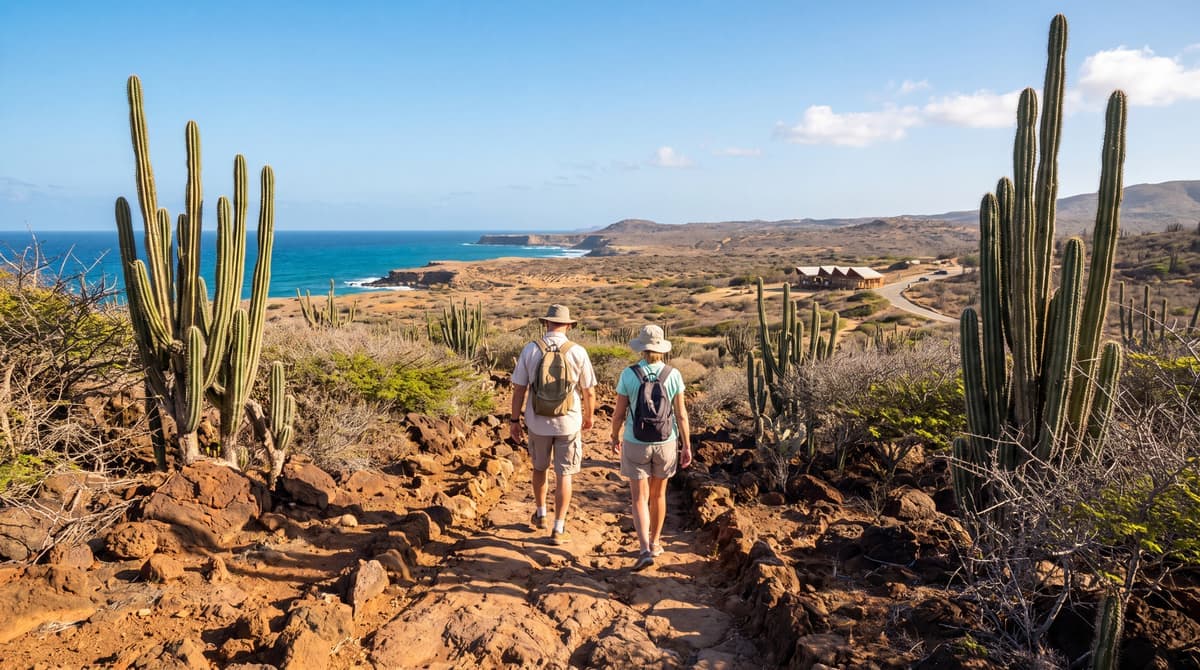
There is a version of an Aruba trip where you never need a vehicle, and a version where a regular car is the only thing between you and the half of the island you flew here to see. Arikok National Park covers roughly a fifth of Aruba, the track out to Conchi is rock and rut the whole way, and the park does not bend on the rule that a normal rental car cannot go there. That is the case for a Jeep, and it is also the priciest way to put yourself behind a wheel here. So: what one costs, what the two Jeeps are for, where the rules let you take them, and the days you should book a guided tour instead. Every rental figure below was read from the crew's published rates and booking window on September 9, 2026.
Who actually needs a Jeep in Aruba, and who does not
Start with the honest half. If your week is Palm Beach or Eagle Beach, dinners near the hotel, and a couple of booked tours with pickup included, you do not need a Jeep, and our honest guide to renting a car here will talk you out of a vehicle on most of those days. Taxis run on fixed government rates rather than meters, there is no Uber or Lyft here, and the Arubus covers Oranjestad to the hotel strip for a couple of dollars.
You need a Jeep for one thing: driving yourself into Arikok National Park and out to the Natural Pool. There is no paved road to Conchi, and access is by 4x4, ATV, horseback or on foot. A regular economy car handles beaches, restaurants, Oranjestad and the California Lighthouse without complaint. It does not handle the park, and the park makes no exceptions.
So the real question is not "Jeep or car", it is "how many of my days are off-pavement days". For most visitors the answer is one, occasionally two, and that number shapes everything below.
Natural Pool and Indian Cave Jeep Safari
4.5 Hours · from $99 per person. Live prices, dates, and the honest details, one page.
Wrangler or Gladiator: the difference is the back
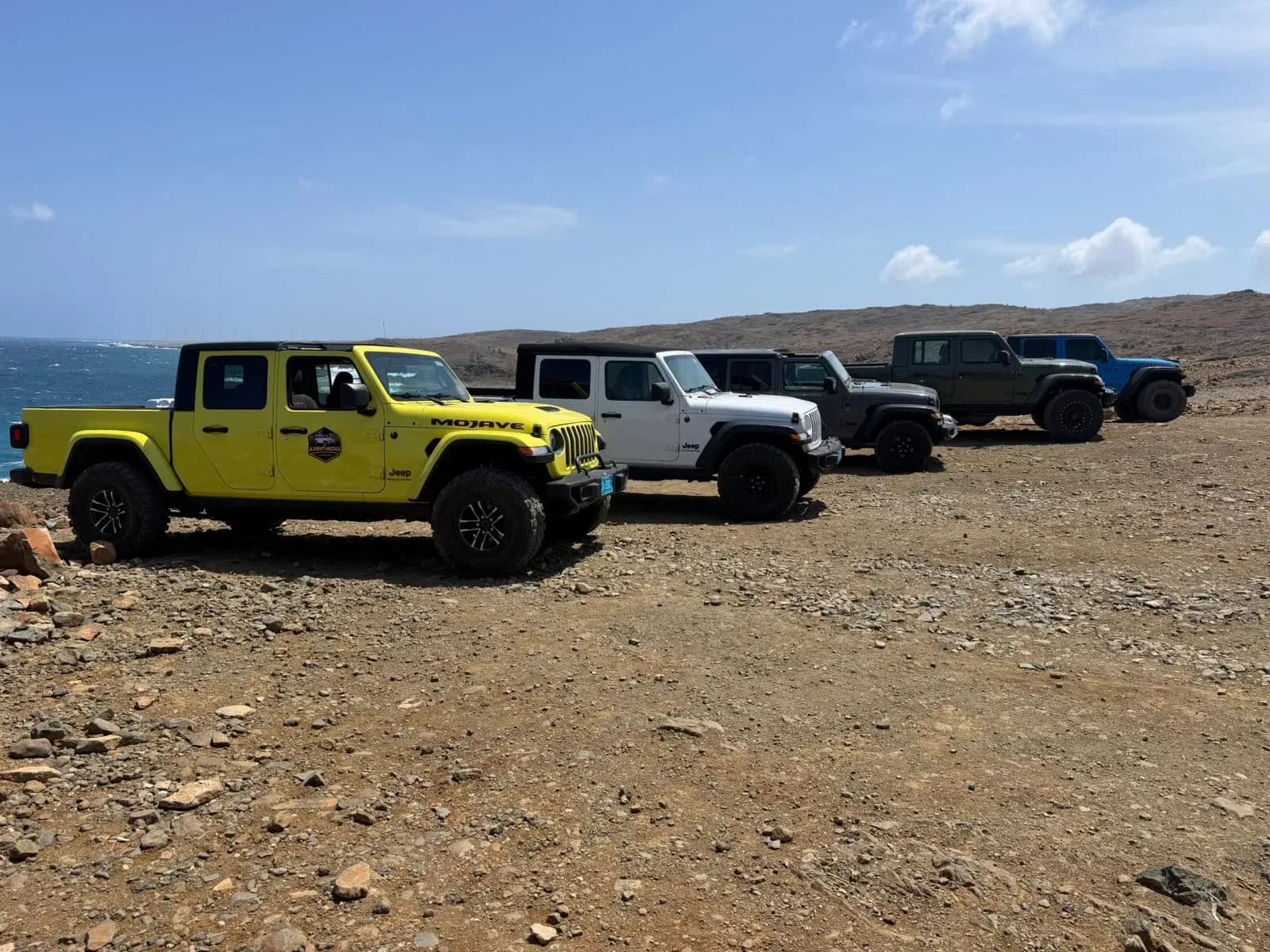
The crew behind our Jeep page, a family run team in Oranjestad, rent two Jeeps, and choosing between them is simpler than the badges suggest.
The Jeep Wrangler seats 5 passengers, runs 4x4 off-road tires and a removable top, has four doors, air conditioning and power steering, and keeps enclosed rear storage for everything you would rather not leave in the sun. Published rate: from $259.99 per day, before tax and before optional protection.
The Jeep Gladiator seats the same 5 passengers on the same 4x4 platform, same removable top, four doors. What the extra $20 a day buys is the open pickup bed behind the cab, where coolers, beach chairs and dripping snorkel gear ride outside instead of on somebody's lap. Published rate: from $279.99 per day.
Both are permitted inside Arikok and out to the Natural Pool, the only specification that genuinely matters here. The two sit side by side with their full feature lists on the Jeep rental page.
Take the Gladiator if you are four or five people with beach gear you would rather leave outside the cabin. Take the Wrangler if you want bags locked away out of sight, or if $20 a day matters more than a cargo bed. There is no off-road difference between them.
What the price includes, and what gets added on top
Included in every rental: unlimited mileage, free delivery of the Jeep to you with the return at their office in Oranjestad, 4x4 capability with the Jeeps permitted inside the National Park, Natural Pool access, a free road map their team marks up with their own eating and exploring tips, free road service, liability insurance in the standard rate, and staff on hand for route planning.
Added after that:
- A 15 percent tax and fee, applied after booking and separate from the base rental price. On the $259.99 Wrangler that is $39.00, an indicative $298.99 for a single day before anything optional. On the $279.99 Gladiator it is $42.00, an indicative $321.99. That arithmetic is ours on their published numbers, not a quote.
- A $500 refundable security deposit, held on a credit card only: no debit cards, no cash. They state the bank releases it automatically and that it can take 14 to 21 business days to appear, worth knowing before you plan around that money.
- Arikok National Park entrance, which is not part of the rental. The Conservation Day Pass is $22 per adult aged 18 and over, children under 17 free, and tickets are sold only at the two park gates rather than online.
- Fuel, on the simplest rule in the business: the Jeep comes back at the level you got it, or $20 per one eighth of a tank.
- CDW+ at $24.99 a day, optional, with a $3,500 deductible on Jeep damages. Read what it excludes: their own list rules out prohibited off-road driving and driving on white sand, dunes, mud or water. Liability insurance is already in the base rate, but if there is an accident and you are at fault, a $250 accident fee applies.
- The small stuff, if you need it: an additional driver at $4.99 a day, and infant, child or booster seats at $4.99 a day each.
What a day and a week actually add up to
A day and a week are priced on different scales, so never multiply the day rate. Worked out on their published numbers:
- One day, Wrangler: $259.99 rental, plus $39.00 tax and fee, an indicative $298.99.
- One day, Gladiator: $279.99 rental, plus $42.00 tax and fee, an indicative $321.99.
- Seven days, Wrangler: their booking window showed $129.99 a day for a seven day rental when we checked on September 9, 2026, so $909.93 rental, plus $136.49 tax and fee, an indicative $1,046.42 for the week.
Outside every one of those totals: the $500 refundable card hold, taken once and not once a day; optional CDW+ at $24.99 a day; an additional driver or a child seat at $4.99 a day each; fuel; and the Arikok entrance fee, paid at the park gate. These are examples on published rates, not quotes. Their booking window prices your own dates and is the number that counts.
One number they publish twice: the one way luggage ride shows as $40.00 on their Jeep page and $29.99 in their FAQ, so confirm it with the team rather than budgeting the cheaper one.
The requirements are short. Minimum rental age is 23, with a valid driver license and a credit card at the time of rental, and every driver named and authorized in the agreement, each of them 23 or over.
Multi-day changes the math. Their booking window prices longer rentals directly, and a seven day Wrangler came out at $129.99 a day when we checked on September 9, 2026, half the one day rate.
Where a Jeep is allowed, and where it is not
Arikok covers about 20 percent of Aruba. Entry is the $22 Conservation Day Pass, the main San Fuego gate runs 8:00 am to 3:30 pm and the smaller Vader Piet gate 8:30 am to 3:00 pm, and no public transport reaches the main entrance. From Palm Beach it is roughly 25 to 30 minutes by road. Our full Arikok National Park guide covers the caves, the trails and the wildlife.
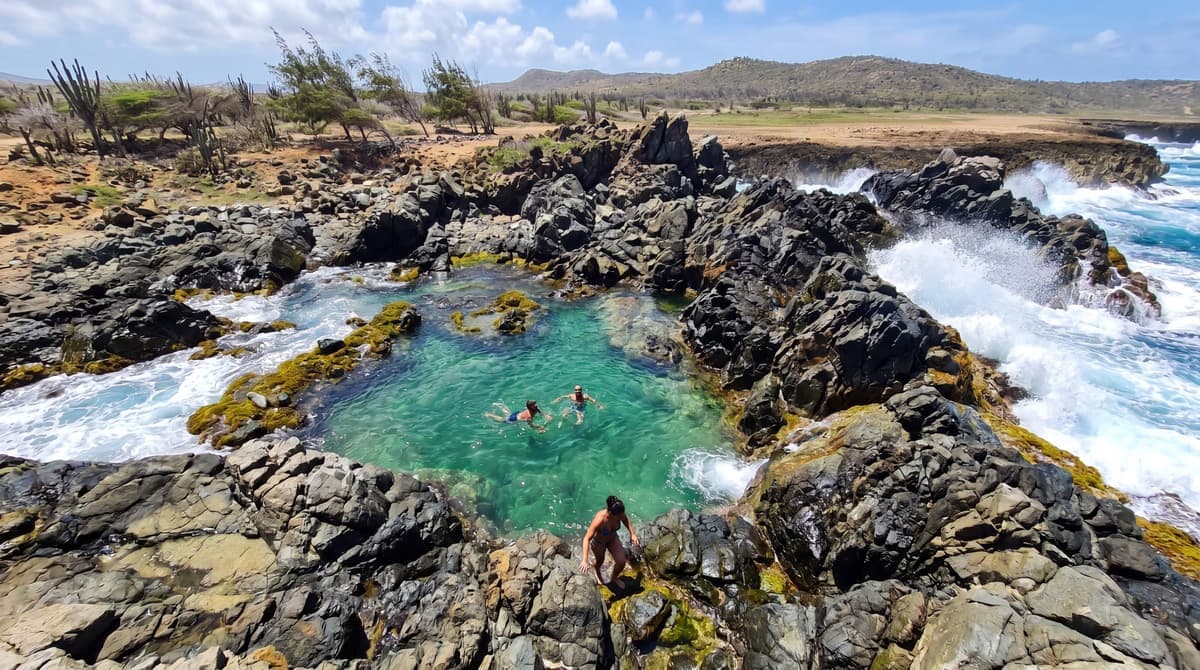
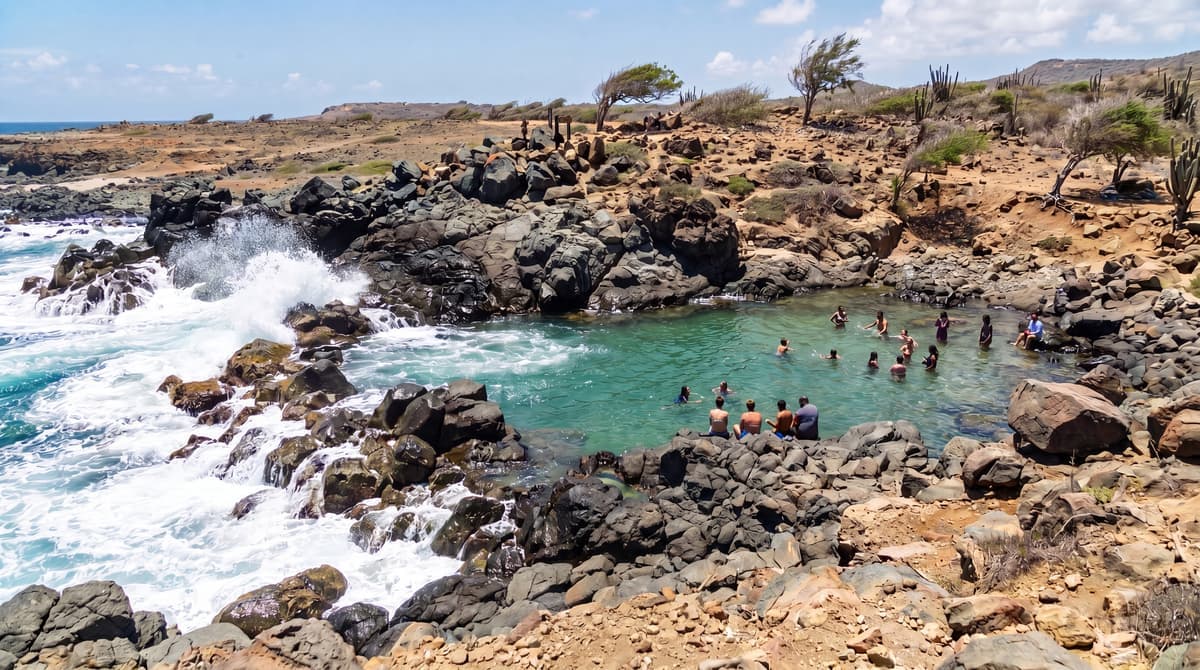
Conchi, the Natural Pool, is a volcanic rock formation that traps a sheltered tidal pool on the north coast, reachable only by 4x4, ATV, horseback or on foot. The last stretch is about 90 steps down the cliff and the same 90 back up. And the caveat nobody prints on a brochure: the pool closes for swimming whenever waves wash over the rim, a call made on the day by rangers and operators, with the best odds December through May. Our guide to whether the Natural Pool is worth it covers that closure risk before you build a day around it.
Where you cannot go, straight from their terms: white sand, dunes, mud, ocean water, rainwater and large puddles, plus any off-road stretch a sign closes, and no 360 turns or donuts. The fine is $250 plus all towing and damage costs, and CDW+ does not cover damage from prohibited driving. The beach-driving photo in your head is the exact thing that costs $250.
Worth stating plainly, because the marketing blurs it: UTVs are not permitted inside Arikok. Only the Jeeps are, so a rented Jeep and a rented UTV are not two versions of the same day.
One day, one Jeep: the route that earns the rental
This is the run most first-timers end up driving, built from the timeline on the Jeep rental page and our own beach and park notes.
Morning, the keys come to you. They deliver free to the airport, the cruise port, most hotels and Airbnb places. You get the Jeep and the road map marked up with their tips.
Stop one, Arikok National Park. A fifth of the island, unpaved and quiet: the Fontein and Guadirikiri caves, the windward cliffs, wildlife that ignores you. Pay the $22 at the gate. Ticket sales close at 3:30 pm, so the park half of this route is a morning job.
Stop two, Conchi. Getting there is half of it. You float while the swell breaks over the rim a few feet away, then climb the 90 steps back to the Jeep.
Stop three, the California Lighthouse. The northwestern tip, named after a steamship that went down nearby in 1891, with 360 degree views over the dunes and Arashi below. The crew name it among their own top destinations. It is a free landmark, about $7 to climb.
The long way back, Baby Beach. Roughly 40 to 45 minutes south of the hotel strip, a shallow, calm lagoon with the gentlest water on the island. Baby Beach makes the Jeep earn its keep in both directions.
Evening, back to Oranjestad. Returns happen at the crew's office in Oranjestad, open Monday to Sunday, 8:00 AM to 5:00 PM.
Renting a car? Compare every Aruba agency
One search across the island rental companies, free cancellation on most cars, no card to reserve.
Pick-up, return, and the return detail people miss
Free pick-up and drop-off means delivery: the Jeep comes to you at Aruba Airport, the Cruise Port, most hotels and Airbnb locations, rather than you to a counter.
Returns are the asymmetry, and the single most missed line in the whole rental. Their Jeep page publishes returns at the crew's office in Oranjestad only, with airport returns not available and no vehicle left in a public airport parking lot without prior approval. Their FAQ still lists the airport and the cruise port under free pick-up and drop-off, so the two pages do not fully agree; both lines were live when we read them on September 12, 2026, and we would rather show you the gap than pick one for you. Plan on the office, settle the return point with the crew in the booking window, and if you fly out in the evening sort your ride to the terminal from town. Reviews from past renters mention hotel and airport collections, which is somebody's good day rather than a published rule.
The rest of the clock: the office runs Monday to Sunday, 8:00 AM to 5:00 PM, a reserved Jeep is held 2 hours after your scheduled pick-up time, and a late return costs $25 an hour.
The honest trade-off: Jeep, standard car, guided safari, or UTV
A Jeep day is not cheap, and there are four ways to spend that money.
Against a standard rental car. An economy car runs about $40 to $60 a day and a regular SUV or 4x4 about $70 to $100 a day before insurance, with CDW roughly $15 to $30 a day on top. The Wrangler at $259.99 before their 15 percent tax and fee, an indicative $298.99 all in for a single day, sits well above that for specific reasons: an off-road equipped 4x4, unlimited mileage, free delivery to your hotel, park permission and liability in the rate. If your day never touches the park, you are paying for capability you will not use, and our car rental comparison is the better page.
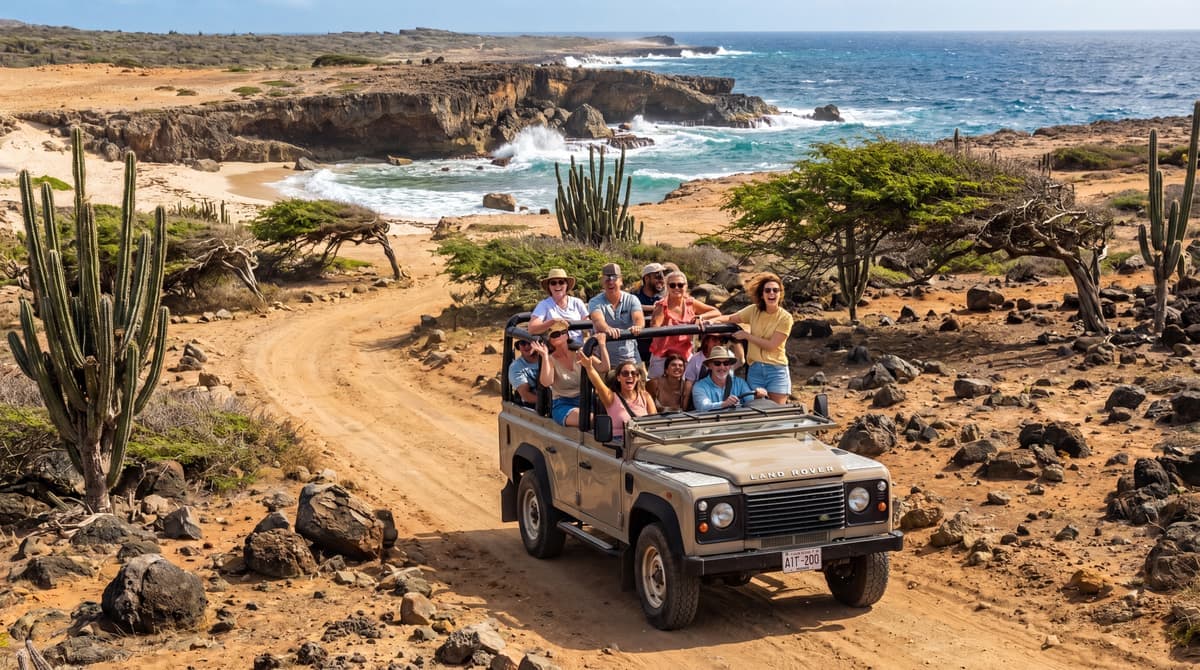
Against a guided jeep safari. The two guided morning safaris we list run from $85 and $99 per person with snorkel gear included, so a couple pays roughly $170 to $200 and never touches a steering wheel, a deposit or a fuel rule. Check each listing for what it does with the Arikok entrance fee: one includes the park ticket, the other charges $25 per person at check-in. A self-drive Jeep only wins the money argument at three, four or five people, or across more than one off-road day. What it always wins is the freedom to stop where the light is good. Compare the guided versions on our activities page.
Against a UTV. UTV tours are priced per vehicle, roughly $225 to $340 for a 2 seater and $460 to $560 for a 4 seater on morning departures, and they are a genuinely great day out. But UTVs are not allowed into Arikok, so combo tours drive you to the park entrance and transfer you into a tour jeep for the pool itself. If the park is the point, that is an argument for the Jeep. Our jeep versus UTV versus ATV comparison sorts the three by the day you actually want.
Against no engine at all. If nobody wants to drive rough track, a local guide walks a small group in from Santa Cruz at first light. Three hours, $60 per person, swimming before the first convoys arrive: the sunrise hike to the Natural Pool, booked direct.
How to book, and the terms worth reading first
Booking and payment happen in a window over our page, so nothing is charged on this site itself. Our Jeep rental page lays out the fleet, the full terms and verified reviews from past renters, then opens the window to pick your dates.
Two things about that window, because they surprise people. It books the crew's Jeeps and their UTVs in one flow, so the rules line across the top is written for the UTVs, rented between 8:00 AM and 5:00 PM and returned at the office, and it is not a limit on a Jeep. And the return location opens on Cruise Port, which is the window's starting value rather than the rule, so change it with the crew before you pay. There is no Jeep-only link into it either: you pick the Wrangler or the Gladiator inside. Checked on September 12, 2026.
Before you confirm, three things.
Cancellation. Free more than 24 hours before pick-up. Inside 24 hours, one day of rental plus tax is charged. There are no refunds for early returns, so reserve the day you actually want rather than padding the booking.
The deposit and the card. $500 on either Jeep, credit card only, released by the bank automatically, 14 to 21 business days to appear. Every driver has to be listed and authorized in the agreement, and each of them 23 or over.
The date. Rates move with the calendar. The $259.99 and $279.99 above are their published from prices as of September 9, 2026, and the rate for your dates is whatever their booking window quotes. Longer rentals bring the daily number down sharply.
Rent it for the days that need it, hand it back in Oranjestad, and spend the rest of the week on foot. That is the version worth the money.
Photographs of the Jeeps and the coast are the crew's own.