Most first-time visitors to Aruba spend every morning on a beach chair and every afternoon on a catamaran. They do not go inland. Which means they miss the one place on the island that looks like nowhere else in the Caribbean: a designated national park the size of a small American county, covering 20% of Aruba, where the terrain is all volcanic rock and arid cactus desert and crashing surf and cave ceilings painted by the people who lived here a thousand years before the first European ship arrived.
Arikok National Park is not a hard sell once you understand what it actually is. It is where the island's most dramatic photography happens. It is the only path to the Natural Pool. It is the only place on Aruba where you will hear the Shoco, the island's critically endangered burrowing owl, if you show up early enough. And at $22 per adult for a full day, it is one of the best-value excursions you can plan.
This is the honest practical guide to visiting it well, written for July and August conditions.
The basics before you go
Entry fee: $22 USD per adult. Children under 17 enter free. There is no separate charge for the caves; the Conservation Day Pass covers the whole park. Aruban, Bonairean, and Curacaoan residents receive a discount with a valid island government ID.
Hours: The main entrance at the San Fuego Visitor Center is open from 8:00 AM. Ticket sales close at 3:30 PM. The secondary Vader Piet entrance closes at 3:00 PM. In practice, plan to arrive at or before 8:00 AM, especially in July and August: the heat on exposed trails by 10:00 AM is the number one reason people cut visits short. An early start is not a suggestion, it is the single most important advice in this guide.
Getting there: The park sits in the northeastern interior, roughly 25 to 30 minutes from Palm Beach by car. There is no public transport that reaches the main entrance. You need your own vehicle or a guided tour. From Oranjestad, take L.G. Smith Boulevard east toward Santa Cruz, then follow the signs for Arikok. The visitor center and its parking area will be on your left.
What is at the visitor center: Free park maps, wristbands, restrooms, and information displays on the park's geology, wildlife, and history. The staff here can orient you and point you toward whichever sections of the park match your time and energy level. Spend five minutes here before heading in.
A quieter door into the park: we work directly with a local guide who hikes a small group to the Natural Pool at first light, daily from Santa Cruz. Three hours, $60 per person, swimming included, and the park feels like yours alone. Read about the sunrise hike.
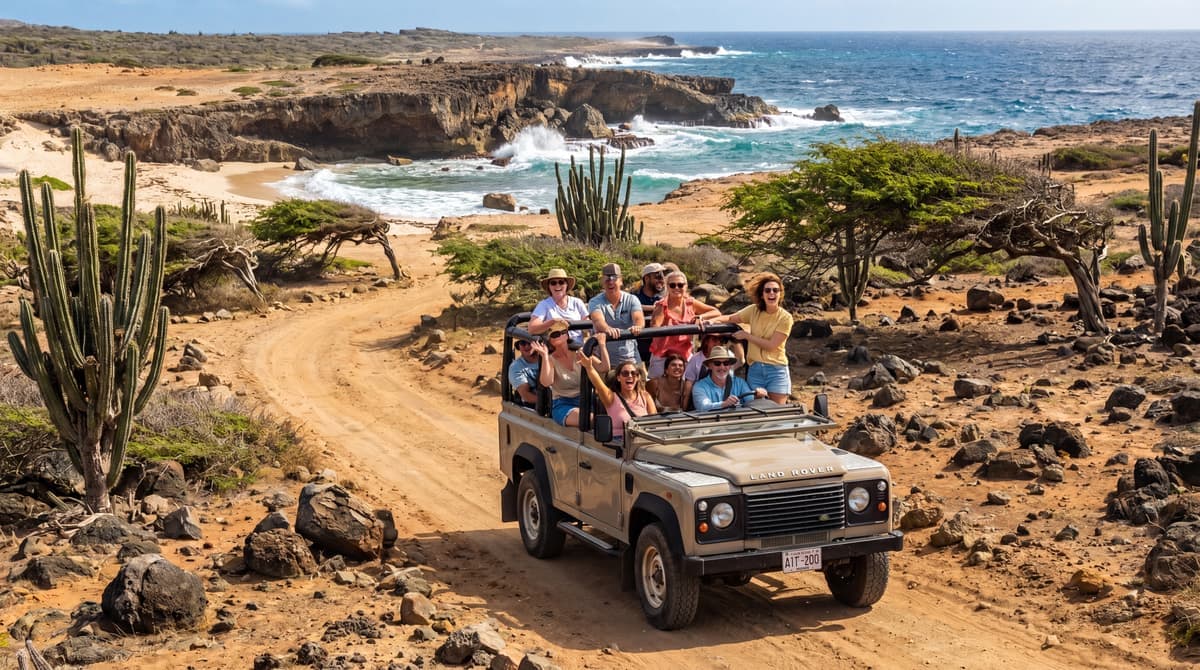
Arikok National Park Jeep Safari
Half Day · from $85 per person. Live prices, dates, and the honest details, one page.
The Fontein Cave: the oldest thing you will see in Aruba
Fontein is the cave to visit first. It is also the closest significant attraction to the park entrance, which means it gets busy by mid-morning. Go at opening.
The cave's ceilings and walls hold Arawak Indian pictographs, red-orange pigment drawings that date back roughly 1,000 years. These are among the oldest surviving human marks on the island. The images are abstract, mostly geometric, with some animal-like forms. On top of them, or next to them depending on the section, you will find carvings from the colonial era, dated in the 1800s, carved by people who were clearly also fascinated by the same walls.
The cave itself is a short walk into the hillside. It is dim inside but not pitch dark; natural light filters in from the opening. No torch required. The walls are close enough that you can read the textures of the drawings without any special equipment.
One honest observation: the pictographs are real and genuinely worth seeing, but they are not a grand museum exhibit with interpretive panels at every turn. Bring patience and curiosity rather than high exhibition expectations, and you will find the experience genuinely moving. Hurry through and you will miss the point.
Quadirikiri Cave: bats, skylights, and the inner dark
Quadirikiri is the second major cave, about a five-minute drive from Fontein. It is larger, darker, and stranger.
The cave has two main chambers. The first is open enough that you can see clearly without additional light. The second is deeper and lower, and here is where the fruit bats live: hundreds of them, hanging from the ceiling and shifting in the dark. The chambers have natural openings in the roof that let columns of sunlight through, creating a dramatic contrast between the lit sections and the pitch-black interior around the bat colony.
Important: flashlights and camera flashes are not permitted inside Quadirikiri. This is to avoid disturbing the bats, and operators and signage take it seriously. If you want photos of the chamber, natural-light shots from the sunlit entrance sections are the ones that actually work. The bats themselves are harmless to visitors.
Quadirikiri also has Amerindian petroglyphs on its limestone walls, though Fontein is the primary site for those. The cave is worth the visit on its own terms for the skylights and the bats alone.
The Natural Pool (Conchi): the most dramatic swim in Aruba
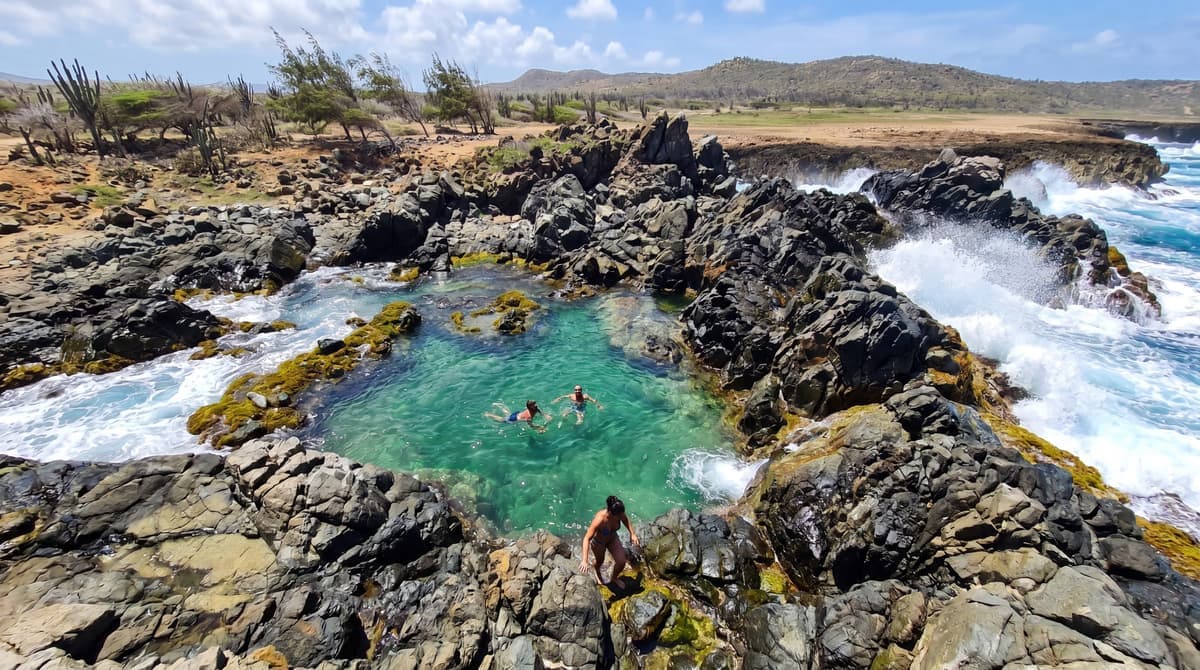
The Natural Pool, known locally as Conchi, is a volcanic rock formation on the wild northeastern coast of the park that creates a sheltered circular pool where waves enter over the rock lip and calm into swimmable water. From outside the pool, the Atlantic crashes hard against the black rocks. Inside, it is clear, protected, and extraordinary.
Getting there is the complication.
Conchi is accessible by 4WD vehicle over a rough 5-kilometer track, or on foot via marked trails, or by horseback. It is not reachable by standard rental car. Most rental agreements explicitly forbid taking a vehicle off-road, which means your insurance cover evaporates the moment you attempt the track in a sedan. If you are renting a proper 4WD jeep for the day specifically to reach the pool independently, that is fine and practical. If you are in a standard compact rental, the correct choice is a guided tour or a self-guided hike.
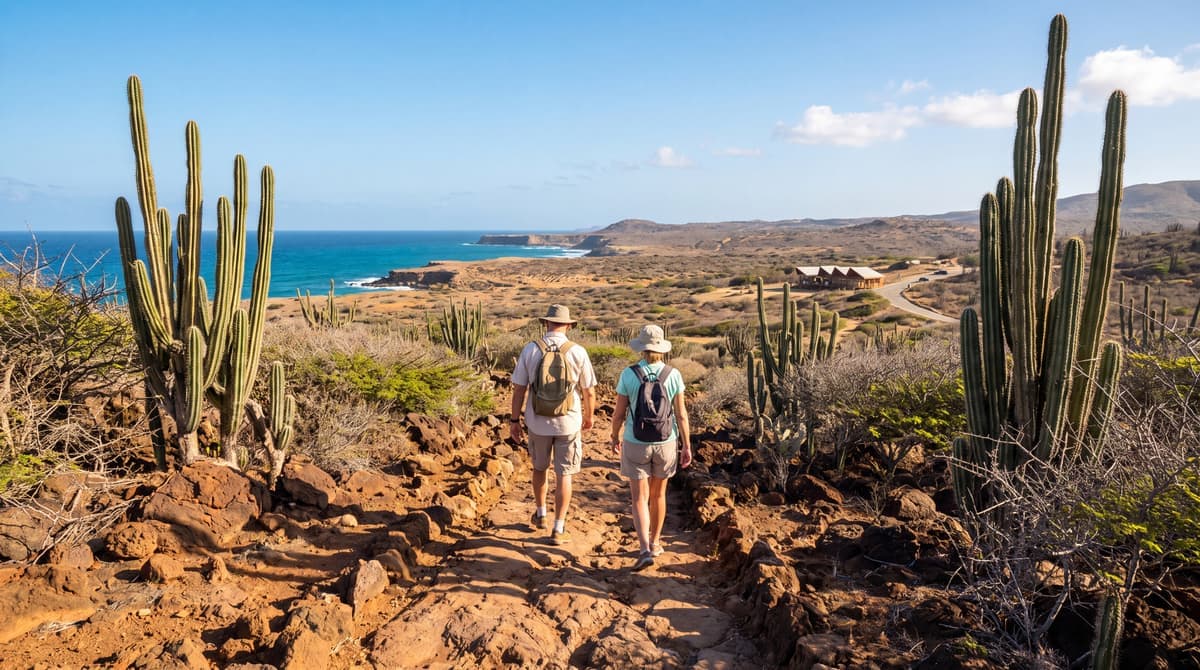
The on-foot trails from inside the park to Conchi are the Daimari-Conchi trail (approximately 2.4 miles one way, around an hour each direction) and two longer routes. In July and August, hiking to the Natural Pool without a very early start and at least 3 liters of water per person is a genuine heat-management challenge. The terrain is rocky with minimal shade.
The simpler solution for most visitors is a guided 4WD jeep tour that includes Conchi as part of an Arikok circuit. These include vehicle transport, a guide who reads the park's history and geology as you go, and a swim stop at the pool. On the one we link below, hotel pickup is offered from the operator's listed hotels about 45 minutes before departure, or you meet at their own office. We have verified the tours available through Viator and the one that consistently performs: check dates and prices for the Natural Pool 4WD tour on Viator. Rated 4.9 on 330 Viator reviews, with a further 9,230 TripAdvisor reviews at 5.0 shown on the same listing. Checked September 12, 2026.
If you want the longer full-park circuit that includes the caves, the coastline, and Conchi together, see the full Arikok jeep safari, booked direct with a local crew: the pool, both caves and Dos Playa in one morning, park entrance and hotel pickup included. Our full take on whether the Natural Pool tour is worth it: Aruba Natural Pool: is it worth it?
Dos Playa: twin bays on the wild coast
Dos Playa is two adjacent beaches separated by a rock formation, on the park's northeastern coast. The Atlantic swells here are too strong and unpredictable for swimming, and signs make that clear. What Dos Playa offers instead is one of the most dramatic pieces of coastline in Aruba, waves that crash into sea caves and spray up through fissures in the rock.
Sea turtles live and nest around Aruba; if you meet one, keep your distance, never touch or chase it, and keep beaches dark at night.
Cunucu Arikok: the farmhouse in the desert
On one of the loop trails inside the park sits a restored traditional Aruban farmhouse, a cas di torto built in the old way from mud and cactus with thick walls designed to hold cool through the heat of the day. The property is named for Arie Kok, who farmed this land before the park existed. The old cactus hedges that marked his property boundaries are still standing. Stone walls. A dry well.
This section of the park draws almost none of the visitor traffic that the caves and the Natural Pool attract, which is exactly why it is worth including. Walking this trail on a weekday morning, you may well have it entirely to yourself. The Cunucu loop also passes one of the rock-painting sites in the interior. It is a slow, quiet stretch of the park that feels different in character from the drama of the coastline.
Wildlife: what you can actually see
Arikok holds almost all of the island's wild species in one concentrated space.
The Shoco, the Aruban burrowing owl, is Aruba's national bird and critically endangered. The population here is one of the last viable ones. Shocos nest in burrows in the desert floor and are easiest to spot at dawn and dusk when they sit at burrow entrances. If you arrive at 8:00 AM you have a reasonable chance of seeing one before the tour buses arrive.
Aruban whiptail lizards are everywhere: fast, small, striped, completely harmless. Iguanas move more slowly and are easily spotted on the rocks. Feral donkeys and goats graze openly on the park's hillsides and appear at trail bends without warning. The park's bird checklist is long, with over 280 species recorded across the island, many of them present inside Arikok. Early morning is the most productive time for any wildlife, not just the Shoco.
The Aruban rattlesnake (Cascabel) is also present in the park. It is critically endangered and uncommonly seen; encounters are rare. Stay on marked trails, watch where you step in rocky sections, and you will likely see nothing more alarming than a lizard. This is not a park where wildlife concerns should shape your visit.
Let us plan this trip for you
We live in Aruba and vet every spot ourselves, share your dates and we'll build the rest.
Self-guided versus a guided tour
Both options are genuinely good, depending on what you want.
Self-guided, with your own 4WD or standard vehicle for the cave and trail sections, gives you the park at your pace. You pick up a map at the visitor center, drive between the main sites, and spend as long as you like at Fontein. The caves, Dos Playa, and the Cunucu trail are all accessible on main park roads that do not require a 4WD. What you lose is context: the cave paintings have limited interpretive signage, and the desert ecology is much richer with someone reading it for you.
A guided jeep tour adds a knowledgeable guide, transport to sections you cannot reach without a 4WD (including the Natural Pool), and a structured itinerary that ensures you see the highlights without navigation decisions. The best tours depart early, which aligns with the single most important piece of advice in this guide: go before the heat builds. For the full Arikok circuit including Conchi, a half-day guided tour is almost always the better choice for first-time visitors. See the current tours on our activities page. If you want the eight-hour version, our full-day island jeep safari page covers the run that adds Baby Beach to the park circuit.
If you are driving yourself and plan to visit just the caves and Dos Playa, a standard rental vehicle is fine for those sections. For the Natural Pool, you need either a proper 4WD or a guided tour. Our car rental guide covers what vehicles are available on the island and what the rental conditions say about off-road use.
Practical July and August notes
July and August bring Aruba's most intense heat. Daily highs run 84 to 90 degrees Fahrenheit (29 to 32 Celsius) on exposed terrain. Arikok has almost no shade on its trails. The volcanic rock surface amplifies the heat from below, and the mid-day sun is relentless.
Arriving at 8:00 AM opening is the single highest-impact thing you can do for your comfort and your enjoyment of the park. By 10:00 AM the trails that felt manageable at 8:15 AM are significantly harder. Bring at least 2 liters of water per person for a cave-and-trail morning, more if you are hiking to the Natural Pool. A hat and reef-safe sunscreen are not optional.
The trade winds that make Aruba comfortable on the beach do blow across the park, which provides some relief. The caves are cooler than the outdoor temperatures by several degrees. Plan your itinerary to alternate exposed outdoor walking with cave visits and shaded rest stops.
Weekday visits also avoid the organized tour rush. Most jeep safari groups arrive mid-morning; an independent visitor at opening on a Tuesday or Wednesday will often have the caves essentially to themselves for the first hour.
Putting it together
A full Arikok morning covers more ground than most people realize. Arrive at 8:00 AM at San Fuego, pick up your map, walk Fontein Cave first (you will have it nearly alone), drive to Quadirikiri while the heat is still manageable, then head toward either Dos Playa or the Cunucu loop depending on your preference. If you are on a guided jeep safari that includes the Natural Pool, all of this is handled for you and you are back at your hotel by early afternoon.
For the rest of your Aruba planning, the best tours page has our full reviewed lineup of the island's top excursions, and the activities page keeps live pricing and availability. If you would rather have us build the whole itinerary around the park visit and everything else you want to do, the concierge service is the path to that.