A week in Aruba adds up fast once you tally the hotel rate, the rental car, and a full slate of paid tours, and rates only climb as the island heads into its busier months. The good news, and it is genuinely good news, is that a real chunk of what makes this island worth visiting costs nothing at all. We live here, and these are the spots we send visiting family to when they want a full morning or afternoon away from the resort without touching the credit card.
Not everything labeled "free" on a tourism blog actually is, though, and that mix-up is exactly where first-time visitors get caught out. Aruba's rock formations and its donkey sanctuary cost nothing. Its single most-photographed beach very much does. Below are twelve places and experiences we checked one by one as of October 2026, plus the two famous spots worth knowing about before you build your itinerary around the wrong assumption.
Every Beach on the Island Is Already Free
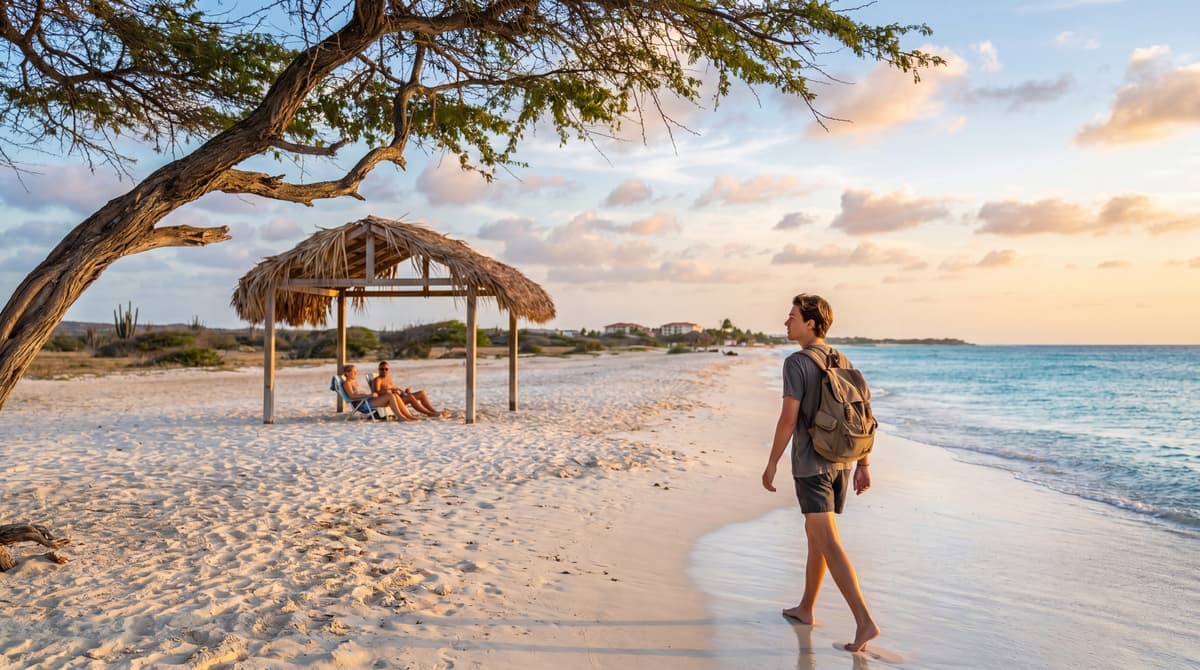
Start with the biggest one, because it is also the most overlooked: every beach in Aruba is public by law. The island's National Ordinance for Public Waters and Beaches guarantees it, and no hotel, however large the resort sitting behind the sand, can fence off its stretch of beach or charge admission to walk onto it. Eagle Beach, Palm Beach, Baby Beach, Arashi, Boca Catalina, Mangel Halto, all of it is yours, free, every single day. Parking is free too at the major beaches, with lots or roadside spots at Eagle Beach, Palm Beach, and Baby Beach, no meters, no time limits. Our full beaches guide breaks down all 12 of our favorites, and Eagle Beach versus Palm Beach helps you pick a home base if you have not already booked.
The one honest catch: "free" does not mean "first dibs on the good shade." The thatched palapas along Eagle Beach and Palm Beach are free and first-come, first-served, but you cannot use a resort's own branded loungers and umbrellas even though the sand underneath belongs to everyone. In high season, arrive before mid-morning if a shaded spot matters to you. While you are on Eagle Beach, look for one of the island's most photographed natural landmarks, a lone divi-divi tree bent permanently sideways by the trade winds. It costs nothing to walk up and take the exact photo everyone else paid a flight to get.
Browse 32 vetted Aruba experiences
Most confirm instantly with free cancellation up to 24h, and 4 of them are free.
Shore Snorkel for Free (If You Already Own a Mask)
Aruba's calm, clear west coast means some of its best snorkeling happens a few steps off a public beach, no boat required. Boca Catalina and Mangel Halto are the two spots we send people to first. Boca Catalina has a small sandy beach with easy entry and a short swim out to reef and fish, while Mangel Halto, on the south coast near Savaneta, pairs a mangrove channel with a reef edge rich in parrotfish and snapper. Both are free public beaches with free parking, and neither charges anything to get in the water. Our shore snorkeling guide maps out which spots suit beginners versus stronger swimmers.
The honest catch is tucked into the parentheses above: this is only truly free if you already own a mask, snorkel, and fins. Renting gear on-site or from a shop costs money, same as anywhere else, so this is a real freebie mainly for travelers who packed their own set. If you would rather let someone else handle the boat, the reef, and the gear, our general snorkeling guide covers the paid tour side of things.
Casibari and Ayo: The Rock Formations Everyone Assumes Cost Money
Because they sit so close to Arikok National Park on the map, a lot of visitors lump Casibari and Ayo Rock Formations in with the paid park and skip them entirely. That is a real mistake. Both sit well outside Arikok's boundary, and both charge nothing to visit.
Casibari, in the island's interior near Paradera, is a cluster of massive diorite boulders with government-built steps, handrails, and short tunnels winding up to a flat lookout with views stretching across most of the island. It is open 24 hours a day with free parking right out front. The one catch: the on-site restroom asks for a one-dollar donation, so keep a small bill handy.
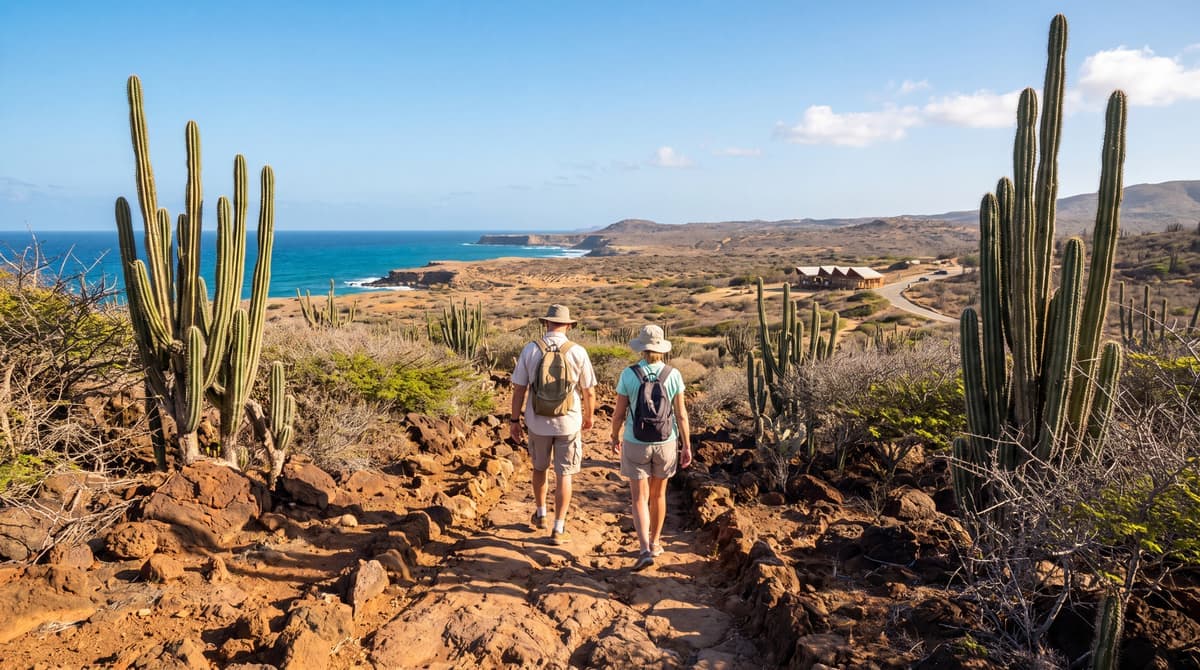
Ayo, a short drive away, is a similar boulder formation with marked walking trails and ancient petroglyphs left by the island's original Caquetio inhabitants. Also free, also free parking, also no entrance gate of any kind. The honest trade-off at both spots is shade, or the near-total lack of it. This is open desert terrain, so a hat, water, and real shoes rather than flip-flops make the climb far more pleasant.
Alto Vista Chapel, the Island's First Church
On Aruba's quieter northwest coast sits a small, bright-yellow chapel built in 1750, the first Catholic church on the island. Alto Vista Chapel charges no admission, though a donation box helps with its upkeep, and the grounds offer a genuinely peaceful overlook of the coastline below.
One caveat worth knowing: it is still a working chapel, with Mass held weekly, so treat it as the quiet spot it is rather than a backdrop for a loud photo shoot, particularly if you happen to roll up during a service.
California Lighthouse: the View Is Free, the Climb Isn't
At the island's northwestern tip, the California Lighthouse marks the spot where the paved road runs out and the wilder, rockier coast takes over. Walking the grounds, taking in the view, and photographing the lighthouse against the surf below cost nothing at all, any time the site is open.
The one place on this list that needs precision: actually climbing to the top costs a small fee, about $5 as of late 2026, paid on-site with no reservation required. So the lighthouse earns its spot here for the grounds and the view, not the climb. Either way, it is one of the better perches for a sunset you will actually remember, free or not.
Natural Bridge and the Bushiribana Gold Mill Ruins
A few minutes apart on the rugged north coast sit two free stops that pair well as one outing. The original Natural Bridge collapsed back in 2005, but a smaller "Baby Bridge" nearby still arches over the surf, and the site itself, between the gold mill ruins and Andicuri Beach, charges no entrance fee and has a free parking area. A short drive away, the Bushiribana Gold Mill Ruins, stone walls from an 1872 gold-smelting operation that ran for barely a decade before closing, stand open to the public around the clock with no fee and no gate.
The honest catch at both: there is essentially zero visitor infrastructure out here. No restrooms, no shade structures, no paved paths, just raw heritage sites on uneven, rocky ground. Wear real shoes and watch your footing, especially if you climb any of the old stairs at Bushiribana for the view over the coast.
Bubali Bird Sanctuary
A short walk from the Palm Beach hotel strip, directly across from the old windmill, sits a 20-hectare wetland that is easy to drive right past and completely free to visit. Bubali Bird Sanctuary's two connected ponds draw more than 80 species of migratory birds, egrets, herons, coots, and more, and a wooden observation tower lets you take it all in from above at no cost, for as long as you like.
The catch: the access path is a short, unmaintained dirt road rather than a paved sidewalk, so it can get muddy after rain. Still, for a quiet half hour away from the resort noise, it is hard to beat.
Downtown Oranjestad and the Free Trolley
Oranjestad's Main Street, with its Dutch colonial facades, waterfront promenade, and public plazas, costs nothing to wander, and the easiest way to see the core of it is the restored double-decker streetcar that loops the downtown area. The trolley is entirely free, no ticket or reservation needed, running Monday through Saturday, roughly 10 a.m. to 5 p.m. Our Oranjestad guide maps out the stops worth getting off at.
The one thing to plan around: the trolley does not run on Sundays, so build your downtown walk into another day of the week if riding it actually matters to you. Window shopping along Main Street and the Renaissance Mall costs nothing either, though if the browsing turns into buying, our shopping guide rounds up where locals actually go.
Aruba Aloe Museum and Factory Tour
Aruba Aloe has been growing and processing aloe vera on the island since 1890, and its factory on Pitastraat in Oranjestad runs a genuinely free guided tour, no ticket, no donation box, nothing. A local guide walks you through the cutting room, the testing lab, and the filling and packing lines in about 25 minutes, with new tours departing roughly every 15 minutes throughout the day.
The only real catch is timing: tours run on a rolling schedule rather than on demand, so you may wait a few minutes for the next one to start, and yes, the tour conveniently ends in the gift shop.
What flights to Aruba cost right now
Real recent round-trip fares by departure city, with a live search one tap away.
Donkey Sanctuary Aruba
Aruba's wild donkeys, descendants of animals brought over centuries ago and later left to roam free, now have a dedicated home in Santa Cruz, where more than a hundred rescued donkeys live, get fed, and visibly light up when visitors show up. Admission is free, every day from morning into mid-afternoon.
The honest caveat: the sanctuary explicitly asks for a donation (a commonly suggested amount is around $10 per adult and $5 per child) because that donation is what actually funds the vet care and feed for the animals living there, and buying a bag of pellets to feed them yourself costs a little extra too. Nobody checks at the gate if you skip it, but it is the kind of free that works a lot better when visitors chip in something.
San Nicolas's Street Art Murals
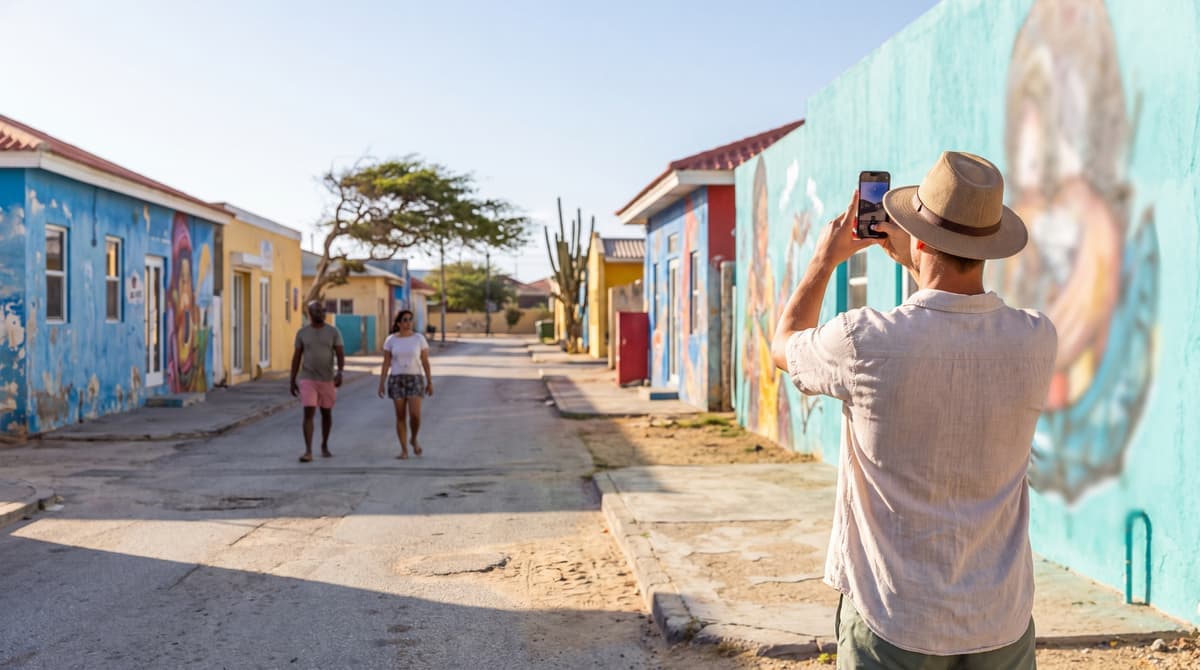
Aruba's second city, San Nicolas, has quietly turned itself into an open-air gallery, with dozens of large-scale murals, by some counts more than fifty, painted by local and international artists across a handful of walkable blocks near Main Street and the old bus terminal. A self-guided map is available free from the tourist information center on Main Street, and walking the core few blocks takes about an hour at an easy pace. Every bit of it is free, public, outdoor art.
The one honest thing to know: San Nicolas is a real, lived-in working town, not a staged attraction, so a few blocks look rougher than the postcard version of Oranjestad. Visit during daylight, as most people do, and it is one of the more rewarding free hours on the island.
Two Famous "Free" Spots That Actually Cost Money
Because the line between free and paid gets blurry fast on this island, two specific places deserve a direct correction before you plan a day around them.
Arikok National Park, home to the Natural Pool (Conchi), the Quadirikiri and Fontein caves, and Boca Prins, is not free. Entry requires a conservation pass, roughly $22 per adult as of 2026 (it has climbed from about $11 a few years back, so confirm the current rate before you go), purchased at either park entrance. Casibari, Ayo, and the Natural Bridge area, all covered above, sit outside the park's boundary entirely and charge nothing, which is exactly why first-time visitors mix them up. Our Arikok National Park guide covers the pass, the hours, and what is actually inside.
Flamingo Beach, the pink-sand beach on privately owned Renaissance Island that shows up in nearly every Aruba photo on social media, is also not free. It requires either a stay at the Renaissance hotel itself or a paid day pass (roughly $125 per guest as of 2026), released in a limited batch each week and often gone within the hour. Every other beach on this island is public. This one specific stretch of sand sits on a private island, and it is the single biggest "wait, that costs money?" surprise we hear from first-time visitors.
How to Actually Get to All of This
Most of what is on this list sits outside the hotel strip, spread across the island's interior and north coast, so a rental car genuinely opens up a free day in a way that staying put at the resort cannot. Casibari, Ayo, Alto Vista Chapel, the lighthouse, and the Natural Bridge area all fit into a reasonable loop by car in a single morning or afternoon. A taxi can get you to any one of these stops, but stacking several together by taxi gets expensive fast, which rather defeats the purpose. Our getting around Aruba guide walks through renting a car, taxi fares, and the bus system if a car is not part of your plan.
When You're Ready to Spend a Little
A full free day is a genuinely great way to spend one morning or afternoon of an Aruba trip, especially early in your stay while you are still getting oriented. But it is honestly not the whole trip for most visitors, and we would be doing you a disservice pretending otherwise. When you are ready to add a boat, a tour, or a proper excursion to the mix, our activities page lists what we actually vet and recommend, and what's on covers anything happening locally worth timing your visit around.
If you are still mapping out the rest of the week, our trip planning tool and interactive island map help put all of it, free and paid, onto one route, and our booking hub is the place to sort out a rental car once you decide you want one. Pair a free afternoon with an easy dinner afterward using our dining guide. And if the real goal is stretching a limited budget across a full week rather than just one free day, our broader budget travel guide and full vacation cost breakdown go deeper on where the real money goes, and where it genuinely does not have to.