We have stood under these trees on a hundred different afternoons, watched their branches lean the exact same way every single time, and answered the exact same question from a hundred different visitors: "why do all the trees here look like that?" It is one of the first things anyone notices on the drive out from the airport, and it turns out the honest answer is more interesting, and a little more surprising, than most postcards let on.
Meet the Watapana, Aruba's Official National Tree
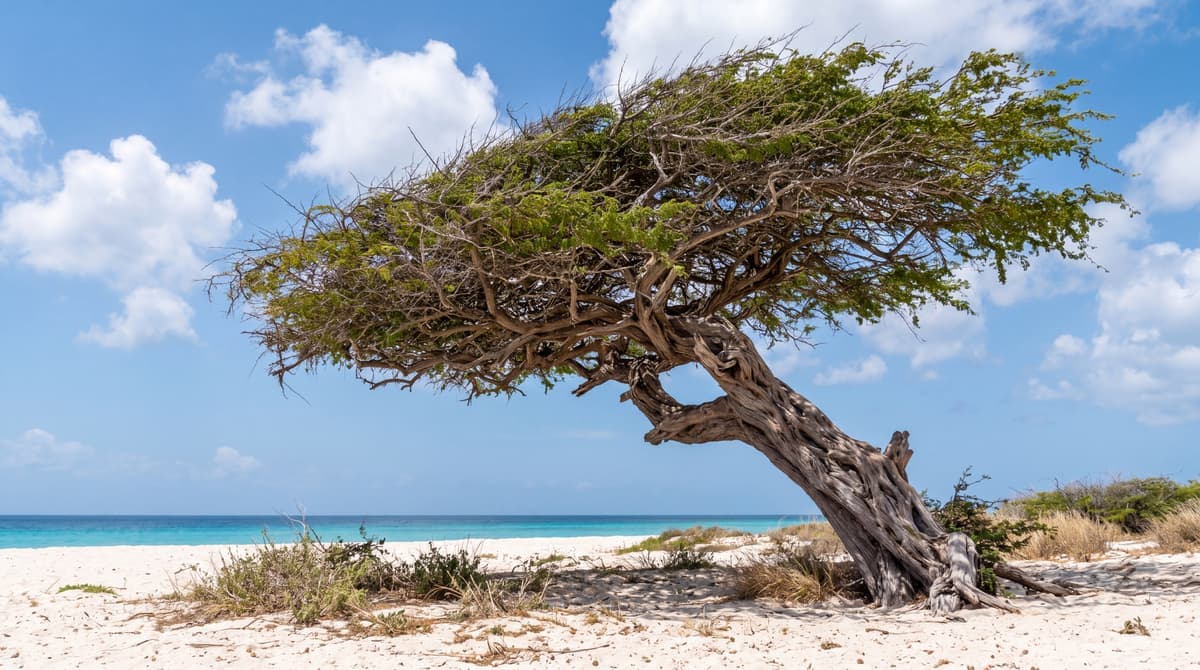
The tree everyone calls "divi-divi" is, technically, misnamed. Locally it is the watapana, and it is watapana that Aruba's Parliament decreed the island's official national tree, recognizing a plant that shaped both the landscape and, for a while, the local economy. Botanically it is classified as Caesalpinia coriaria, also referred to in scientific literature as Libidibia coriaria, and the name "divi-divi" actually belongs to the tree's twisted seed pods rather than the tree itself, a naming mix-up borrowed from an old Amerindian word that simply stuck. Aruba shares the honor with its sister islands: the watapana is recognized across all three of the Dutch Caribbean's ABC islands, Aruba, Bonaire, and Curacao, though nowhere does it feel more central to the identity of the place than here.
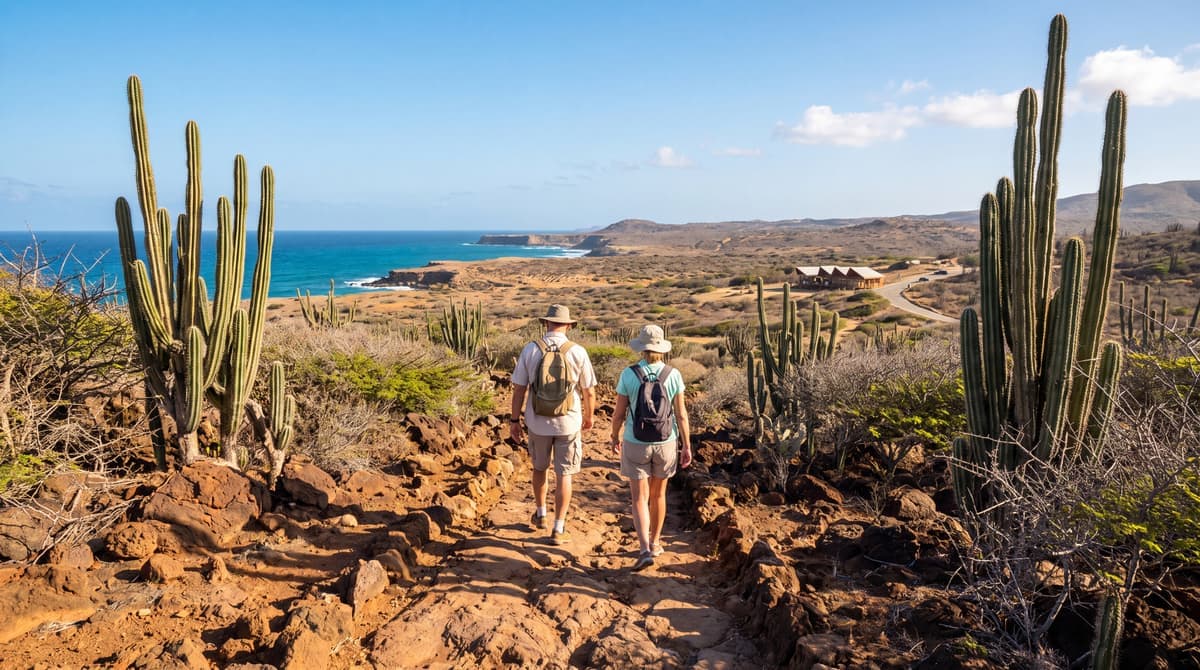
You will find true watapana trees scattered across Aruba's dry interior, not lining the beaches the way postcards suggest. They are a genuinely tough, drought-loving species, thriving in the same cactus-strewn, sun-baked soil that makes the island's landscape so distinct from the lush greenery of islands further south. If you are driving yourself around the island rather than sticking to the resort strip, you will pass dozens of them along inland roads, low, gnarled, wind-carved silhouettes standing alone in scrubland, which is exactly how the local team here likes to spot them, unplanned and unpolished. Unlike the towering imported palms planted around resort pools, a watapana rarely reads as tall or grand up close, its whole shape is horizontal effort rather than vertical height, all its energy visibly spent leaning away from the wind instead of growing up into it.
Morning yoga on Eagle Beach, booked direct
$30 per person, Tuesday and Friday mornings, all levels, and it closes with a short sound bath on the sand.
Why Every Tree on This Island Leans the Same Way
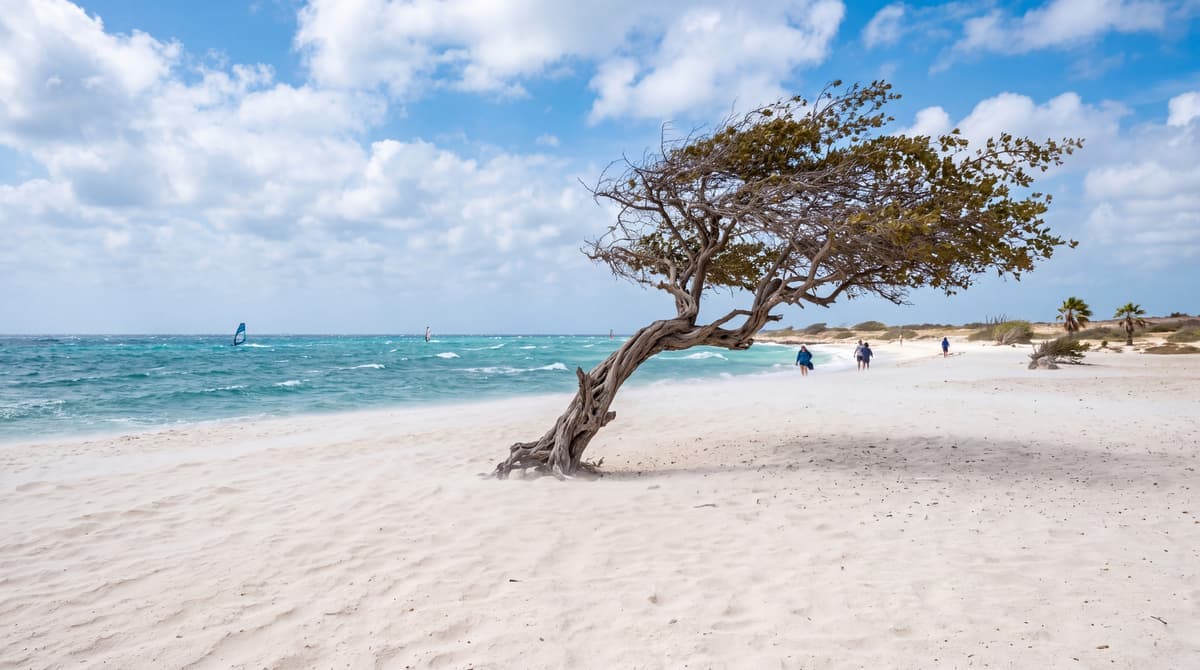
Aruba's trade winds are not an occasional weather event, they are close to a daily constant, blowing from the northeast to east-northeast at typically 15 to 22 mph, with gusts higher on breezier days (our full breakdown of just how windy Aruba really is covers the seasonal pattern in more depth). Over years and decades, that unbroken pressure trains a watapana's crown to grow away from the wind, so nearly every mature tree on the island ends up leaning toward the southwest, its branches swept back like hair caught mid-gust. Locals have long used this as a literal compass: follow the direction a watapana bends, and you are pointed roughly toward town. It is a small, practical piece of folk knowledge that doubles as one of the most photogenic facts about the island, and once you know it, you will find yourself checking the lean of every tree you pass for the rest of your trip.
The Honest Twist: Eagle Beach's Famous Trees Are Not Divi-Divi at All
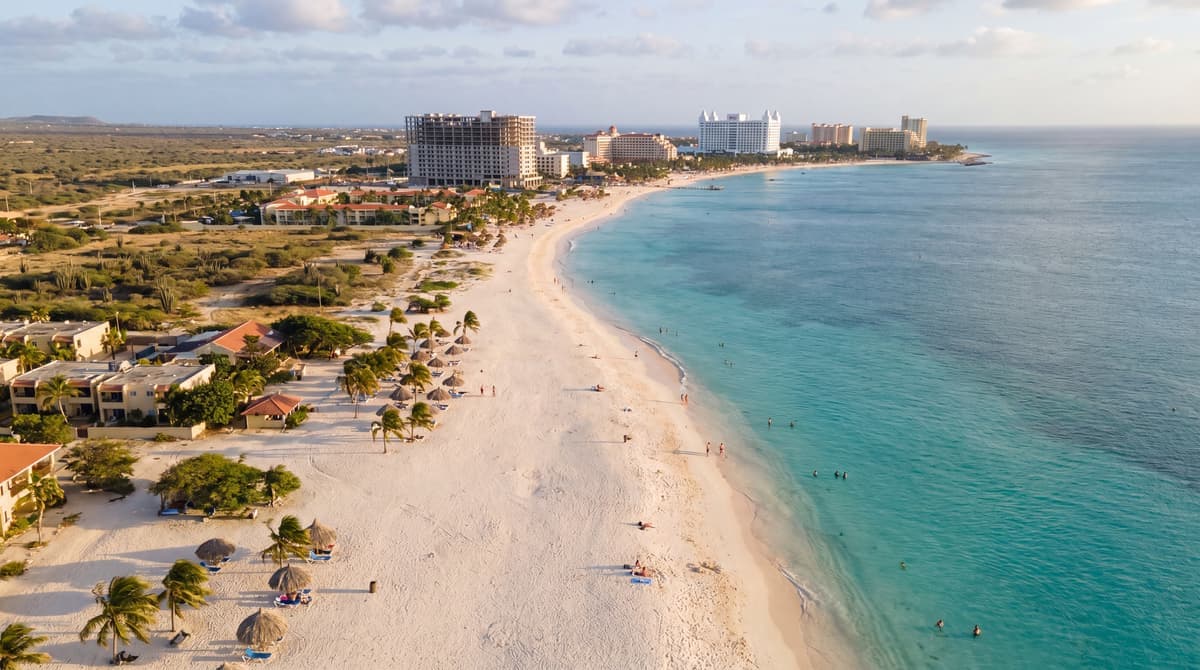
Here is the part almost nobody gets right, including plenty of travel guides that should know better. The two iconic, dramatically bent trees standing right at the waterline of Eagle Beach, the ones in front of the low-rise resort strip near Amsterdam Manor that show up in more Aruba photographs than perhaps any other single landmark on the island, are not divi-divi trees. They are fofoti trees, Conocarpus erectus, a member of the buttonwood mangrove family. Both species get bent into the same southwesterly lean by the same relentless trade winds, both have that unmistakable twisted, wind-sculpted silhouette, and both get called "divi-divi" by nearly every visitor who photographs them, which is exactly how the confusion took root and never let go.
The genuine differences are subtle from a distance but real up close: fofoti has thicker, grayer bark, evergreen leaves, and grows right at the coastline in salty conditions that would kill a true watapana, while the actual divi-divi favors dry inland ground well back from the beach. Because they are mangroves, the fofoti trees at Eagle Beach (along with the species generally, seen also around Malmok and Baby Beach) are protected under Aruban law, and signage near the Eagle Beach specimens specifically asks visitors not to climb them or hang bags, towels, or hammocks from their branches, a small courtesy that keeps the island's most photographed tree standing for the next arrival. We think it is worth knowing the difference before you post the photo, not because it makes the tree any less beautiful, but because the honest story is genuinely more interesting than the myth.
If you want to see how these famous leaning trees compare to the busier stretch up the coast, our Eagle Beach versus Palm Beach guide lays out exactly what each shoreline offers and why Eagle Beach earns its quieter, more photogenic reputation.
From Working Tree to Island Icon
Before the watapana became a tourist symbol, it was a working tree. Its curled seed pods are unusually rich in tannin, and for a stretch of the nineteenth and early twentieth centuries, harvested divi-divi pods were genuinely exported from Aruba to tanneries in Europe, used to process animal hides into leather. That trade faded once cheaper synthetic tanning agents arrived and made the natural export obsolete, but the tree's local uses did not disappear entirely, its leaves and bark still show up in traditional folk remedies on the island today. It is a fittingly practical origin story for a tree that has since become almost entirely ornamental in the public imagination, more photographed than harvested, more symbol than raw material.
Browse 32 vetted Aruba experiences
Most confirm instantly with free cancellation up to 24h, and 4 of them are free.
Where to Actually Find and Photograph One
If a true watapana is what you are after rather than a fofoti stand-in, look inland. Self-driving is genuinely the best way to spot them: they turn up along the roads through Aruba's arid interior, near the California Dunes and Malmok area, and scattered through the cactus-and-divi-divi scenery inside Arikok National Park, where the wind-bent silhouettes sit against a properly rugged, undeveloped backdrop.
For the postcard shot at Eagle Beach, honesty requires one caveat: those two trees are genuinely small, genuinely famous, and genuinely busy. Sunrise and the last hour before sunset are your best light and your best odds of a clear shot without a stranger's beach bag in frame, and our best sunset spots guide can help you plan the timing. If you would rather have a professional handle the framing, lighting, and crowd-dodging entirely, a golden-hour sunset photoshoot with a local photographer takes that pressure off completely.
Hunting for a genuine, uncrowded watapana is also a nice, free addition to a longer self-drive day rather than a destination on its own. Nobody plans a whole afternoon around one tree, but nearly everyone who drives the interior ends up pulling over for a photo anyway, precisely because the real ones look nothing like the polished version most people expect.
Our Verdict
The watapana deserves its place as Aruba's national symbol, not because it is the flashiest thing on the island, but because it tells you something true about the place: shaped by relentless wind, built for a dry climate, and quietly useful before it ever became photogenic. Skip the assumption that every leaning tree you see is the "famous" one, learn to spot a real watapana on a drive inland, and give the Eagle Beach fofoti the respectful distance its protected status asks for. From there, our trip planner can help you string the rest of the island's beaches and landmarks into a trip built around your own pace.