Straight answer first. If money is no object and your entire vacation is one flawless beach, Turks and Caicos is probably the better pick, because Grace Bay is arguably the single best beach in the Caribbean and we are not going to pretend Eagle Beach beats it. For almost everyone else, Aruba delivers comparable five-star quality for roughly 30 to 40 percent less, with more restaurants, more nightlife, more to do, and no hurricane belt anxiety. This is a comparison between perfection and value, and your budget decides it more than we ever could.
We plan trips on Aruba for a living, so weigh our perspective accordingly. But Turks and Caicos comes up constantly with honeymooners and beach perfectionists, and it deserves a fair hearing. Here it is.
Aruba vs Turks and Caicos at a glance
| Turks and Caicos | Aruba | |
|---|---|---|
| Flight from NYC | About 3 hr 15 min to 3 hr 41 min nonstop | About 5 hr nonstop |
| Published daily cost | Around $379 per person, but realistic hotel floor is $400 to $500+ per night | Around $369 per person, real budget and mid-range tiers exist |
| Hurricane risk | Inside the belt, peak impacts late August to mid September | Outside the belt, no hurricane landfall on record in 168 years |
| US travel advisory | Level 2 (March 4, 2025), strict firearms and ammunition laws | Level 1 (reissued August 19, 2024) |
| Signature beach | Grace Bay | Eagle Beach |
| Vibe | Quiet, couples, villas, early nights | Beaches plus dining, casinos, nightlife, exploring |
Renting a car? Compare every Aruba agency
One search across the island rental companies, free cancellation on most cars, no card to reserve.
Getting there
Turks and Caicos wins this category, and not by a little.
New York to Providenciales runs about 3 hours 15 minutes to 3 hours 41 minutes nonstop on JetBlue, Delta, and American, with service running around three times weekly as of May 2026 and American adding another nonstop in November 2026. From Miami it is barely 2 hours on American, with two to three flights daily. We have seen New York roundtrip deals from $180 to $278 on Delta, with typical fares around $377 to $497.
Aruba from New York is about 5 hours nonstop, with 2026 deal fares of $339 to $353 and typical fares around $339 to $601. So Turks and Caicos is both closer and, on deal fares, sometimes cheaper to reach.
Two logistics notes. First, Turks and Caicos is a British Overseas Territory, so US citizens need a passport, same as Aruba (where you will also complete the online ED card and pay the roughly $20 sustainability fee). Second, Aruba claws some advantage back at the end of the trip: its airport has US preclearance, so you clear customs before boarding and land back in the States as a domestic passenger.
What it costs
Here is where the islands separate dramatically, and where most travelers make their decision.
The published traveler-spend averages look deceptively close: around $379 a day for Turks and Caicos versus around $369 for Aruba. Ignore that similarity, because the averages hide completely different markets. The published budget figure for Turks and Caicos, around $164 a day, is frankly implausible for what is actually bookable on the ground, and a published one-week figure runs around $2,653 per person.
The on-the-ground reality on Providenciales: there is effectively no budget tier. The practical floor for a Grace Bay area hotel is $400 to $500+ a night. Grace Bay Club starts around $866 a night, and the average five-star rate on Provo runs around $1,757 a night. There is no equivalent of Aruba's $150-a-night guesthouse in Noord or its mid-range Eagle Beach low-rises. You pay resort prices or you do not really go.
Aruba, by contrast, runs the full range: real budget stays around the published $157-a-day level, a deep mid-range, and a luxury tier around $780 a day for those who want it. Comparison sites consistently put Aruba 30 to 40 percent cheaper than Turks and Caicos for comparable quality, and that matches what we see travelers actually spend. Our Aruba vacation cost guide has the full 2026 breakdown by category.
If you have the budget and want the splurge, Turks and Caicos delivers genuine ultra-luxury. If you want five-star sand without a five-star invoice, Aruba is the value play.
One piece of budgeting advice we give everyone weighing these two: price the entire week both ways before you fall in love with either. Build the Turks and Caicos version with the real room rate, the resort dining you will actually eat, and travel insurance if you are anywhere near the fall window. Build the Aruba version with a mid-range room from the hotel listings, a rental car, restaurant dinners, and a couple of booked tours. Most travelers discover the honest gap between the finished numbers is larger than they guessed, and a meaningful number discover the opposite, that the Provo splurge is closer to reach than they assumed if they shorten the trip by a night or two. Either way, deciding on total trip cost beats deciding on a nightly rate every time.
Want a local to plan the whole trip?
Our concierge builds your days around what you actually want, from $149. Real people who live in Aruba.
Weather and the hurricane reality
Turks and Caicos sits inside the Atlantic hurricane belt, with peak impact risk running late August to mid September. Annual rainfall varies by island from roughly 21 to 40 inches, so it is a dry, sunny destination most of the year, drier than most of the Caribbean. But a September booking carries real storm risk, and travel insurance is not optional money in that window.
Aruba sits outside the belt entirely, about 12 degrees north, with no hurricane landfall on record in 168 years of NOAA data, around 15 to 18 inches of rain a year, and steady 81 to 88°F temperatures. You can book any week of the year with confidence, which matters enormously if your only vacation window falls in storm season. Our best time to visit Aruba guide covers the month-by-month picture.
Day to day, both islands are sunny, warm, and dry by Caribbean standards. The difference is tail risk: Aruba has essentially none, Turks and Caicos has the normal hurricane belt share.
The beaches
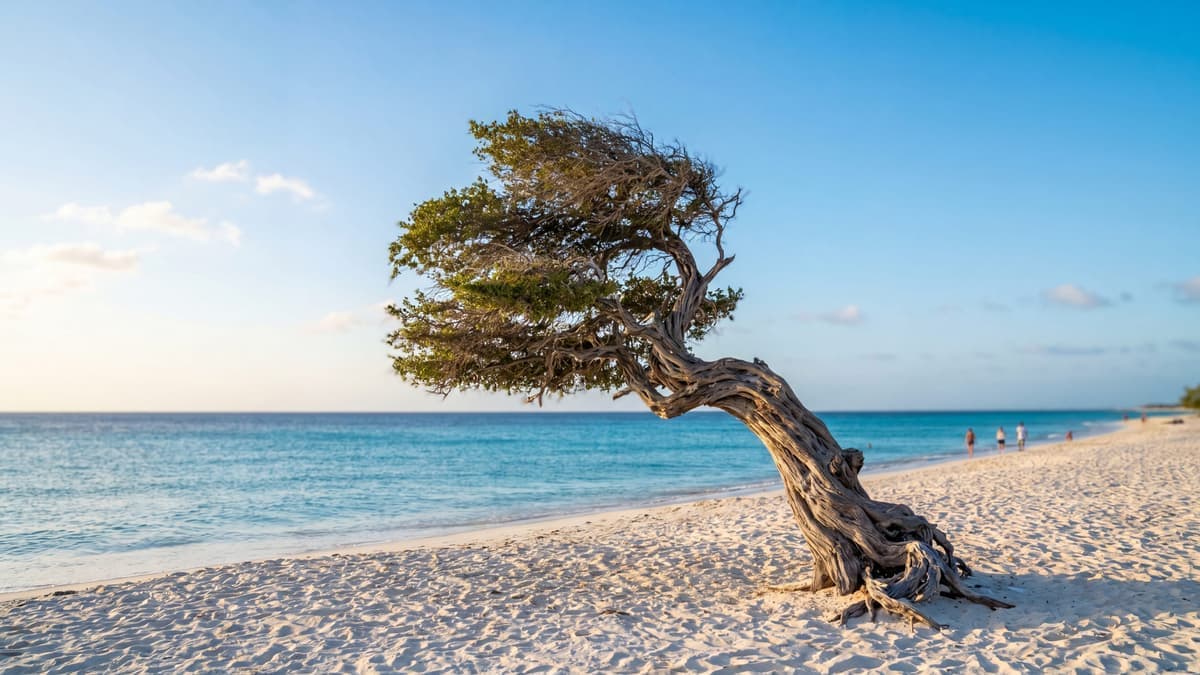
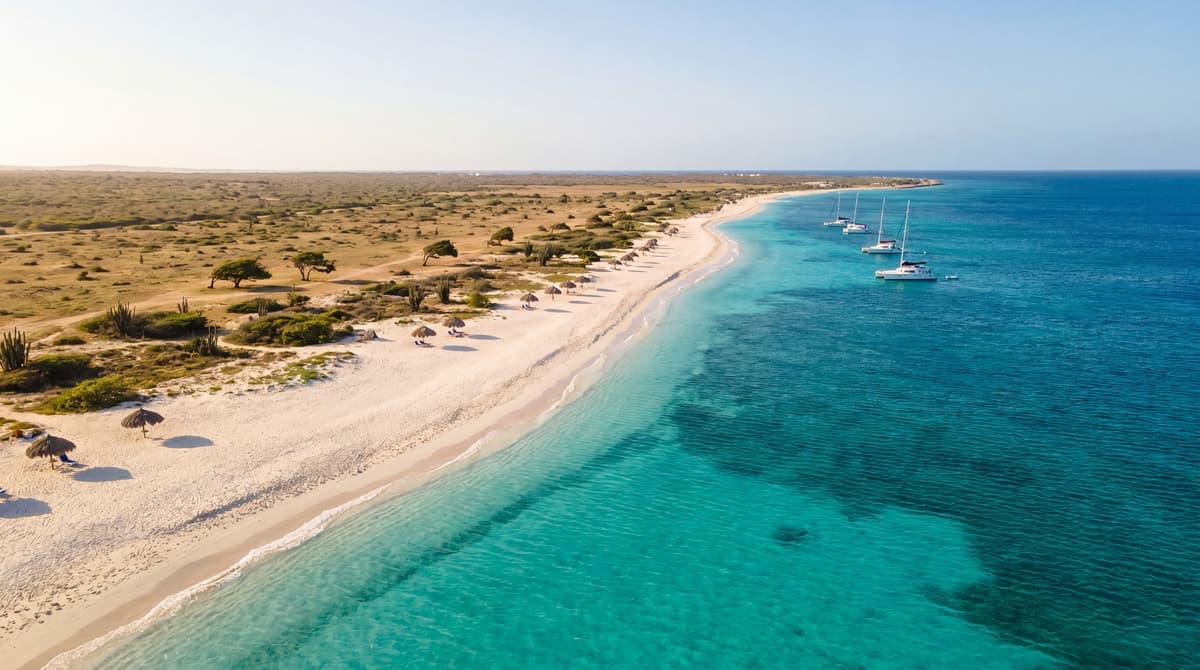
Time to concede the headline point. Grace Bay is routinely ranked among the best beaches in the world, and the ranking is deserved. The water clarity is extreme, the sand is impossibly soft, Bight Reef sits a short paddle offshore for snorkeling straight from the sand, and the wall diving off the islands is world class. In winter, humpback whales pass through the Columbus Passage. As a single stretch of beach and water, we think Grace Bay edges out anything on Aruba, including Eagle Beach. There, we said it.
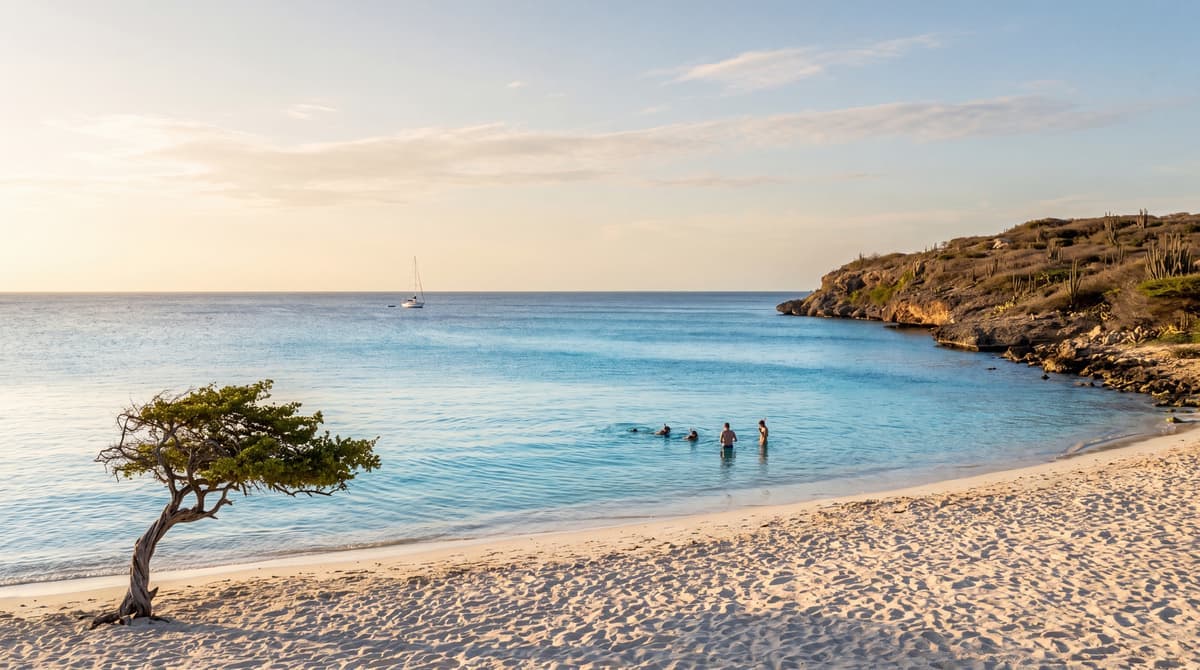
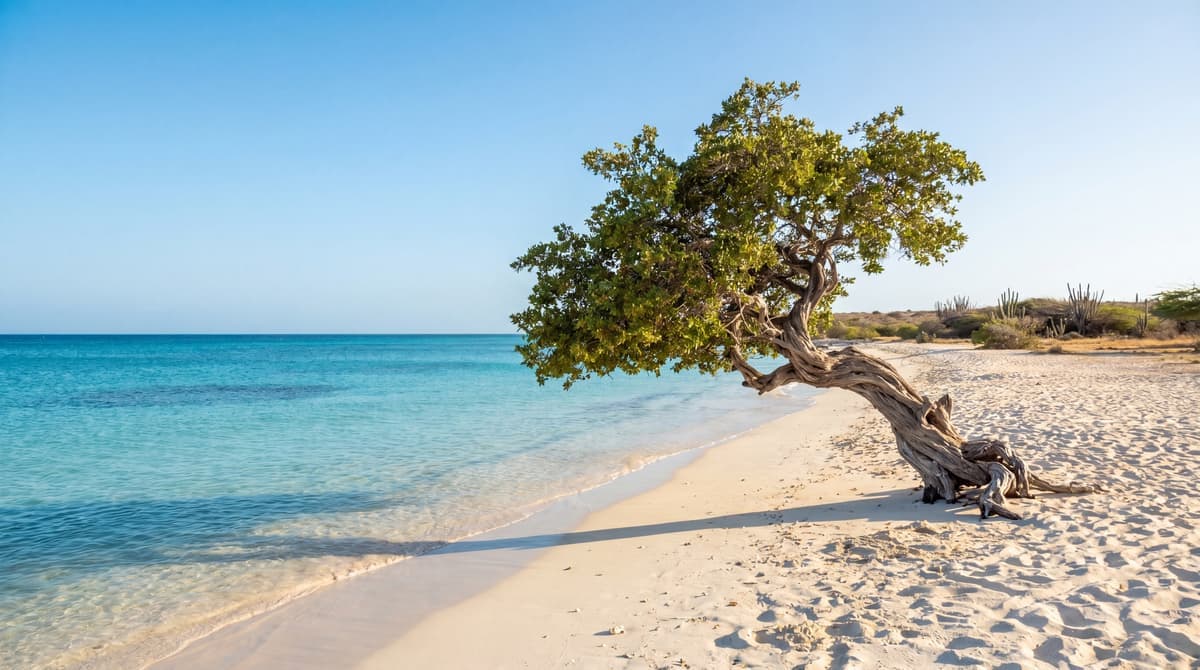
What Aruba offers instead is a portfolio. Eagle Beach took the number 3 spot in TripAdvisor's 2026 Travelers' Choice Caribbean rankings, and behind it sit Palm Beach, Arashi, Boca Catalina, Baby Beach, and a dozen others, all on a reliably calm leeward coast, all free, all reachable in a 20-minute drive. The Aruba beach experience is variety plus certainty: a different beach every day, calm swimmable water at every one of them. See the full lineup in our beaches guide.
So the honest framing: best single beach, Turks and Caicos. Best beach week, it depends on how much you value variety over perfection.
Let us plan this trip for you
We live in Aruba and vet every spot ourselves, share your dates and we'll build the rest.
Things to do and the vibe
This category is not close, and which island wins depends entirely on who you are.
Turks and Caicos is quiet. Deliberately, expensively quiet. It is a couples and honeymoon destination built around villas, spas, long beach days, and early dinners. Nightlife is minimal, there is no casino culture, and after about 10pm Grace Bay is essentially asleep. Getting beyond Providenciales to the other islands means boats or small prop planes. If serenity is the product you are buying, this is a feature, and Turks and Caicos sells it better than almost anywhere.
Aruba is a fuller-service island. The beach days are just as good, but around them sit a real dining scene from fresh-fish shacks in Savaneta to fine dining in Oranjestad, a dozen casinos, beach bars with live music, 4x4 trails through Arikok National Park, the Natural Pool, snorkeling the Antilla wreck, San Nicolas street art, and the kind of rentable, drivable island where a 7-day itinerary fills itself. Browse the options on our activities page.
Families, groups, and anyone who gets restless by day three will be happier on Aruba. Couples who want the world to go away will be happier on Grace Bay.
Where to stay
On Providenciales, almost everything that matters sits along or near the Grace Bay strip: a line of low-rise luxury resorts and condo-style suites facing the famous water, plus a deep villa market for groups and families who want kitchens and privacy. The quality level is uniformly high, which is exactly the problem for budget planning, since the market simply does not offer a meaningful tier below it. There is no hostel scene, no cheap guesthouse zone, no aging three-star strip. When we said the practical floor is $400 to $500+ a night, that is not the compromise option, that is the entry point. Villas can beat hotel math for groups of six or more, but they require booking far ahead and usually a rental car.
Aruba's market runs the full keyboard. Palm Beach is the high-rise strip with the casinos and walkable dining. Eagle Beach is the quieter low-rise zone fronting the island's best sand. The Renaissance in downtown Oranjestad comes with its private island and resident flamingos. And below all of that sits a real budget layer: guesthouses and vacation rentals in Noord with kitchens, at prices that simply have no Provo equivalent. Add the 30 to 40 percent rate drop in the September to November value season and the same total budget buys either five nights on Grace Bay or two full weeks on Aruba. That is not an exaggeration, that is the math.
Browse 33 vetted Aruba experiences
Most confirm instantly with free cancellation up to 24h, and 4 of them are free.
The free 7-day itinerary
The exact 7 days we send friends
One email with our day-by-day Aruba plan: which beach on which day, where to eat, and the tours worth booking. No spam, unsubscribe anytime.
Evenings and food
Here is the part of the Turks and Caicos experience that surprises unprepared visitors: the island goes quiet early. Dinner at seven, a walk on the beach, and by ten the strip is essentially done. The restaurants are good, conch in every preparation, fresh grouper, polished resort dining rooms, but they are few, they are resort-priced, and they are the whole evening economy. There is no casino floor, no bar-hopping circuit, no late music scene to speak of. For honeymooners this is the entire point. For a group of friends or a multigenerational family trip, it can feel like the island closes before you do.
Aruba runs a full second shift. The independent restaurant scene spans waterside fish shacks in Savaneta to fine dining in Oranjestad, see our dining guide for the spread, and after dinner there are a dozen casinos, beach bars with live music, and a strip that stays awake. Nobody confuses Palm Beach with Las Vegas, but the difference between Aruba at 11pm and Grace Bay at 11pm is the difference between an island with an evening and an island without one.
When to go
The calendar splits these islands cleanly. Turks and Caicos is at its best in winter and spring: dry, breezy, and busy, with humpback whales moving through the Columbus Passage in the winter season as a genuine bonus for divers and boat trips. The window to respect is late August to mid September, the peak of its hurricane exposure, when a nonrefundable booking is a real gamble and insurance is mandatory money.
Aruba has no equivalent bad month. The forecast barely moves all year, so the only real question is price: peak rates December through April, and the 30 to 40 percent value window September through November, which happens to sit exactly on top of the weeks when Turks and Caicos is riskiest. Fall travelers are not really choosing between equal options; they are choosing between Aruba at its cheapest and Grace Bay at its most weather-exposed. Our best time to visit Aruba guide has the month-by-month detail.
Find your hotel by month, beach & budget
Compare current Aruba rates across the major booking sites in one place, in USD. Most rooms are free to cancel.
Who we would honestly send where
After enough of these conversations, the patterns are clear, so here is our honest sorting.
Honeymooners with a healthy budget: Turks and Caicos, no hesitation. The combination of that water, the villa and suite quality, and the engineered serenity is what a honeymoon is for, and Grace Bay does it better than Aruba does.
Divers and snorkel obsessives: also Turks and Caicos. Bight Reef snorkeling straight off the sand and world-class wall diving beat anything in Aruba's water, where the Antilla wreck is the headline act.
Families with kids, groups of friends, and multigenerational trips: Aruba. More room types, more price points, more restaurants, more for teenagers to do after dark, and calm water at a dozen different beaches instead of one.
Value-driven beach perfectionists: Aruba, especially in the fall window, where five-star-adjacent quality costs 30 to 40 percent less and the weather risk rounds to zero.
Anyone booking late August to mid September: Aruba, full stop, for the hurricane math alone.
Safety, including the warning you must not skip
Aruba carries a US State Department Level 1 advisory (Exercise Normal Precautions), reissued August 19, 2024, the lowest tier issued. Independent exploring is the default way to visit. Full details in our is Aruba safe guide.
Turks and Caicos carries a Level 2 advisory (Exercise Increased Caution), issued March 4, 2025. Day-to-day tourist crime exposure on Provo is low. But the advisory contains one item every single visitor needs to take seriously: firearms and ammunition, including stray loose rounds, are illegal in Turks and Caicos, with sentences of up to 12 years. This is not theoretical. Multiple US citizens have been detained and prosecuted over forgotten bullets found in luggage, hunting bags, and backpacks at the airport. If you own firearms at home, vacuum your bags, check every pocket, and check again. A forgotten round that TSA missed on the way out can become a life-altering legal nightmare on arrival in Providenciales. We cannot flag this strongly enough.
Renting a car? Compare every Aruba agency
One search across the island rental companies, free cancellation on most cars, no card to reserve.
A week on each island, sketched honestly
Picture the same seven days on each island, because the daily texture is where these trips really diverge.
The Grace Bay week: wake to that absurd turquoise, long beach mornings, a paddle out to Bight Reef with a snorkel, lunch at the resort, an afternoon boat trip or a spa hour, dinner at seven, asleep by ten thirty, repeat. By day four you have surrendered to the rhythm completely, which is the entire product. The variations are a half-day excursion to a sandbar, a dive day on the wall, in winter maybe humpbacks from the boat. It is one perfect note, held for a week, at a price that reflects how few places on earth can hold it.
The Aruba week: a different beach most mornings, Eagle, then Arashi, then Baby Beach in the southeast, a catamaran sail over the Antilla wreck one day, a 4x4 morning through Arikok to the Natural Pool another, afternoons split between pool and sand, then a different restaurant every night and a casino or beach bar after. Our 7-day itinerary maps the full version. It is six or seven different notes, none quite as pure as Grace Bay's one, all of them good.
The sketch also explains the budgets. The Turks and Caicos week concentrates spending into the resort, which is why the room rate is nearly the whole cost of the trip. The Aruba week spreads it across restaurants, tours, and a rental car, which is why the room can cost half as much while the week stays full. Travelers who try to do an Aruba-style week on Provo run into thin options; travelers who try a Grace Bay-style cocoon week on Aruba overpay for stillness they could get cheaper. Match the island to the week you actually want.
The verdict
Pick Turks and Caicos if: budget is not the deciding factor, you want the single best beach in the Caribbean, your ideal evening is a quiet dinner and an early night, you are honeymooning or celebrating something, the shorter flight matters, and you are traveling outside peak hurricane months. It is a spectacular, serene, premium product, and nothing on Aruba replicates the Grace Bay water.
Pick Aruba if: you want 80 to 90 percent of that beach quality at 30 to 40 percent less cost, you like restaurants, bars, casinos, and things to do after sunset, you want a real choice of budget levels, you are booking during hurricane season and want certainty, and you prefer an island you can explore freely with a Level 1 advisory and no firearms law landmines at the airport.
If you are still shortlisting, our Aruba vs Bahamas comparison covers the other big beach-first rival, and Aruba vs Curacao covers the Dutch Caribbean sibling question. Leaning Aruba? Tell us your dates and budget on the trip planner and we will show you exactly what your Turks and Caicos budget buys here instead.