This is the closest call in our comparison series, so here is the honest verdict up front. St Maarten and Aruba are near twins on paper: both Dutch Caribbean, almost identical flight times from New York (about 4 hours 11 minutes versus about 5 hours), and almost identical published daily costs (around $391 versus $369 per person). St Maarten wins on variety, two countries on one island, a genuinely famous food scene, and easy ferry day trips to Anguilla and St Barts. Aruba wins on certainty, calmer swimming beaches and a location outside the hurricane belt that St Maarten, hit head-on by Irma in 2017, can never offer. Pick by trip style, not by quality, because both islands deliver.
We are the Aruba team here, so you know our bias. But St Maarten is the comparison where the other island's wins are easiest to name, so this one stays especially honest. Here is the full breakdown.
Aruba vs St Maarten at a glance
| St Maarten | Aruba | |
|---|---|---|
| Flight from NYC | About 4 hr 11 min nonstop, 46 weekly NYC flights | About 5 hr nonstop |
| Published daily cost | Around $391 per person (Dutch side average) | Around $369 per person |
| Hurricane risk | Inside the belt, took Category 5 Irma head-on in 2017 | Outside the belt, no hurricane landfall on record in 168 years |
| US travel advisory | Level 1, Dutch side (August 19, 2024) | Level 1 (reissued August 19, 2024) |
| Signature beach | Maho (plane spotting), Orient Bay | Eagle Beach |
| Vibe | Two countries, food scene, day trips, cruise port energy | Calm seas, casinos, independent exploring, weather certainty |
Renting a car? Compare every Aruba agency
One search across the island rental companies, free cancellation on most cars, no card to reserve.
Getting there
Dead heat, with a slight edge to St Maarten on raw numbers.
New York to St Maarten runs about 4 hours 11 minutes nonstop, and the route is extremely well served: JetBlue alone flies it 15 times a week, with Delta, United, and American bringing the New York total to around 46 weekly flights. Roundtrips from New York run about $293 to $544, with deals around $360. From Miami it is about 3 hours on American, roughly 17 times a week.
New York to Aruba is about 5 hours nonstop on the same four carriers, with 2026 deals at $339 to $353 and typical fares around $339 to $601. Miami to Aruba is about 3 hours 20 minutes.
So: 49 minutes shorter to St Maarten, similar fares, similar frequency. Aruba's counterpunch is US preclearance, clearing US customs before you board the flight home, plus the small admin of its online ED card and roughly $20 sustainability fee. St Maarten arrival has its own spectacle: your plane crosses Maho Beach meters above the sunbathers, which is either a thrill or a warning depending on your temperament.
What it costs
Nearly identical, with interesting differences in where the money goes.
Published traveler-spend averages put the Dutch side (Sint Maarten) around $391 per person per day and the French side (Saint Martin) around $392, against Aruba's roughly $369. A published one-week St Maarten figure runs about $2,737 per person. On the medians, Aruba is slightly cheaper, but this is a rounding-error gap, not a decision driver.
Where St Maarten genuinely outpunches its price tag is food and shopping. Grand Case on the French side is often called the gourmet capital of the Caribbean, and the open secret is that you do not need fine-dining money to eat there: Creole and French meals in the $15 to $25 range are normal at the lolos and casual spots. Philipsburg is a major duty-free port, and serious shoppers can claw back real money on jewelry, electronics, and liquor.
Aruba's money story is the value season: rates drop 30 to 40 percent from September through November, which happens to be exactly when St Maarten carries its highest hurricane risk. That timing asymmetry matters more than the $20-a-day median gap. Full numbers in our Aruba vacation cost guide.
Want a local to plan the whole trip?
Our concierge builds your days around what you actually want, from $149. Real people who live in Aruba.
Weather and the hurricane reality
Here is the category that separates the twins, and we will state it carefully because it involves a real disaster and a real recovery.
St Maarten sits inside the hurricane belt. On September 6, 2017, Hurricane Irma hit the island as a Category 5 and damaged around 90 percent of its infrastructure. The recovery was long and internationally funded, and the trust fund backed by the Netherlands and the World Bank runs through 2028. The official recovery program reports the largest part of the damage repaired and built back improved, and the honest on-the-ground summary in 2026 is that the island is fully open, rebuilt, and functioning as a major tourism destination. Visiting St Maarten today is not visiting a disaster zone, and nobody should treat it as one.
But Irma is also not ancient history. It is what being inside the hurricane belt means when the odds go wrong, and any August-to-October St Maarten booking carries that tail risk and should carry travel insurance with it.
Aruba sits outside the belt, about 12 degrees north, with no hurricane landfall on record in 168 years of NOAA data, roughly 15 to 18 inches of rain a year, and 81 to 88°F temperatures with constant trade winds. You can book Aruba for the first week of September with essentially the same confidence as the first week of February, and that booking confidence is, frankly, Aruba's single biggest structural advantage over its sister island. Our best time to visit Aruba guide covers the calendar in detail.
The beaches
Different strengths, and a clear answer depending on what you want from the water.
St Maarten's beaches are more varied and more famous as scenes. Maho Beach is a global bucket-list item, with jets landing meters overhead on approach to the airport, still going strong in 2026. Orient Bay on the French side, sometimes called the St. Tropez of the Caribbean, runs beach clubs, water sports, and a lively, social shoreline. Mullet Bay and Simpson Bay round out a coastline with real range. The trade-off is that conditions vary more: some beaches are calm, others catch swell, and the swimming experience depends on which coast and which day.
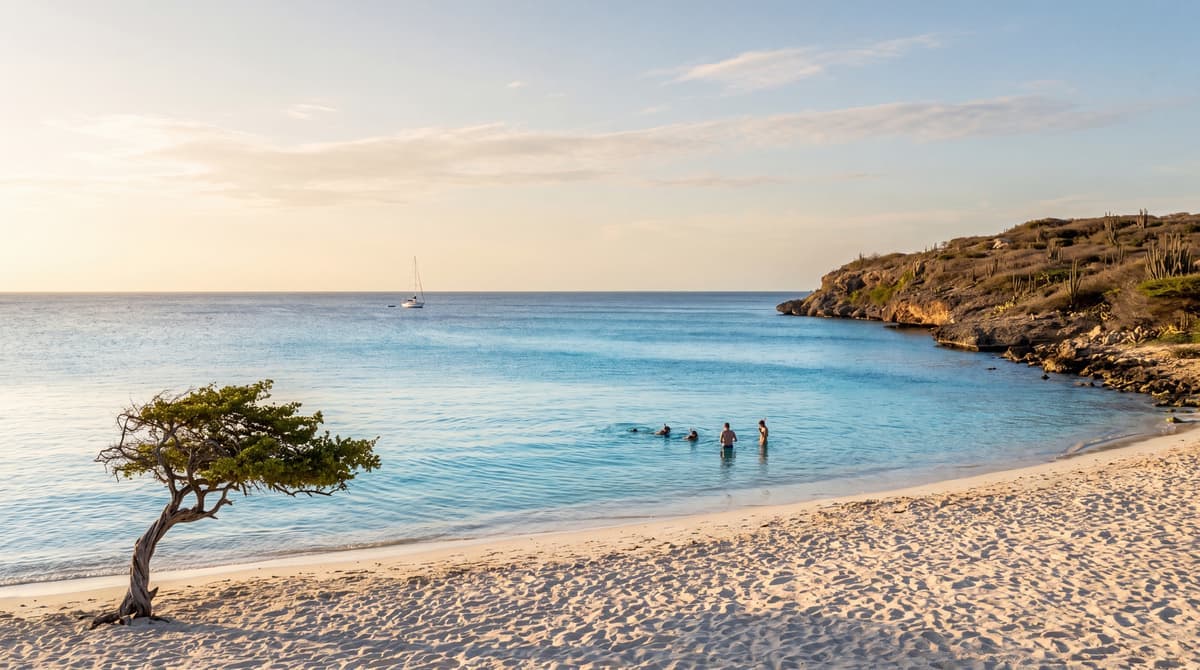
Aruba's west coast is the consistency champion. Eagle Beach took the number 3 spot in TripAdvisor's 2026 Travelers' Choice Caribbean rankings, and along with Palm Beach, Arashi, and Baby Beach it offers calm, clear, reliably swimmable water essentially every day of the year. Less spectacle, more certainty, and for families with small kids or anyone who plans to be in the water daily, that certainty is the whole game. Full coastline rundown in our beaches guide.
Spectacle and variety: St Maarten. Day-after-day swimming: Aruba.
Let us plan this trip for you
We live in Aruba and vet every spot ourselves, share your dates and we'll build the rest.
Things to do and the vibe
St Maarten's pitch is genuinely unique in the Caribbean: two countries on one 34-square-mile island. The Dutch side brings nightlife, casinos, Philipsburg's duty-free strip, and the airport; the French side brings Grand Case dining, quieter beaches, and a completely different rhythm, with an open border between them. You can have breakfast in the Netherlands and lunch in France without showing a passport. The island is compact enough that no two points are more than about a half-hour drive apart, so the two-countries novelty is not a logistical burden, it is just the texture of an ordinary day there: Dutch guilders of history on one side, baguettes and French road signs on the other, and a rental car that crosses between them without slowing down.
Then there are the day trips, and this is a category Aruba simply cannot match. The Anguilla ferry from Marigot takes 20 to 25 minutes and lands you on some of the finest quiet sand in the region. Fast catamarans reach St Barts in about 45 minutes, with around 13 daily departures. Saba is reachable too. St Maarten is effectively a base camp for four islands, plus a major cruise port in Philipsburg with all the energy (and ship-day crowds) that brings.
Aruba's answer is depth on a single island: the Antilla shipwreck snorkel, 4x4 days through Arikok National Park to the Natural Pool, San Nicolas street art, sunset catamarans, a dozen casinos, and an independent dining scene from Savaneta fish shacks to Oranjestad fine dining. It is the easier island to explore by rental car, and the one where a single week feels complete without ever boarding a boat to somewhere else. Browse our activities page and the 7-day itinerary to see the shape of the week.
If collecting islands and cuisines is the dream, St Maarten wins. If settling into one easy island is the dream, Aruba wins.
Where to stay
St Maarten's neighborhoods map onto its split personality. Simpson Bay on the Dutch side is the practical favorite: close to the airport, packed with restaurants and bars, with a lagoon full of boats and a beach of its own. Philipsburg is the cruise and duty-free hub, busy by day and best visited rather than slept in. Orient Bay on the French side is the beach-club base, with that social, water-sports shoreline at the door. And Grand Case is the food pilgrimage address, a small village where the point of staying is walking to dinner. Splitting a week between a Dutch-side and a French-side base is a popular play and genuinely feels like two vacations.
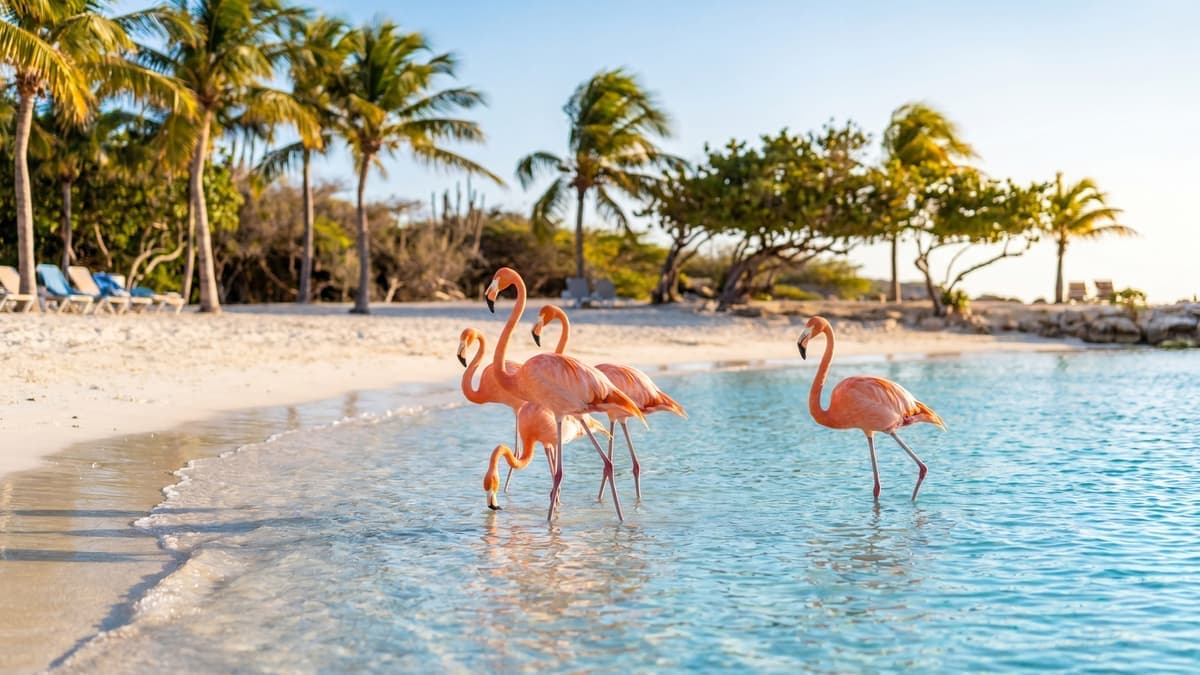
Aruba's bases are simpler and we have covered them across this series: Palm Beach for the walkable high-rise strip with the casinos, Eagle Beach for quiet low-rises on the island's best sand, Noord vacation rentals with kitchens for the budget play, and the Renaissance in Oranjestad for its private flamingo island. The structural advantage is the value season: Aruba rates drop 30 to 40 percent from September through November, and as we keep noting, those are exactly the weeks a St Maarten booking carries its heaviest storm risk.
Browse 33 vetted Aruba experiences
Most confirm instantly with free cancellation up to 24h, and 4 of them are free.
The free 7-day itinerary
The exact 7 days we send friends
One email with our day-by-day Aruba plan: which beach on which day, where to eat, and the tours worth booking. No spam, unsubscribe anytime.
The food, the clearest St Maarten win
Let us hand this category over properly. Grand Case has earned its reputation as the gourmet capital of the Caribbean: one beachfront village street lined with serious French kitchens, and alongside them the lolos, open-air barbecue joints where Creole ribs, fresh snapper, and johnnycakes land in the $15 to $25 range. The combination of genuine French technique and cheap Creole barbecue in one walkable strip exists nowhere else in the region, and food-driven travelers should weight it heavily. The Dutch side adds its own busy restaurant rows around Simpson Bay, and duty-free Philipsburg keeps the wine cheap.
Aruba's reply is depth rather than a crown jewel: a real independent dining culture, fresh-off-the-boat fish at the Savaneta waterside shacks, solid steakhouses and beachfront fine dining across Palm Beach and Oranjestad, every bit of it a short drive from any hotel. See our dining guide for the highlights. We will happily argue Aruba feeds you well for a week. We will not argue it out-cooks Grand Case.
Cruise days and crowds
Both islands are major cruise ports, and it shapes the rhythm of a stay more than brochures admit. Philipsburg is one of the busiest stops in the eastern Caribbean, and on multi-ship days the duty-free strip, the beaches nearest the pier, and the popular excursions fill up fast; savvy visitors check the ship schedule and aim Maho, Orient, or the French side on the heavy days. Oranjestad takes ships too, but Aruba's main hotel beaches sit a few miles north of the pier, so the day-tripper wave mostly stays downtown and the Palm and Eagle Beach rhythm barely changes. Neither island is spoiled by ships; St Maarten just asks for slightly more scheduling awareness.
The same scheduling logic applies to the famous day trips, by the way. The Anguilla ferry and the St Barts catamarans are weather-dependent, and a windy day can churn the crossing enough that casual boaters sit it out, so build the day trips into the front half of your week and keep a flexible day in reserve rather than betting your last morning on a smooth sea. On Aruba, by contrast, a backup beach day is as simple as driving 20 minutes to Baby Beach on the sheltered south coast. None of this is a reason to skip them, the crossings run reliably most of the year, but trips built on boats need slack in the schedule, and that is one more small tax on St Maarten's variety that Aruba's drive-everywhere model never charges.
Find your hotel by month, beach & budget
Compare current Aruba rates across the major booking sites in one place, in USD. Most rooms are free to cancel.
When to go
The calendars are the quiet decider here. St Maarten is at its best from winter through late spring: dry, breezy, every ferry running, Grand Case in full swing. Its riskiest stretch is the heart of hurricane season, August through October, when the Irma history we covered above stops being trivia and becomes a reason to buy insurance and book refundable.
Aruba's calendar is flat by comparison: the same 81 to 88°F forecast nearly every week of the year, around 15 to 18 inches of rain annually, and a price curve as the only real season, peak December through April, value September through November. The practical upshot for twins this close: for a winter or spring trip, choose on style and either island rewards you; for a late-summer or fall trip, Aruba is both the cheaper and the dramatically safer bet, and that asymmetry is the most decision-relevant fact in this whole comparison.
Safety
Good news on both sides of this comparison. Sint Maarten (the Dutch side) carries a US State Department Level 1 advisory (Exercise Normal Precautions), issued August 19, 2024, with routine notes about pickpocketing and bag snatching, the standard advice anywhere tourists gather. Aruba carries the same Level 1 tier, reissued the same date. Both are among the most relaxed advisories in the region, and neither island requires the zone-awareness that some Caribbean destinations do. Aruba adds the small comforts of universally accepted US dollars, drinkable tap water, and that preclearance airport. Our is Aruba safe guide has the full picture, but the honest summary is that safety should not decide between these two islands.
Renting a car? Compare every Aruba agency
One search across the island rental companies, free cancellation on most cars, no card to reserve.
A week on each island
Since these two are so often a coin flip, here is the texture of the same seven days on each.
The St Maarten week: a Dutch-side base in Simpson Bay, a morning at Maho watching the heavies come in over the sand, an afternoon crossing to the French side for Orient Bay's beach clubs. One day on the Anguilla ferry for the quietest sand of the trip, another on the fast catamaran to St Barts to gawk at the harbor. Grand Case for dinner twice, once French, once at the lolos, duty-free Philipsburg on a low-ship day, and a casino night back on the Dutch side. By Friday your week has touched four islands and two countries, and your camera roll looks like a regional tour.
The Aruba week: one base, one rental car, and the island unrolling at its own pace. A different calm beach most mornings, the Antilla wreck snorkel one day, Arikok and the Natural Pool by 4x4 another, San Nicolas murals on the drive south, sunset sails, a casino after dinner, and a restaurant rotation that never repeats. Our 7-day itinerary lays out the full shape. By Friday you know the island like a local commute, and the week felt twice as long as it was because none of it was spent in transit.
That last line is the real trade-off. St Maarten's variety is bought with ferries, border hops, and schedule checking; Aruba's calm is bought with sameness, the same reliable coast, the same forecast, the same easy rhythm. Collectors of experiences should go north to St Maarten. Collectors of unhurried beach days should come here. The islands are close cousins, but the weeks they produce are not.
The verdict
Pick St Maarten if: variety is the point of your vacation. Two countries and two cultures on one island, the best casual-to-gourmet food scene in the region in Grand Case, duty-free shopping in Philipsburg, planes over Maho Beach, and ferry day trips that turn one trip into three or four islands. It is the better choice for restless travelers, food-driven travelers, and anyone who measures a trip by how many different things it contained. The flight is even slightly shorter.
Pick Aruba if: certainty is the point of your vacation. Calm swimmable water every single day, a hurricane-free booking window that covers the entire year including the cheap fall months, slightly lower daily costs, the same Level 1 advisory, and an island built for easy independent exploring with US preclearance to smooth the trip home. It is the better choice for families with young kids, water-every-day travelers, and anyone booking August through October.
This is the rare comparison where we would happily take either trip, and the right answer really is about you, not the islands. For the rest of the shortlist, see how Aruba stacks up against Curacao, the Bahamas, and Punta Cana. And if the calm-and-certain week sounds like yours, tell us your dates on the trip planner and we will put the whole thing together.