Almost nobody worries about shade until they are standing on a blindingly bright Aruba beach at eleven in the morning, sunscreen already sweating off, and every thatched palapa in sight is taken. It is the most avoidable bad afternoon on the island, and it comes down to one thing most first-time visitors get wrong: how palapas actually work here, who can use them, and what it costs if you want a guaranteed spot. We live here and watch this play out every high season, so here is the honest version, beach by beach.
The one rule that changes everything
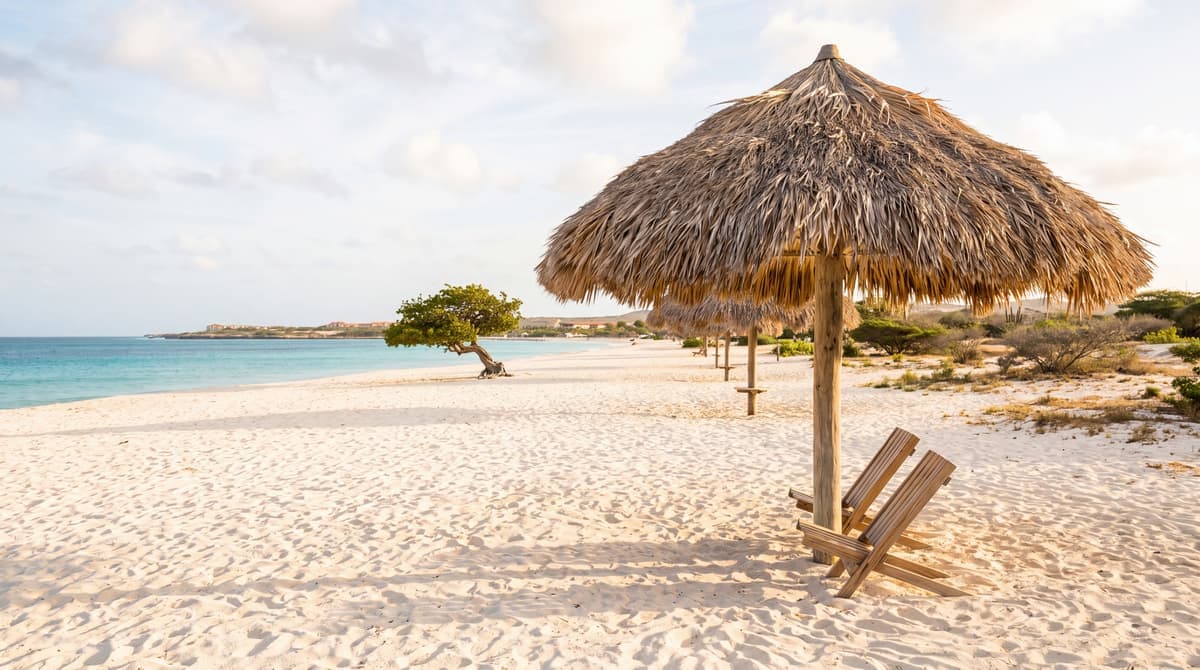
Every beach in Aruba is public by law, under the National Ordinance for Public Waters and Beaches. That means the palapas (the round, thatched shade huts) on public beaches are free and first-come-first-served. A 2015 court ruling made the key point explicit: a palapa does not belong to anyone, and draping towels or chairs under one does not reserve it. It is only "taken" while someone is actually there using it. The Aruba Tourism Authority restated all of this in its official Aruba Beach Guidelines published in April 2026.
Here is the honest caveat, because it matters below. Those 2026 guidelines were described as temporary while a broader beach policy is finalized, and a few stretches of sand directly in front of certain hotels sit on hotel leasehold land that is not treated as general public beach. So "it is all free and first-come" is the law of the island, with a couple of genuine gray zones you should know about before you plant your towel. Close to your trip, it is worth a quick look at aruba.com for the current version of the guidelines.
Morning yoga on Eagle Beach, booked direct
$30 per person, Tuesday and Friday mornings, all levels, and it closes with a short sound bath on the sand.
Eagle Beach: the free-palapa system at its best
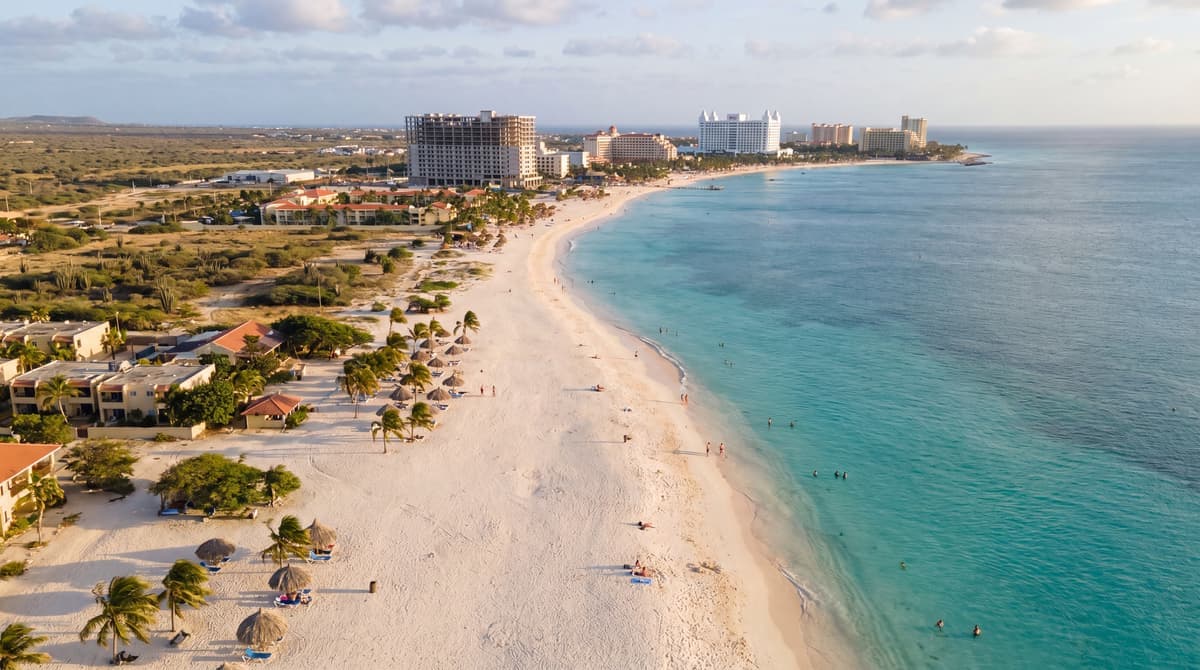
Eagle Beach is the wide, low-rise beach most travelers picture, and it is where the free-palapa system works exactly as advertised. The palapas are free and first-come. In high season the shaded spots closest to the water go early, and travelers commonly report arriving somewhere around 7 to 8 in the morning to be sure of one. We have never seen an official number for that, and it swings with the day and the season, so treat it as a rule of thumb rather than a promise.
Because towels do not legally reserve a palapa, you will sometimes see "saved" but empty huts. Officially, if nobody is there, it is fair game. In practice that causes friction, so read the situation and use common sense rather than starting a standoff.
That tension is real, and it made local news in 2026. In February 2026, security at the Manchebo Beach Resort confronted a visiting family over a palapa the hotel said had been rented to another guest, and Aruba's Beach Police unit responded and reminded staff that public-beach palapas cannot be exclusively reserved. Manchebo's counter-position is that its particular stretch sits on hotel leasehold rather than public beach, a distinction the ATA's own 2026 guidance admits is still unsettled. Around the same time, Barcelo began removing its beachfront palapas altogether and replanting coconut trees, citing years of public-versus-private disputes. None of this changes your day at the wide public heart of Eagle Beach, but it is why you might hit a gray zone on the narrow strip right in front of one specific hotel.
If you would rather not gamble on a free hut, rent. As of 2026, one delivery vendor, Coconut Rentals, lists a low beach chair at $8, a high chair at $9.50, an umbrella at $12, and a canopy shade at $20, each per day and delivered to Eagle Beach. Prices move, so confirm the current rate when you book. For the full lay of the land here, see our Eagle Beach guide and our honest Eagle Beach versus Palm Beach comparison.
Palm Beach: same law, very different reality
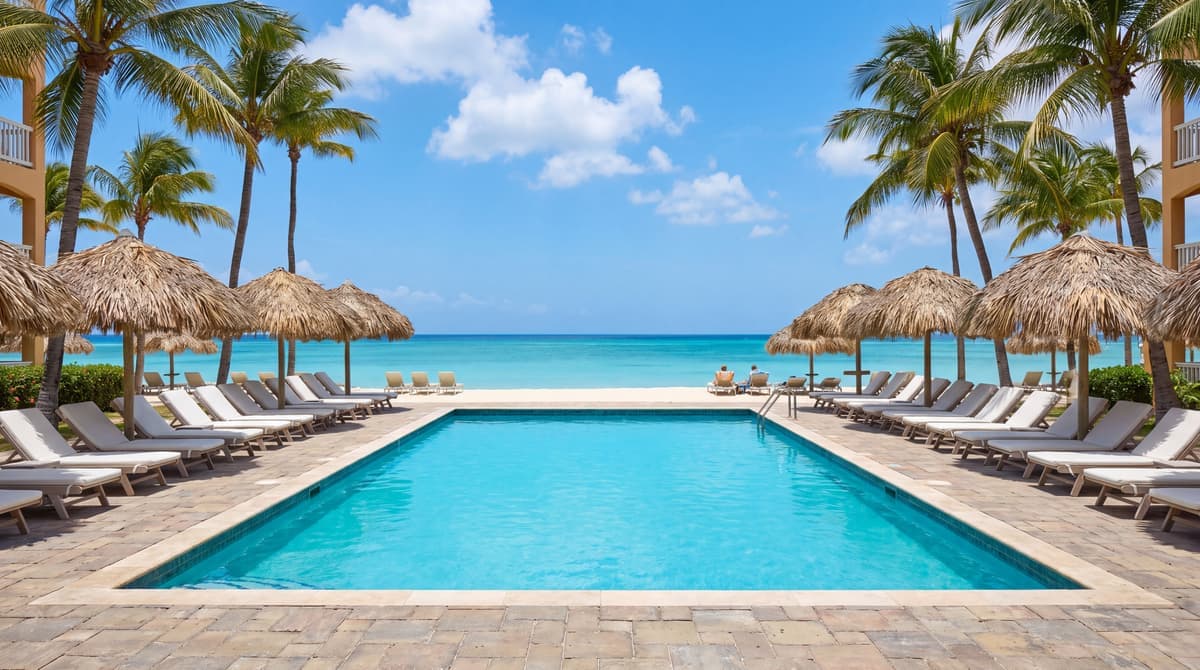
Palm Beach, the high-rise hotel strip in front of properties like the Marriott, Ritz-Carlton, Riu, Hilton, Holiday Inn, and Playa Linda, is governed by the same public-beach law, but it plays out differently in practice. The hotels stock the palapas and loungers in front of them with their own chairs and umbrellas, and in reality their guests get priority on that gear. You are legally allowed to stand on any public sand, but you should not expect to settle into a hotel's stocked palapa and lounger set without friction.
If a guaranteed lounger and palapa matter to you more than the nightly rate, that gear comes with a room on the strip. We keep honest reviews of the Palm Beach and Eagle Beach properties, including the Marriott, the Ritz-Carlton and the Hilton.
Some resorts run formal systems for their own guests. Marriott's Aruba Ocean Club and Surf Club, for example, use an online palapa reservation system: guests and owners book a palapa online a few days ahead, pick up a ticket at the Towel Hut by a set morning cutoff or lose the reservation, and any reserved-but-unoccupied palapa is released around midday. The honest caveat: that is a guest-facing procedure that changes from time to time, so if you are staying there, confirm the current rules with the resort rather than trusting last year's version.
The practical takeaway for Palm Beach is simple. If you are staying at a high-rise, your shade is handled by your hotel, so learn its palapa rules on day one. If you are staying elsewhere and just want a day on Palm Beach, the reliable move is to rent your own setup or plant your own umbrella on the open public sand, not to hope for a free hotel palapa. And if what you actually want is day access to a specific resort's pool and beach, that is a different thing entirely, which we cover in our Aruba resort day passes guide.
The arid-island problem: where natural shade runs out
Aruba is a dry, largely treeless island, and once you leave the two famous strips the shade math changes fast. A few beaches are worth understanding before you drive out to them.
Baby Beach in the far southeast is the shallow, calm lagoon families love, but shade there is limited and inconsistent. Beachside vendors rent chairs and pop-up shade (loosely around $70 a day for a two-chair-plus-tent setup, reported rather than itemized, so confirm on the spot), and there are some huts, but do not count on scoring free shade. If shade matters for your group, bring your own. More in our Baby Beach rundown.
Arashi Beach at the northwest tip has decent public palapas and a small beach bar, which makes it one of the better bets for free shade outside Eagle Beach. It is popular, though, so earlier is better. See our Arashi Beach guide.
Boca Catalina, the little snorkeling cove, is small and popular with limited shade, and the common advice is to arrive early if you want a shady spot. Details on our Boca Catalina page.
Mangel Halto on the south coast is the exception that proves the rule. It has genuine natural shade from mangroves, with some free palapas and lounge chairs in the middle section. If you want guaranteed shade without a rental or a sunrise alarm, this is the honest pick. Here is our Mangel Halto guide.
Want a local to plan the whole trip?
Our concierge builds your days around what you actually want, from $149. Real people who live in Aruba.
Bringing your own shade: legal, smart, but mind the wind
It is completely legal to bring your own umbrella, tent, or beach shelter to any public beach in Aruba, and for a lot of travelers it is the least stressful option of all: no rental, no palapa lottery, no early alarm. The one honest warning is the wind. Aruba's trade winds blow hard and steady, and a standard cheap beach umbrella will cartwheel down the sand within the hour. A sturdy, sand-anchored design holds up far better. Whatever you pack, our Aruba packing list has the rest of the beach-day kit.
Two practical notes. Because the island's beach rules were still being formalized through 2026, it is smart to keep your setup reasonable, skip staking out an oversized tent or leaving gear on the sand overnight, and check aruba.com for the current guidelines before you go. And wherever you set up, leave the free palapas for the people actually sitting in them.
The honest verdict and a simple game plan
Shade in Aruba is only a problem if you assume it will sort itself out. The system is genuinely traveler-friendly once you know it. On the public beaches the palapas are free and first-come, nobody can lawfully reserve one with a towel, you can rent a chair and umbrella for the price of a couple of coffees, and you can always bring your own.
Match the plan to the beach. On Eagle Beach, arrive early for a free hut or rent a setup and skip the stress. On Palm Beach, lean on your hotel if you are staying there, or bring your own shade if you are visiting for the day. For Baby Beach, Arashi, or Boca Catalina, assume shade is scarce and pack an umbrella. And when you simply want to lie in real shade with zero effort, drive to Mangel Halto. Do that, and the palapa question stops being a worry and becomes a five-minute part of planning your beach day. When you are ready to build the rest of it, our beaches guide and trip planner will take it from here.