If you are staring at your packing list and wondering whether you need to brush up on your Dutch before a trip to Aruba, you can cross that worry off entirely. We hear this question constantly from first-time visitors, usually phrased some version of "will I actually be able to communicate there," and the honest answer is one of the more reassuring things we can tell you about this island: English works everywhere a tourist needs it to work, and the deeper story behind that is genuinely interesting.
The Short Answer: Yes, They Speak English
Every hotel front desk, every restaurant menu, every tour operator, every taxi driver who regularly works tourist routes, and nearly every shop on the island operates comfortably in English. That is not an accident. English has been a compulsory subject in Aruban schools from around the fourth grade onward, and with the island's tourism economy built heavily around visitors from the United States and Canada, English fluency in hospitality and service roles is simply part of the job. You can land at the airport, check into your hotel, order dinner, book an excursion, and ask for directions without a single moment of confusion. If you only remember one thing from this post, it should be this: you do not need to learn another language to have a smooth trip here.
Want a local to plan the whole trip?
Our concierge builds your days around what you actually want, from $149. Real people who live in Aruba.
So What Language Do Arubans Actually Speak at Home?
Here is where it gets more interesting than most visitors expect. English may be the language of tourism, but it is not the island's native tongue. That honor belongs to Papiamento, the language nearly every Aruban grows up speaking and the one you will genuinely hear on the street, in homes, and between friends and family. It is a creole language, rooted in Portuguese and Spanish (linguists still debate exactly how much of each, since the island's history pulled from both), layered with influence from Dutch, English, West African languages, and the Indigenous Caquetio people who lived on the island long before European contact. The result is a language that sounds a little like Spanish to an untrained ear but carries its own distinct rhythm and vocabulary, and one that locals are visibly proud of.
Papiamento became an official language of Aruba, alongside Dutch, back in 2003. That single fact tells you a lot about how the island sees its own identity: tourism runs on English, but home runs on Papiamento, and the government made that distinction formal rather than letting one language quietly crowd out the other.
Dutch: The Formal, Official Language
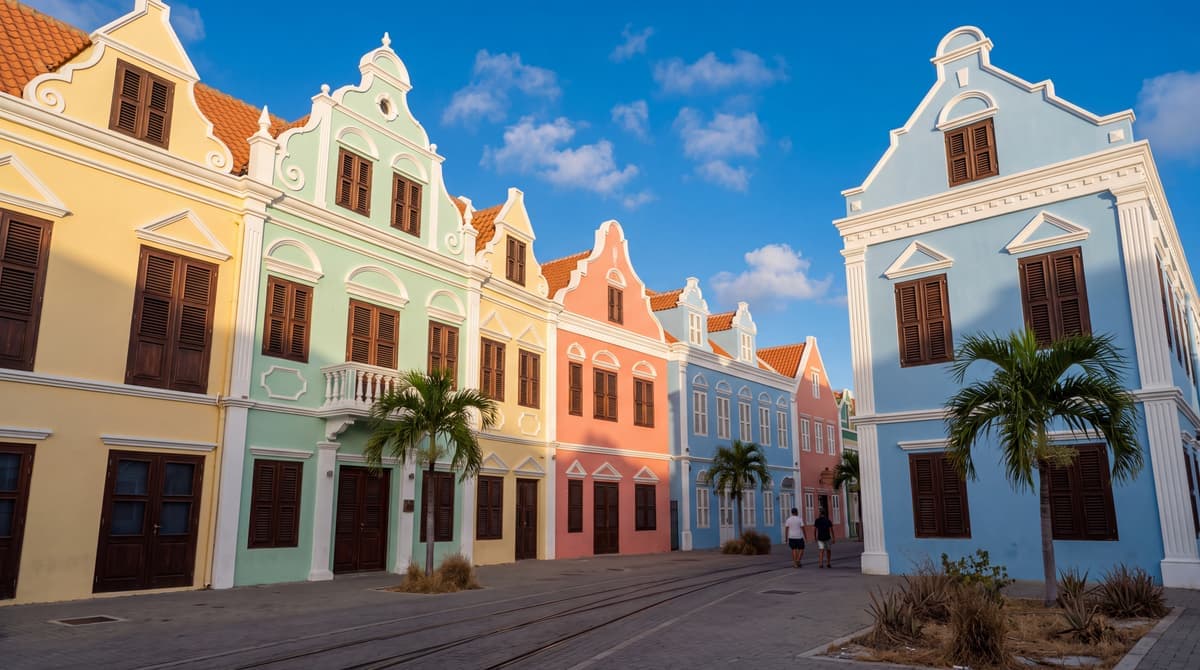
Aruba is part of the Kingdom of the Netherlands, and Dutch is the other official language on the island, the one you will see on government forms, in courtrooms, and woven through much of the school curriculum. If you spend time in Oranjestad, the capital, you will spot Dutch on official buildings and some government signage.
But here is the honest caveat worth knowing: Dutch is more of a formal, administrative language than an everyday one. Walk down a residential street or sit in a local snack bar away from the resorts, and what you will actually hear is Papiamento, not Dutch. Dutch is the language of paperwork and the classroom; Papiamento is the language of life. If you happen to run into an official form or a piece of government signage written only in Dutch, that is the one small, genuine spot where English does not automatically cover you, though it is rarely something a visitor needs to navigate directly.
Spanish and the Venezuela Connection
Spanish is the third language in regular circulation, and it is also taught in Aruban schools, typically starting around fifth grade. Geography explains a good chunk of why: Aruba sits only about 15 miles off the coast of Venezuela, and the island has a sizable Venezuelan community, which keeps Spanish genuinely useful and widely spoken in daily life. If you speak Spanish, you will find plenty of people happy to switch into it with you, particularly outside the main hotel strips.
Why Arubans Are So Multilingual
Put it all together and you get an island where switching languages mid-sentence is completely normal. Aruba's own tourism board describes most Arubans as speaking at minimum four languages, Papiamento, Dutch, English, and Spanish, and while fluency naturally varies person to person, it is fair to say many Arubans comfortably switch between three or four languages depending on who they are talking to. A big part of that comes down to the school system: Papiamento and Dutch are foundational from early childhood, English arrives as a required subject around fourth grade, and Spanish follows around fifth grade. By the time a local finishes school, juggling languages is simply second nature, not an impressive party trick.
Browse 32 vetted Aruba experiences
Most confirm instantly with free cancellation up to 24h, and 4 of them are free.
A Few Papiamento Phrases Worth Knowing
You will never need Papiamento to get through your trip, but a few words go a long way if you want to connect with locals a little more, and Arubans genuinely light up when a visitor makes the effort. Here are a few you will actually enjoy using:
- Bon bini - welcome. You will see and hear this constantly, starting at the airport.
- Bon dia / Bon tardi / Bon nochi - good morning / good afternoon / good evening and night. Simple, warm, and easy to drop into any interaction.
- Con ta bai? - how are you? A friendly way to open a conversation with a shopkeeper or server.
- Masha danki - thank you very much. You will hear it everywhere, and using it yourself is always appreciated.
- Dushi - sweet, nice, tasty, or a term of endearment. Arubans use it for food, people, a good moment, even the weather. It might be the single most-used word on the island.
- Ayo - a casual, cheerful way to say bye.
One fun detail for anyone who has also traveled to Curacao or Bonaire: Aruba spells it "Papiamento," with an -o, while Curacao and Bonaire use "Papiamentu," with a -u. Same language family, different islands, different spelling conventions, which is a small but real reflection of how each island shapes its own identity even within a shared Dutch Caribbean history.
Do You Need to Know Any of This to Visit?
No. That is the entire point of this post. English will carry you through every hotel, restaurant, tour, taxi, and shop you interact with on this island, with zero exceptions that matter to a typical visitor. Everything above, Papiamento, Dutch, Spanish, the phrases, is purely for curiosity and connection, never a requirement. If learning a word or two of Papiamento sounds fun, use it. If it does not, you will have just as smooth a trip either way. Before you go, our general travel tips cover the other small things worth knowing, and once you land, our guides to getting around Aruba, money and tipping, and the best time to visit round out the practical side of the trip. If you still need to settle entry paperwork, our passport guide is worth a look too.
Once the logistics are sorted, our 7-day itinerary and trip planning tool can help you map out the days, and the activities page and dining guide are good next stops for booking the parts of the trip you will actually remember, no language lessons required.