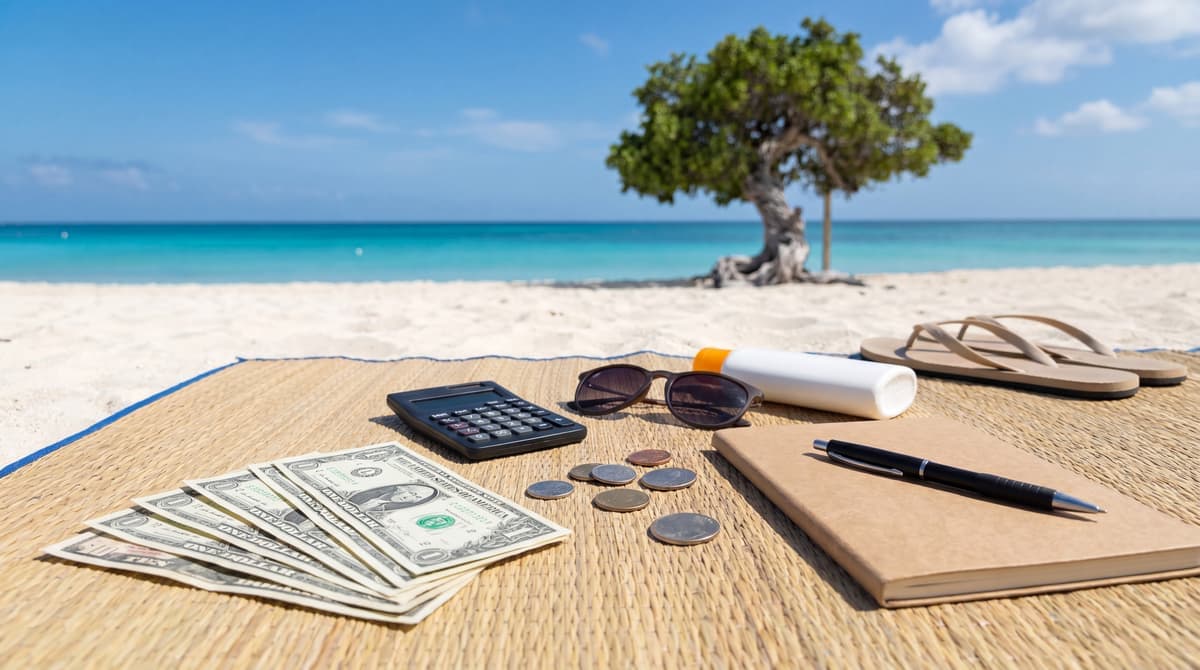
Here is the good news before you even pack: handling money in Aruba is about as easy as the Caribbean gets. You can land with a wallet of US dollars and a normal credit card and be completely fine for the whole trip. There is no scramble for local currency at the airport, no mental math at every register, and no tipping minefield, as long as you know the one thing that trips up almost every visitor: a lot of restaurants already add a service charge to your bill, so the tip you think you owe may have been paid before you reach for your wallet.
We live here, pay in both dollars and florins every day, and have watched plenty of first-timers either overthink the currency or tip twice on the same meal. So here is the whole money picture in one place: what the florin is, how to pay, where cash beats card, and exactly what to tip the people who look after you, with one honest caveat per point.
The Aruban florin, and why you barely need it
Aruba's local currency is the Aruban florin, written AWG and shown with the symbol Afl. It is pegged to the US dollar at a fixed official rate of 1 USD to 1.79 AWG, and that peg does not move from day to day, so there is no rate to watch or worry about. In everyday shops and restaurants you will often see dollars converted at a rounded commercial rate, commonly around 1.75 to 1.80 florins to the dollar, which is close enough that it rarely matters for a typical purchase.
The practical upshot: US dollars are accepted essentially everywhere on the island, from resorts and restaurants to supermarkets, taxis, and tour operators. You can pay in dollars and frequently get your change back in florins, which is normal and fine. Keep a few of those florin coins for the bus or a bottle of water, and spend the rest down before you fly home.
The honest caveat: when you pay dollars and receive florin change, you are at the mercy of whatever rounding that business uses, and a slightly stingy rate on your change adds up over a week of cash purchases. For anything large, paying by card (billed at the bank's rate) or in exact dollars avoids losing a little on every transaction.
Want a local to plan the whole trip?
Our concierge builds your days around what you actually want, from $149. Real people who live in Aruba.
Cards versus cash: what to actually carry
Major credit and debit cards, especially Visa and Mastercard, are widely accepted across Aruba, at hotels, restaurants, shops, and most tour operators. For the bulk of your spending, a card is the simplest and safest way to pay, and it bills at a fair bank rate with no guesswork about florin conversion.
Where cash still earns its place is the small stuff and the human stuff: the public bus, a beach snack shack, a local food truck, parking, and above all tips. Taxi drivers, tour guides, housekeeping, and bartenders are all far easier to tip in cash, and some smaller or more local spots are cash-friendly first. A sensible strategy is to put big-ticket items (hotel, car, dinners, tours) on a card and keep a modest stack of small US bills, ones, fives, and tens, for everything hand-to-hand.
The honest caveat: some businesses will not accept US 50 and 100 dollar bills because of counterfeiting concerns worldwide, so bring your dollars in smaller denominations. A pocket full of fifties can leave you oddly stuck at a small shop or unable to tip cleanly. Tell your card issuer you are traveling, too, so a foreign charge does not trip a fraud hold.
ATMs: florins, sometimes dollars
If you do want cash on the ground, ATMs are easy to find in Oranjestad, the hotel areas, and at the airport, and they take cards on the Visa, Mastercard, Cirrus, and Maestro networks. Most machines dispense Aruban florins, and some will also give out US dollars, with the on-screen instructions typically offered in English alongside Dutch, Spanish, and Papiamento.
Because dollars are so widely accepted, many visitors simply arrive with the cash they already have and skip island ATMs entirely. If you do withdraw, taking out florins for small local spending and tips works smoothly, since that is the change you will accumulate anyway.
The honest caveat: your own bank's foreign-ATM and currency-conversion fees are usually the real cost here, not the machine itself, and if an ATM offers to convert the withdrawal to dollars for you on the spot (dynamic currency conversion), declining and being charged in florins is almost always the cheaper choice.
The service charge nobody warns you about
This is the single most important thing in this guide, so read it twice. Many Aruba restaurants automatically add a service charge of roughly 10 to 15 percent to your bill. It usually appears as a line reading service, servicio, or service charge near the bottom of the check. When it is there, that is the gratuity, and you do not need to add another full tip on top unless the service genuinely blew you away.
That charge is not a scam. In a lot of restaurants it goes into a pool shared across the whole team, including the kitchen and support staff you never see. But it does mean the honest move is simple: read the bottom of the bill before you tip. If a service charge is already listed, you have tipped. Rounding up the remaining few dollars, or adding a small extra five to ten percent for service you loved, is plenty and appreciated. If no service charge appears, then a normal tip of around 15 to 20 percent is the standard for good service.
The honest caveat: the rule is not universal, the percentage varies, and a few places word it vaguely, so do not assume either way. Glance at the itemized bill every time, and if you genuinely cannot tell whether service is included, it is completely fine to ask your server directly. They will tell you straight. The goal is to tip fairly once, not to tip twice out of guilt or skip a tip that was never collected. While you are weighing where to eat, our restaurants guide and dining hub flag the spots worth the splurge.
What to tip everyone else
Away from the restaurant table, tipping in Aruba is genuinely optional and never aggressive, but a few cash gratuities are customary and warmly received. Here is the simple rundown.
Taxi drivers. Fares are set by the government, not by a meter, so you are not tipping on top of an inflated ride. A tip is optional and appreciated rather than expected: rounding up to the next few dollars, or handing over an extra 1 to 5 dollars for a driver who helped with bags or shared good local tips, is the norm. For how the fixed-fare system works and what each ride costs, see our Aruba taxi rates guide.
Tour and excursion guides. For a snorkel sail, a jeep safari, or any guided excursion, tipping around 10 to 15 percent of the tour price is customary when the guide and crew did a good job. On a shared catamaran there is often a tip jar at the bar at the end. Browse and book tours on our activities page.
Hotel housekeeping. Around 2 to 5 dollars per day is the going rate, and the kindest way to do it is to leave it daily, clearly visible, rather than in one lump at the end, because a different person may clean your room on different days. A short note saying thank you removes any doubt about whether the cash is a tip.
Bartenders. A dollar or two per drink, or rounding up a tab, is standard and keeps the next round coming a little faster.
Bag handlers and bellhops. Roughly 1 to 2 dollars per bag for porters at the airport or your hotel is the usual courtesy.
The honest caveat: none of these are mandatory, and you should never feel shamed into a tip for service that did not warrant one. Equally, housekeeping, taxi drivers, guides, and bartenders are the people most reliant on cash gratuities, and they are exactly the ones a card cannot easily reach, which is the whole reason to carry small bills.
Browse 32 vetted Aruba experiences
Most confirm instantly with free cancellation up to 24h, and 4 of them are free.
A simple cash-versus-card strategy
If you want a plan you can stop thinking about, here it is:
- Put the big stuff on a card: hotel, rental car, restaurant bills, organized tours. Fair rates, no conversion math, and a record of every charge.
- Carry a modest stack of small US dollars, mostly ones, fives, and tens, for tips, the bus, parking, food trucks, and small local shops.
- Keep whatever florin change you accumulate for coins-and-small-notes spending, and run it down before you leave.
- Decline on-the-spot dollar conversion offers on card terminals and ATMs, and skip carrying US 50s and 100s.
That is the entire system, and it covers a normal trip without a single anxious moment at a register. For how all of this folds into the total price of a week here, see our Aruba vacation cost 2026 guide, and if you are planning to self-cater, our grocery stores guide shows where the cash-and-card lines fall at the supermarket.
Bottom line
Money in Aruba is refreshingly low-stress. The florin is pegged to the dollar, US dollars are accepted essentially everywhere, cards cover the big purchases, and ATMs are there if you want local cash. The only real trap is tipping, and it is easy to dodge: read the bottom of every restaurant bill, because a 10 to 15 percent service charge may already be there, and tip the people a card cannot reach (taxis, guides, housekeeping, bartenders, porters) in small dollar bills. Do that, and you will pay fairly, tip kindly, and never once overthink your wallet. When you are ready to turn all of this into an actual itinerary, tell us your dates on the trip planner and we will build the week around it.