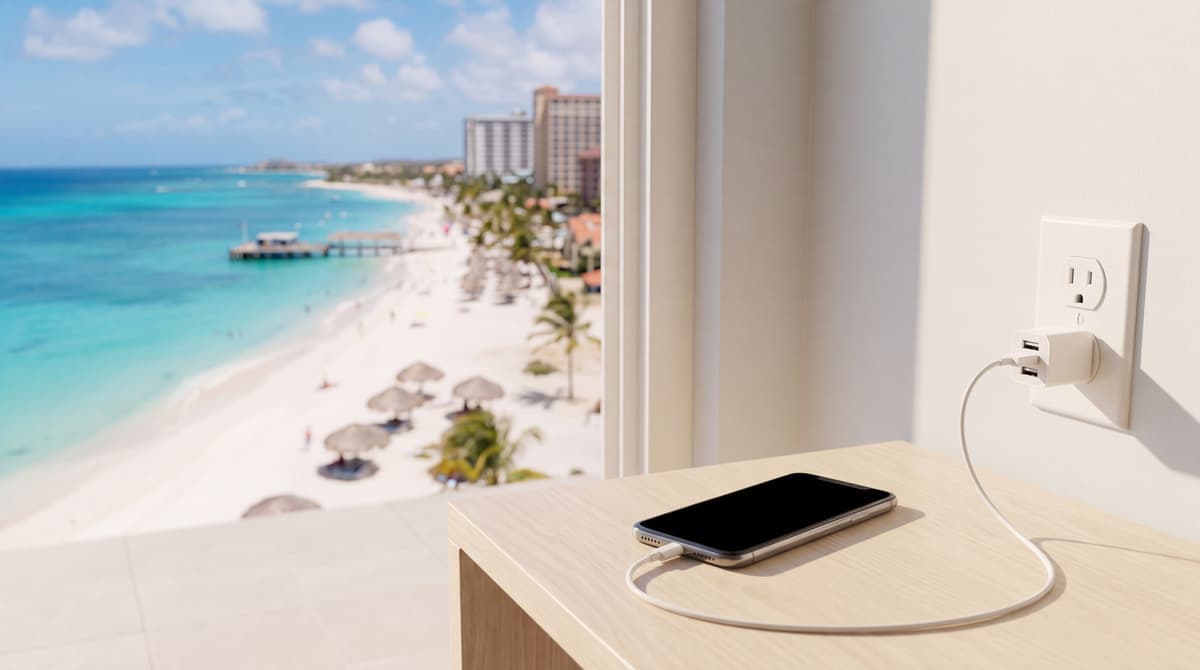
We get this question in some form from almost every traveler packing for a first Aruba trip, usually somewhere between the sunscreen and the swimsuits: will my charger actually work when I land. It's a fair thing to wonder, because the answer genuinely changes depending on whether you're flying out of Miami or Amsterdam. We live here, so we've plugged in every kind of charger, hair tool, and travel gadget a visiting friend has ever handed us, and the real answer is simpler than the warnings you'll find online.
If You're Flying From the US or Canada, Pack Nothing Extra
This is the good news, and it applies to the large majority of our readers. Aruba's electrical system is effectively the same as the one in your house. The island runs on 127 volts at 60 Hz, and its wall sockets are Type A and Type B, the exact flat two-pin and three-pin plugs used across the US and Canada.
Some travel sites round Aruba's voltage down to "120V" to match the US standard exactly. That's close enough in practice, and the point that actually matters for you is this: your phone charger, laptop charger, camera battery charger, electric razor, and any other standard North American device will plug directly into an Aruba wall socket and run completely normally. No plug adapter, no voltage converter, no special gear of any kind. If you've already started your Aruba packing list, you can cross "adapter" off it entirely.
Want a local to plan the whole trip?
Our concierge builds your days around what you actually want, from $149. Real people who live in Aruba.
If You're Flying From the Netherlands or Europe, You Need an Adapter, Not a Converter
Aruba is part of the Dutch Caribbean, and we get a steady stream of Dutch and wider European visitors, so this section is for you specifically.
Your plug will not fit. Continental European sockets are Type C or Type F, both round two-pin designs, and Aruba's sockets are the flat North American Type A and Type B. A European plug simply cannot go into one of those sockets without an adapter, full stop. So yes, pack a basic plug adapter (the kind that converts a round European plug to a flat North American one). They're small, cheap, and worth throwing in before you leave rather than hunting for one once you land.
Here's the part that surprises most European travelers, though: you almost certainly do not need a voltage converter. A voltage converter is a separate, bulkier device that actually changes the electrical current, and it's only necessary for appliances that are built to run on a single fixed voltage. Nearly everything you're likely to bring, phones, laptops, tablets, camera and battery chargers, and most electric toothbrushes, is dual-voltage by design. Check the fine print on the charger brick itself (not the device), and if it says something like "100 to 240V," that device is built to run safely on power anywhere in the world. An adapter for the plug shape is all it needs.

Traveling with little ones
Land with the crib already sorted
A full-size crib, stroller, and car seat rarely fit in the luggage. Local BabyQuip providers deliver the gear to your hotel or rental for your dates and collect it when you fly home, cleaned and insured per their standards. Pick what you need, see the price for your stay, and board with carry-ons instead of cargo.
- Cribs, pack-and-plays, and toddler beds
- Car seats sized to your child
- Strollers, wagons, and beach gear
Delivered by independent BabyQuip providers on the island. We may earn a commission at no extra cost to you.
The One Real Exception: Single-Voltage Appliances Run Weak, Not Dangerous
This is the detail that's easy to get backward, so we want to be precise about it. The risk with voltage mismatches almost always runs one direction: a single-voltage appliance built for the lower end (think a US hair dryer rated only for 110 to 120V) can genuinely be damaged if you plug it into Europe's 230V without a real converter, because it's suddenly getting roughly double the power it expects.
That scenario does not happen in Aruba. Since Aruba's 127V supply sits on the North American end, the risk runs the other way, and it's far less dramatic. If you bring a single-voltage European appliance, say a hair dryer or a flat iron rated only for 220 to 240V, and plug it into an Aruba socket through a simple plug adapter, it will not break, spark, or overheat. It will just underperform, because it's only getting about half the voltage it's built for. A high-wattage European hair dryer might feel like a weak travel dryer here. Annoying, not dangerous.
The fix, if styling tools matter to your trip, is to pack a dual-voltage travel version (again, look for "100 to 240V" printed on the appliance itself) rather than your everyday single-voltage one from home. Otherwise, the easiest move is simply using whatever dryer your hotel room provides and saving the suitcase space. One honest caveat: not every Aruba hotel room is guaranteed to have one, so check with your property directly if that would be a dealbreaker, rather than assuming.
What Plug Type Does Aruba Actually Use
To put it plainly: Type A (the flat two-prong plug) and Type B (the same flat two-prong plug plus a third round grounding pin), identical to what you'll find in any US or Canadian home or hotel. If you've traveled to Florida, you've already used the exact socket you'll find in Aruba.
One nuance worth knowing if you're coming from the Netherlands or Europe: some hotels and apartments geared toward European guests also install a Type F (European round-pin) socket alongside the standard ones, usually a single outlet near the bathroom mirror or desk. It's a nice bonus when it's there, but it is not something you can count on island-wide or even property-wide, so don't skip packing your plug adapter on the assumption your room will have one.
The Real Problem Isn't Voltage, It's Not Enough Outlets
Honestly, the more common frustration we hear about from guests has nothing to do with voltage or plug shape. It's that hotel rooms, especially older ones, often only have two or three usable outlets, and between a phone, a laptop, a camera battery, and maybe a kid's tablet, that fills up fast. A small multi-port USB wall charger or a basic power strip (packed in a carry-on, not checked) solves this instantly and takes almost no suitcase space. If you're traveling with a family and juggling multiple devices, it's worth adding to your list alongside anything from our toddler-specific packing notes.
Browse 32 vetted Aruba experiences
Most confirm instantly with free cancellation up to 24h, and 4 of them are free.
Power Banks and Beach Days
A portable power bank is genuinely useful here, less for the hotel room and more for full days away from any outlet: a boat trip, a beach day, or a long stretch exploring Arikok where you won't see a charger for hours. One rule worth knowing before you pack one: airlines require power banks to travel in your carry-on, not your checked bag, because of the lithium battery inside. Keep it in your day bag either way, since that's also where you'll actually want it.
If you're planning to get any work done from the island, whether that's a quick morning check-in or a full remote-work stretch, our guide to working remotely from Aruba covers the connectivity side (wifi reliability, where to work from) that pairs with everything above. And if you're still finalizing what to wear once you've sorted what to plug in, our what to wear in Aruba guide and full packing list are good next stops. For the rest of the pre-trip logistics, our general travel tips page and trip planning tools round out the checklist.
The Short Version
US and Canadian travelers: pack nothing, your chargers work exactly as they do at home. Dutch and European travelers: pack a plug adapter, skip the voltage converter for anything dual-voltage (which is almost everything), and only worry about a converter for a single-voltage 220 to 240V-only appliance, which will simply run weak here rather than get damaged. Everyone benefits from a small multi-port charger for the outlet shortage and a power bank for long days away from a wall.