March is a month that quietly outperforms its reputation. Aruba’s peak season is in full swing, the trade winds run at a steady, comfortable clip, the beaches are clean and largely sargassum-free, and on the 18th the whole island stops to celebrate one of its most meaningful national holidays. Carnival is finished by now in most years, which means the parade-weekend hotel crunch has passed and the island is simply doing what it does best: delivering near-perfect weather to a beach chair near you.
The honest trade-off is that March is still expensive. Hotel occupancy on the island ran at 86.4 percent in March 2026, and rates track right alongside that demand. You will not find a bargain, but you will find reliably gorgeous weather, clean leeward beaches, and a cultural moment in Flag Day that most visitors never know to look for. Here is the full picture.
What March weather is actually like
March is one of the driest months of the Aruban year, competing with February and April for the most reliably sunny stretch on the calendar. Daytime highs sit right around 88°F (31°C), with nights cooling to roughly 77°F (25°C). The sea on the calm western side runs about 78 to 79°F, which is warm enough to stay in for hours.
Rainfall in March is minimal. Most climate records put it between 0.4 and 0.6 inches for the entire month, spread across just a handful of days, meaning brief passing showers rather than anything that cancels a beach afternoon. The practical experience is wall-to-wall sunshine with the occasional 10-minute squall that leaves as fast as it arrived.
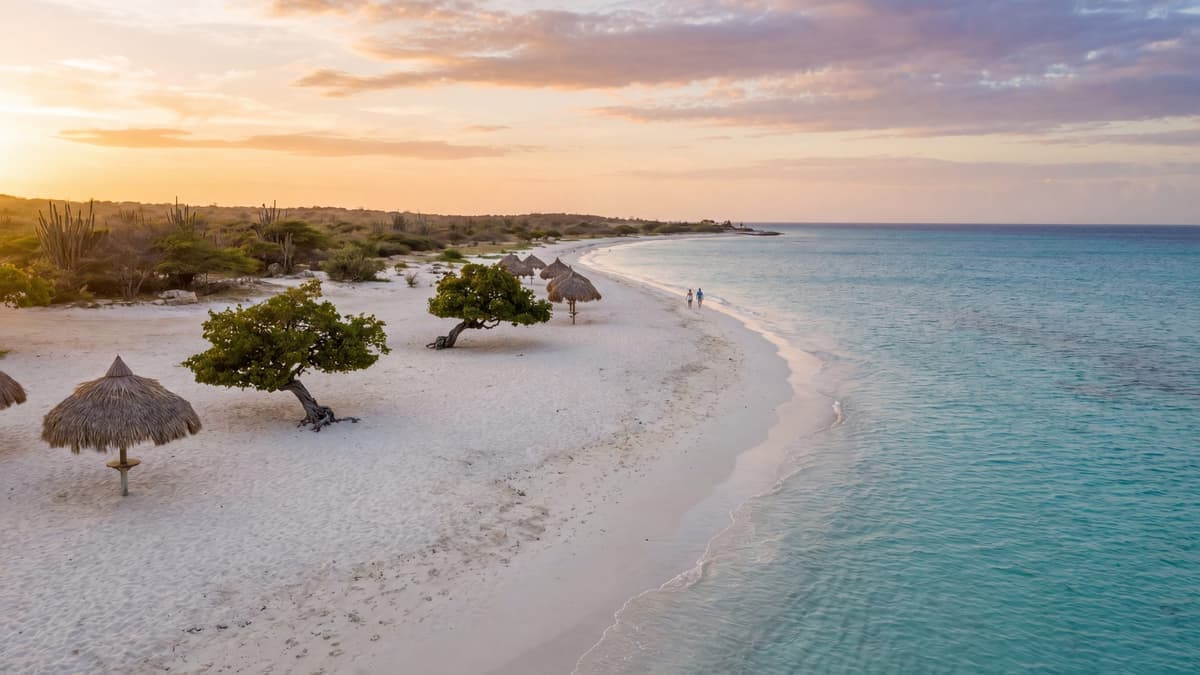
The trade winds blow steadily from the east-northeast at around 17 knots, which is the Aruba you see in every photo: white sand swept clean by a consistent breeze, palm fronds tilting west, beach umbrellas you actually need to stake down. The wind in March is the functional, pleasant version, strong enough to keep you cool on the sand without the gusty overload that summer brings.
One more March bonus that the brochures rarely lead with: this is still inside the lowest-risk sargassum window of the year. The risk runs low from December through March, and Aruba’s leeward west and south coast beaches sit largely outside the main drift belt regardless of season. If you have been burned by seaweed-covered sand elsewhere in the Caribbean, a morning on Eagle Beach in March is the cure.
Want a local to plan the whole trip?
Our concierge builds your days around what you actually want, from $149. Real people who live in Aruba.
The price reality: peak season holds through April
There is no soft-pedaling this. March is peak season, and peak-season prices apply across the board. Hotel occupancy at 86.4 percent tells you what the supply-and-demand picture looks like, and mid-range hotels run roughly 40 to 60 percent above what they charge in the off-season months of May through October. All-inclusive properties run even higher.
Within the month, there is one useful pressure pattern. The first week of March sometimes still carries a trace of the February Carnival premium if your year’s Carnival ended close to or within the month (more on that below). After that, prices hold steady at the peak-season floor without the dramatic demand spikes that characterize the holiday weeks in December and the Grand Parade weekends in January and February. March is expensive in a calm, consistent way rather than in a chaotic surge-pricing way.
For booking lead times, 60 to 90 days out is the practical window for most March trips. The month does not have a single weekend that sells out like New Year’s Eve, so you have more flexibility than a February Carnival-week planner, but the best-located rooms at the best Eagle Beach properties still go early.
The full category-by-category breakdown of what an Aruba trip costs lives in our Aruba vacation cost 2026 guide. If March rates make you flinch, April is when peak season starts winding down and prices begin drifting toward more reasonable ground.
Does Carnival ever reach into March?
This is worth addressing directly, because the answer is: sometimes, yes. Aruba’s Carnival follows the church calendar and ends on Ash Wednesday, the day before Lent begins. In years when Easter falls late, Ash Wednesday lands in late February or even early March, which pushes the Burning of Momo and the tail of Carnival events into the first days of March.
In the 2026 season, the Grand Parades closed on February 15 and Carnival ended well before March. For 2027, the reported schedule puts Ash Wednesday on February 10, so a March 2027 trip lands comfortably after the season; our Carnival 2027 guide tracks the dates. The calendar shifts every year, so before you book a March trip hoping to catch the energy of Carnival or deliberately avoid its crowds, check the official schedule on aruba.com (the Aruba Tourism Authority) for your specific season. A single search will tell you whether your March dates are post-Carnival or still in the thick of it.
If Carnival does reach into your March trip, our Aruba in February guide has the full event and logistics breakdown that applies equally to any early-March Carnival days.
Want a local to plan the whole trip?
Our concierge builds your days around what you actually want, from $149. Real people who live in Aruba.
Flag Day: the March holiday most visitors miss
March 18 is Dia di Himno y Bandera, Aruba’s National Anthem and Flag Day, and it is one of the most genuinely moving public holidays on the island calendar. Since 1985 it has been an official public holiday, and the date is fixed: every March 18, no matter what day of the week it falls on.
The holiday commemorates March 18, 1976, the day Aruba officially adopted its national flag and national anthem. The anthem is “Aruba Dushi Tera,” meaning “Aruba Sweet Land,” a waltz composed by Rufo Wever with original lyrics by Juan Chabaya ‘Padu’ Lampe. It is a piece of music that lands differently once you have heard it sung by an island of 110,000 people who mean every word.
The day fills up with parades, folkloric performances, music, community gatherings, and public events in neighborhoods across the island. Museums and monuments open their doors free of charge. People turn out in Aruba’s national colors, blue, yellow, red, and white. There are sporting events, cultural showcases, and organized activities for families. The official celebrations include a ceremonial component followed by neighborhood-level festivities, which means the energy is not confined to one square in Oranjestad but spread across the whole island.
For visitors, the practical notes are familiar: banks and government offices close, some shops run holiday hours, and the resorts and restaurants carry on as usual. The more important takeaway is cultural. Flag Day is a window into what Aruba cares about, not as a performance for tourists but as an expression of genuine national pride. If you are here on the 18th, the celebrations are open, welcoming, and worth rearranging your beach day for.
What to do in March
March is prime conditions for nearly everything on the island. The weather is as reliable as it gets, the sea is calm on the leeward side, the water is clear from the dry-season absence of runoff, and the wind is steady without being punishing.
Get on the water. A catamaran sail and snorkel cruise over the Antilla, the largest shipwreck in the Caribbean, is the classic Aruba day and never more appealing than in March’s clean, warm water. Visibility at the wreck and at Boca Catalina is excellent this time of year. Check dates and prices on Viator, book morning departures for the calmest sea surface, and book a few days ahead since boats fill in peak season.
Explore the outback. An Arikok National Park 4x4 safari is the antidote to a resort loop, covering the caves, the wild windward cliffs, and the cactus and divi-divi interior that most beach visitors never see. The Natural Pool tour is the marquee version: a jeep ride across the rugged northeast followed by a swim in a rock-ringed ocean pool that you cannot reach any other way. You can book the 4x4 Natural Pool tour on Viator in advance. March temperatures make the inland sections genuinely comfortable, before the summer heat settles in.
Chase the wind. March’s consistent 17-knot trade winds make it an excellent month at Fisherman’s Huts, the flat-water kite and windsurf spot at Hadicurari just north of the Palm Beach strip. The winds have picked up from January’s gentle lull but are not yet at the howling summer peak, landing in the productive middle ground where improving riders make real progress. If you have wanted to try a kiteboarding lesson, this is a month that rewards it.
Work through the beaches. With the lowest seaweed risk and excellent conditions on the leeward coast, March is the month to beach-hop rather than plant yourself in front of your resort every day. Our beaches guide covers the full range from Eagle Beach and Palm Beach in the northwest to Baby Beach’s calm lagoon in the far southeast and the wilder stretches around Arashi in the north. Rent a car for a day and cross three off your list.
Eat well and plan ahead. March is not the frenzy of the holiday weeks, but the good restaurants still fill up in peak season. Our dining guide has honest picks at every price point. Reservations two to three days ahead are standard practice for the popular beachfront rooms.
Let us plan this trip for you
We live in Aruba and vet every spot ourselves, share your dates and we'll build the rest.
The beaches in March
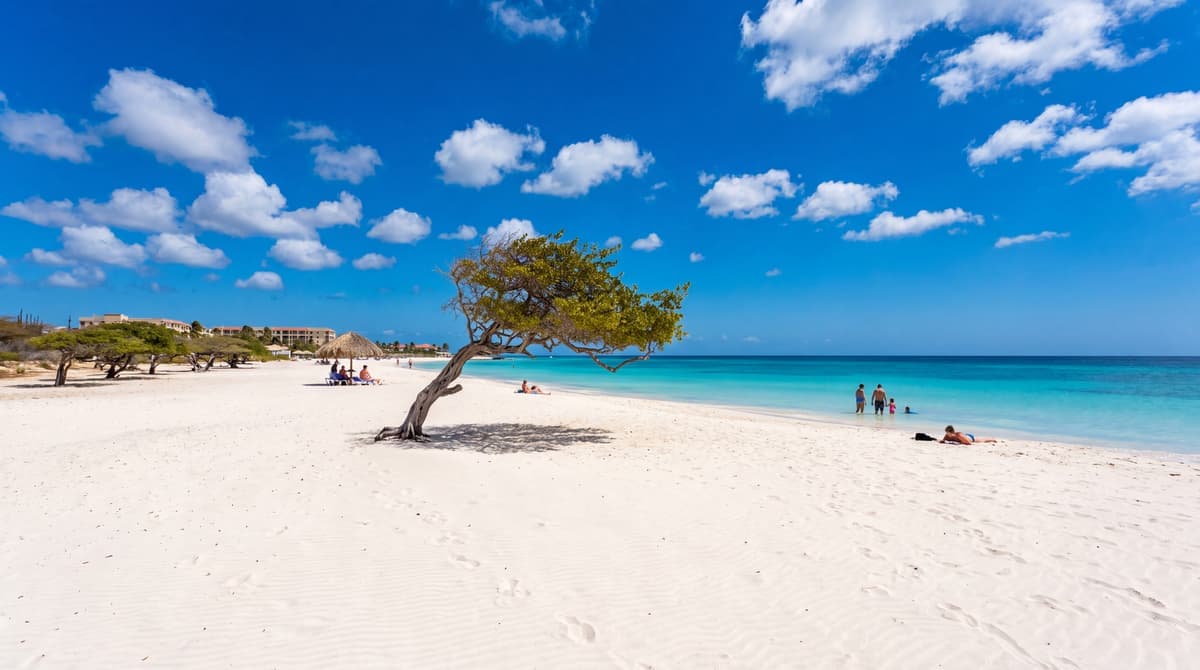
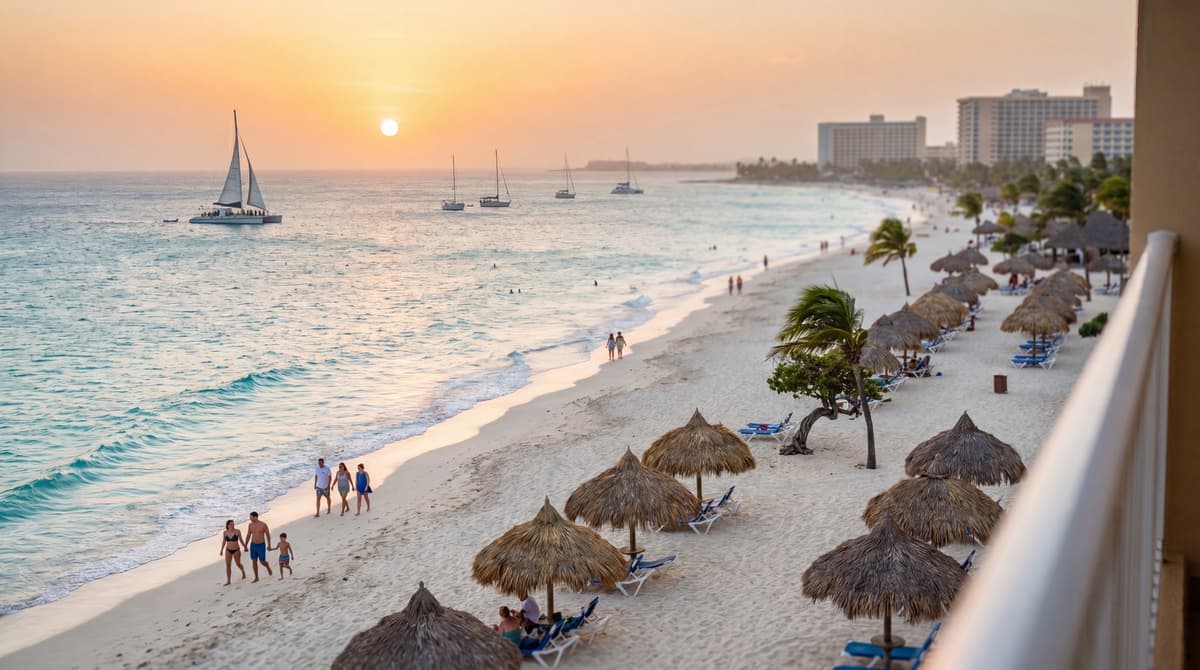
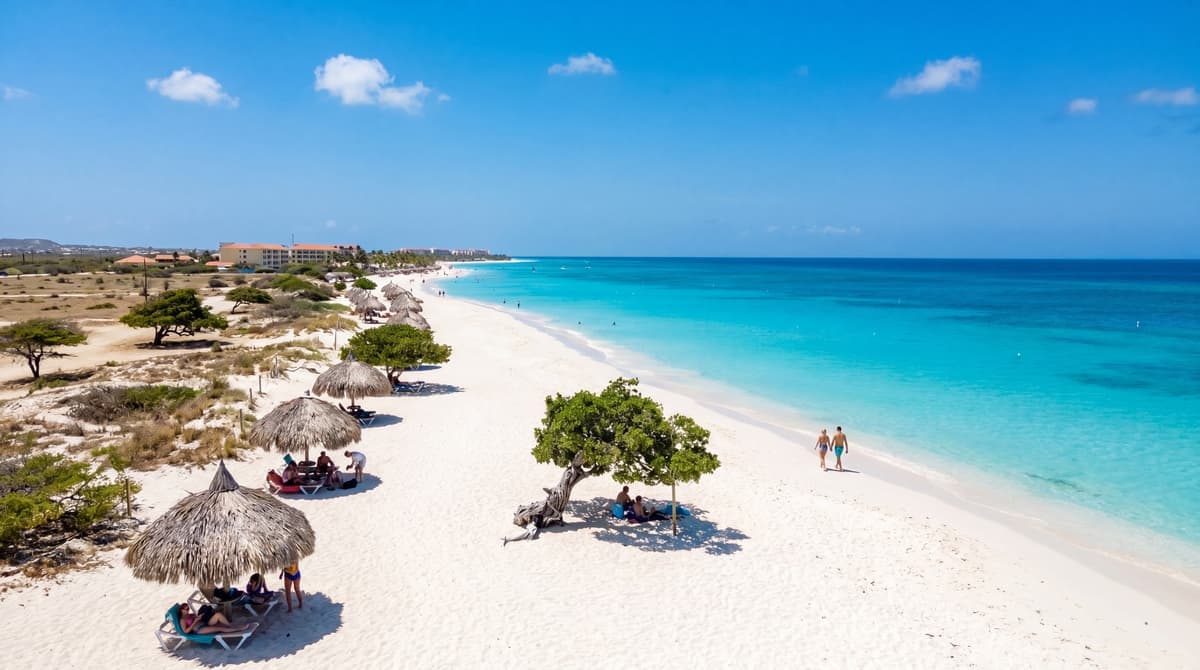
Eagle Beach and Palm Beach are the twin anchors, and both are running at full peak-season occupancy. Eagle Beach remains wider and less built-up, with the iconic fofoti trees that lean into every southwest wind and the palapas that fill by mid-morning. Palm Beach is livelier, more walkable to restaurants and bars, and the base most visitors default to.
Beyond the two famous strips, March rewards exploration. The water at Baby Beach in the far south is warmer and shallower than anywhere else on the island, a shallow lagoon ringed by rock that turns into a natural swimming pool, and it sees a fraction of the peak-season crowd even in March. Boca Catalina and Arashi in the north offer calm, clear snorkeling without a boat. The southern and eastern beaches around San Nicolas have a rougher, more dramatic quality suited to walking rather than lounging.
One note for families: the calm, waist-deep water at spots like Baby Beach and the protected cove at Boca Catalina is exactly what parents of small kids are looking for, and the March sunshine is warm enough that nobody is rushing out of the water.
What to pack for March
March packing is Aruba’s standard kit, nothing exotic required:
- Reef-safe SPF 50 or higher, because the UV index at 12 degrees off the equator is serious even in a trade-wind month
- A hat with a chin strap, because the 17-knot wind has opinions about brimmed hats without one
- A light packable rain layer for the occasional brief shower
- Water shoes for rocky snorkel entries at spots like Boca Catalina
- A reusable water bottle, because Aruba’s tap water is desalinated and excellent, and the wind accelerates dehydration you may not feel coming
- A light layer for breezy evenings and over-air-conditioned restaurants
Leave anything insulating at home. You will not need it.
Browse 33 vetted Aruba experiences
Most confirm instantly with free cancellation up to 24h, and 4 of them are free.
The free 7-day itinerary
The exact 7 days we send friends
One email with our day-by-day Aruba plan: which beach on which day, where to eat, and the tours worth booking. No spam, unsubscribe anytime.
A sample March week
Here is how we would build seven days, balanced between the classic Aruba experiences and the March-specific moments:
Day 1, arrival. Land, check in, walk the beach at sunset. Never over-schedule the first day.
Day 2. Eagle Beach morning under the fofoti trees, pool at midday, sunset drinks looking west over the Caribbean.
Day 3. Morning catamaran snorkel cruise over the Antilla while the water is at its calmest. Afternoon rest, dinner in Oranjestad.
Day 4. Jeep day into the outback: Arikok National Park early, the Natural Pool swim, Baby Beach for a calm afternoon, dinner in Savaneta on the drive back.
Day 5. If your dates include March 18, build the day around Flag Day. Head into town for the neighborhood celebrations and folkloric events, then beach in the late afternoon. If not, this is the free day: kiteboarding lesson at Fisherman’s Huts in the morning, then stay for the sunset kite show.
Day 6. Beach-hop day. Boca Catalina for morning snorkeling, then north to Arashi, then back to Palm Beach for sunset. A rental car makes this the best day of the trip.
Day 7, departure. Arrive at the airport about 3 hours early. Aruba has US preclearance, which turns your arrival back home into a domestic landing, but the lines at departure can be slow on busy spring mornings.
Families vs. couples: who March suits
Both, and in different ways.
Families find March one of the most workable months of the peak calendar. The weather is as reliable as it gets, the sea is calm and warm on the leeward side, and the absence of any single must-attend event means the itinerary is flexible rather than event-driven. There are no late-night parade obligations, no 3am Jouvert wake-up calls, and no gala dinner surcharges to navigate. Flag Day on the 18th is a genuine family event, with games and activities and the kind of community energy that kids respond to in a way that resort pool time does not.
Couples after quiet have better options than the holiday-week crunch but should still note that March is full peak season. The adults-only resorts on Eagle Beach are worth looking at. A sunset catamaran sail, dinner on the sand, and a quieter beach strip away from the Palm Beach high-rise corridor is the March couple formula, and it works well. Couples who want to avoid crowds entirely might read our April guide, when peak season genuinely begins softening.
Find your hotel by month, beach & budget
Compare current Aruba rates across the major booking sites in one place, in USD. Most rooms are free to cancel.
Where to stay in March
The standard Aruba geography applies: Palm Beach for walkability and lively energy, Eagle Beach for wider sand and a quieter feel, with the low-rise boutique properties there being the pick for anyone who values both beach quality and some space from the resort masses. Browse the full range of hotels in Aruba before you commit to a neighborhood.
One March-specific note: if your trip includes March 18 and Flag Day is part of the appeal, consider whether staying closer to Oranjestad makes sense for that day. The downtown neighborhood events and the ceremonial celebrations are easier to enjoy when you are not navigating a round-trip from Palm Beach.
For the full neighborhood breakdown, including the value plays beyond the famous two-beach corridor and where families versus couples tend to land happily, read our where to stay in Aruba guide before you book.
Getting to Aruba in March
March sits in the heart of the peak travel season for the US Northeast and Midwest, which means nonstop flights from roughly 16 US airports are running at peak frequency and peak price. The good news is that peak season also means the schedule is at its most robust: more departures, more options, more competition between carriers than you get at the thin edges of the travel calendar.
Aruba’s US preclearance facility means you clear immigration and customs in Oranjestad before you board the return flight, landing back home as a domestic arrival with no customs line. It is one of the best features of the airport and worth knowing when you are calculating how much cushion to build into your connection.
Our getting to Aruba in 2026 guide covers every nonstop route and how to track cheaper seats on them. Set a price alert early; the March windows that look expensive in January sometimes open up briefly before closing again.
Want a local to plan the whole trip?
Our concierge builds your days around what you actually want, from $149. Real people who live in Aruba.
Now is the right time to plan your trip
If March is your month, the practical window for booking is opening. The lead time of 60 to 90 days means trips that land in March should have rooms locked in by late December or early January. The best Eagle Beach properties at the best rates go in that window, and the rental cars follow right behind them. Our car rental page is worth checking at the same time you book the room, since March demand empties the lots the same way it fills the hotels.
The what to do in Aruba page has the full experience menu if you are still building the itinerary. And if you are comparing months within the winter window, our Aruba in February guide covers the Carnival-month option and our April guide covers the first month where peak season actually starts letting go.
Bottom line on March
March is peak season without the peaks. No New Year’s Eve surge pricing, no Carnival parade-weekend scramble, no mandatory gala dinner surcharges. You still pay peak-season rates, roughly 40 to 60 percent above the low-season floor, and the island is full at 86 percent hotel occupancy. In exchange you get some of the driest, sunniest, most reliably beautiful weather of the Aruban year: 88°F days, a steady trade-wind breeze, 78 to 79°F water, near-zero sargassum risk, and clear visibility at the snorkel sites. March 18 offers something that the holiday weeks cannot: a chance to see Aruba celebrate itself, through music, parades, and neighborhood gatherings tied to a national identity the island takes real pride in.
If that combination sounds right, tell us your dates on the trip planner and we will help you put together the room, the tours, and the Flag Day plan before the good options fill.