Book a room for $250 a night, and the confirmation email looks clean and final. Then you check out a week later and the actual charge on your card is closer to $330, sitting there in a folio full of line items you never priced in: a tourist levy, an environmental levy, a service charge, maybe a resort fee you do not remember agreeing to. We live here, and this is one of the most common questions we field before a trip, because almost nobody arrives on Aruba knowing exactly what stacks on top of the rate they booked. Here is the honest breakdown of what actually shows up on an Aruba hotel bill, in the order it gets added, so the number at checkout stops being a surprise.
The Real Math: How a $250 Room Becomes About $330
Numbers land better with an example than a list of percentages, so here is a worked one. This is a hypothetical nightly rate, not any specific hotel's real invoice, because every property stacks these charges slightly differently. Think of it as the general shape of the bill, not a quote.
- Advertised room rate: $250.00
- Resort fee (property-set, example only, these range roughly $30 to $90 a night at Palm Beach high-rises; we are using a lower example here): $15.00
- Hotel service charge (property-set, commonly 10% to 15%; we are using 10% here, applied to the room plus the resort fee): $26.50
- Subtotal before government charges: $291.50
- Tourist levy (government-set at 12.5% of the gross amount, which includes the surcharges above): $36.44
- Environmental levy (government-set, flat per occupied room): $3.00
- Estimated total for the night: about $330.94
That is roughly a third more than the number you saw when you booked. Some hotels calculate their service charge only on the room rate rather than the room plus the resort fee, which would trim this slightly, and a property with no resort fee at all lands closer to a quarter more than the advertised rate rather than a third. Either way, the gap is real, it is legal, and almost none of it is a surprise once you know where each dollar comes from.
Find your hotel by month, beach & budget
Compare current Aruba rates across the major booking sites in one place, in USD. Most rooms are free to cancel.
The Four Charges Stacked on Every Aruba Hotel Bill
Two of these are government taxes that apply island-wide. Two are set by the individual property and vary from hotel to hotel, sometimes room type to room type. Knowing which is which tells you what you can shop around and what you simply cannot avoid.
Tourist levy, 12.5%, government-set. This is Aruba's accommodation tax, charged on the gross amount the guest pays for the room, which under the tax rules means the room rate plus surcharges like the service charge and resort fee, not just the base rate. The rate has stood at 12.5% since 2023 and remains in effect under Aruba's tax law. Hotels collect it and remit it to the government; you cannot negotiate it away or find a hotel that skips it, because it applies to virtually every short-term tourist accommodation on the island. One honest wrinkle for all-inclusive bookings: Aruba's tax rules calculate the levy differently for all-inclusive packages, applying it to half of the package price rather than the full rate, with a floor of roughly $99.73 per unit per day. Timeshare units are taxed differently too, a 9.5% levy applied against a fixed daily assessed value per unit (roughly AWG 197 to AWG 247 a day depending on whether it is a studio, one-bedroom, or larger unit) rather than the timeshare's actual nightly value, so timeshare owners see a different-looking number than transient hotel guests.
Environmental levy, $3 per occupied room per night, government-set. This is a flat charge, not a percentage, and it applies to every occupied room on the island, including rooms booked on points or comped by the hotel. It is small next to the other charges, but it is universal and non-negotiable, and it funds the island's environmental programs. Honest caveat: because it is flat rather than a percentage, it barely moves the math on an expensive room and barely helps on a cheap one either, it is just a fixed $3 you should expect on every night of your stay.
Hotel service charge, commonly 10% to 15%, property-set. This is not a government tax at all, it is a fee each hotel sets itself, and it is meant to function something like an automatic gratuity or operating surcharge. It usually applies to the room and often to food and beverage charges at the property's own restaurants and bars too. Because it is set by the property, the percentage and exactly what it applies to varies from hotel to hotel, and this is genuinely worth reading in the fine print before you book, since a 15% service charge on top of everything else adds up over a week-long stay.
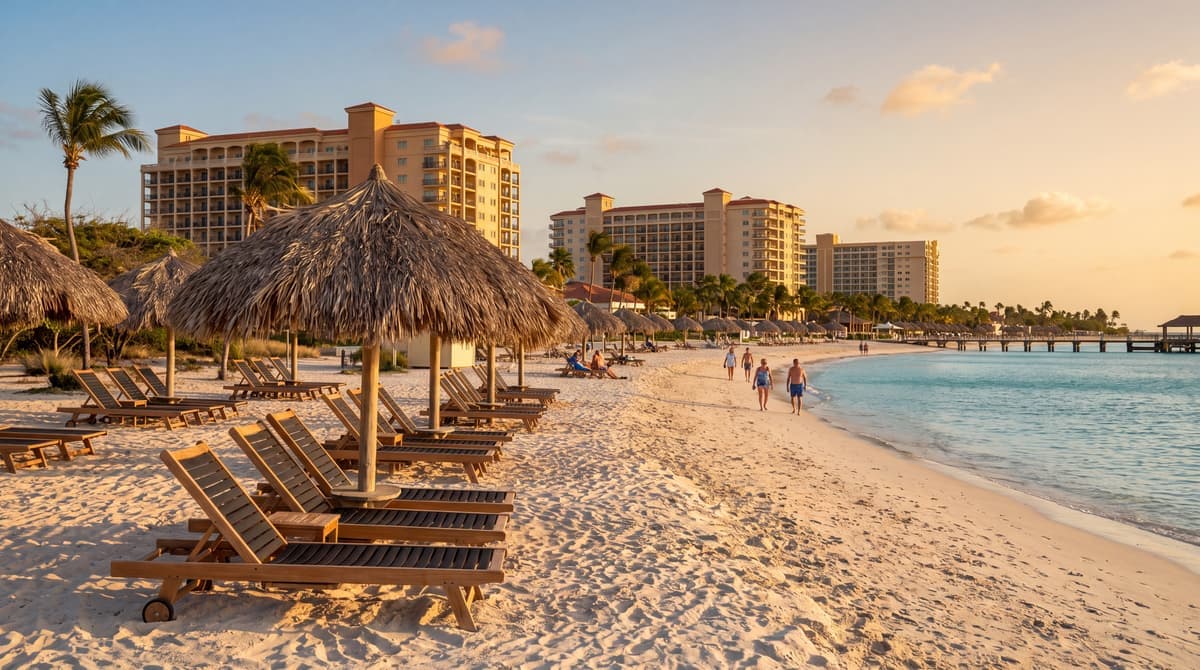
Resort fee or facility fee, commonly $30 to $90 a night, property-set. This is the one that trips up the most first-time visitors, because it is the least consistent charge on the island. It is not universal. It is most common at the larger high-rise resorts along Palm Beach, and it typically bundles in things like wifi, beach chairs or palapas, pool towel service, and access to fitness or beach amenities. Some properties price it as a flat dollar figure per night, others build it in as a percentage of the room rate instead, so the shape of the charge itself is not even consistent across the island. Honest caveat, and this is the important one: we are not going to name a specific property's exact current resort fee here, because these change, and the only number that matters is the one on the booking page for your actual dates. Before you book anything at a Palm Beach high-rise, search the property's own site or booking confirmation for "resort fee" or "facility fee" and read exactly what it covers.
The $20 Sustainability Fee Is a Separate Charge, Not a Hotel Fee
One more charge trips people up, mostly because the timing makes it feel like part of the hotel bill when it is not. Since December 2024, Aruba has required a mandatory $20 Sustainability Fee for every air traveler aged 8 and up, paid online through the Embarkation and Disembarkation (ED) Card process before you fly, not at your hotel. It has nothing to do with your room, your resort, or any of the four charges above, it is an entry fee collected through the ED card, and AWSS does not charge it again when you re-enter Aruba within one year of your last visit, recognizing your passport number automatically. If you have already completed your ED card and paid this fee, you have already handled it, and you will not see it again on your hotel folio. Our full ED card guide walks through exactly how and when to pay it so it is one less thing to think about once you land. Do not double it up with the hotel's environmental levy above, they are two entirely different charges from two entirely different parts of your trip.
Want a local to plan the whole trip?
Our concierge builds your days around what you actually want, from $149. Real people who live in Aruba.
How to Avoid Surprises at Checkout
None of the government charges above are avoidable, and we would rather tell you that plainly than pretend there is a trick around them. But the property-set charges, the service charge and especially the resort fee, are exactly where a little homework saves real money.
Ask for the all-in nightly total before you book, not after. Most booking sites and hotel reservation pages will show a "taxes and fees" estimate before you confirm. Read it. If a resort fee is not itemized anywhere, call the property directly or check their own website's fine print, because a missing line item usually means it is bundled in somewhere you have not looked yet, not that it does not exist.
Compare the total, not the headline rate, when you shop hotels. A $220 room with a $75 resort fee can end up costing more per night than a $260 room with no resort fee at all. Our booking hub is built for exactly this kind of side-by-side comparison, so you are pricing the real number instead of the number in the search results.
Consider an Eagle Beach low-rise, a boutique property, or an all-inclusive. Resort fees are heavily concentrated at the larger Palm Beach high-rises. Many of Eagle Beach's low-rise hotels and Aruba's smaller boutique properties either skip the resort fee entirely or fold the same amenities into the room rate with nothing extra tacked on, and true all-inclusive resorts generally build these costs into the one price you already agreed to (confirm this on the specific property's page, since "all-inclusive" is not a single defined standard). If cost is the deciding factor in where you stay, our all-inclusive versus hotel cost breakdown runs the real math on which style saves more for different types of trips.
Budget the full add-on percentage, not just the room rate, when you plan your trip total. If you are working out what a week in Aruba actually costs beyond the room, from meals to activities to the rental car, our complete Aruba vacation cost guide walks through the rest of the budget so the hotel taxes and fees above are not the only number you were missing.
If a resort fee bothers you but you still want the amenities, look at a day pass instead of a room. Several Palm Beach resorts sell day access to their pools, beach chairs, and facilities without requiring a room booking at all, which can be a genuinely cheaper way to enjoy a big resort's amenities for an afternoon if you are staying somewhere smaller. Our Aruba resort day pass guide covers how that works.
The Bottom Line
An Aruba hotel bill almost always runs higher than the number you saw when you booked, and now you know exactly why: a 12.5% government tourist levy calculated on the room plus surcharges, a flat $3 government environmental levy per occupied room per night, a property-set service charge commonly in the 10% to 15% range, and, mainly at the bigger Palm Beach high-rises, a property-set resort fee that can run $30 to $90 a night or more. None of it is hidden if you know to look for it, and the $20 sustainability fee you paid before you flew is a separate, one-time charge that has nothing to do with any of this. Read the fine print on the resort fee before you book, ask for the all-in total, and if a lower-fee property fits your style better, Eagle Beach's low-rise stretch and Aruba's boutique hotels are worth a look before you commit to a high-rise room.